Cisternino · Puglia, Italy
Cisternino — The Bishops' Tower over the Valle d'Itria
Benjamin Smith, Wikimedia Commons; cropped and resized by ChapterWalks · CC BY-SA 4.0
An audio walk across the hill town of Cisternino, from the borgo outside its walls through whitewashed lanes to the great tower and the Valle d'Itria below.
Narration in English · Stop 1 is free
- 8 stops
- 1.1 km (0.7 mi)
- About 60 minutes
- Easy city route
Stop 1 · Palazzo Lagravinese
Stop 1 is free. Listen before you buy.
Read Stop 1Hide Stop 1 text
Transcript · Stop 1
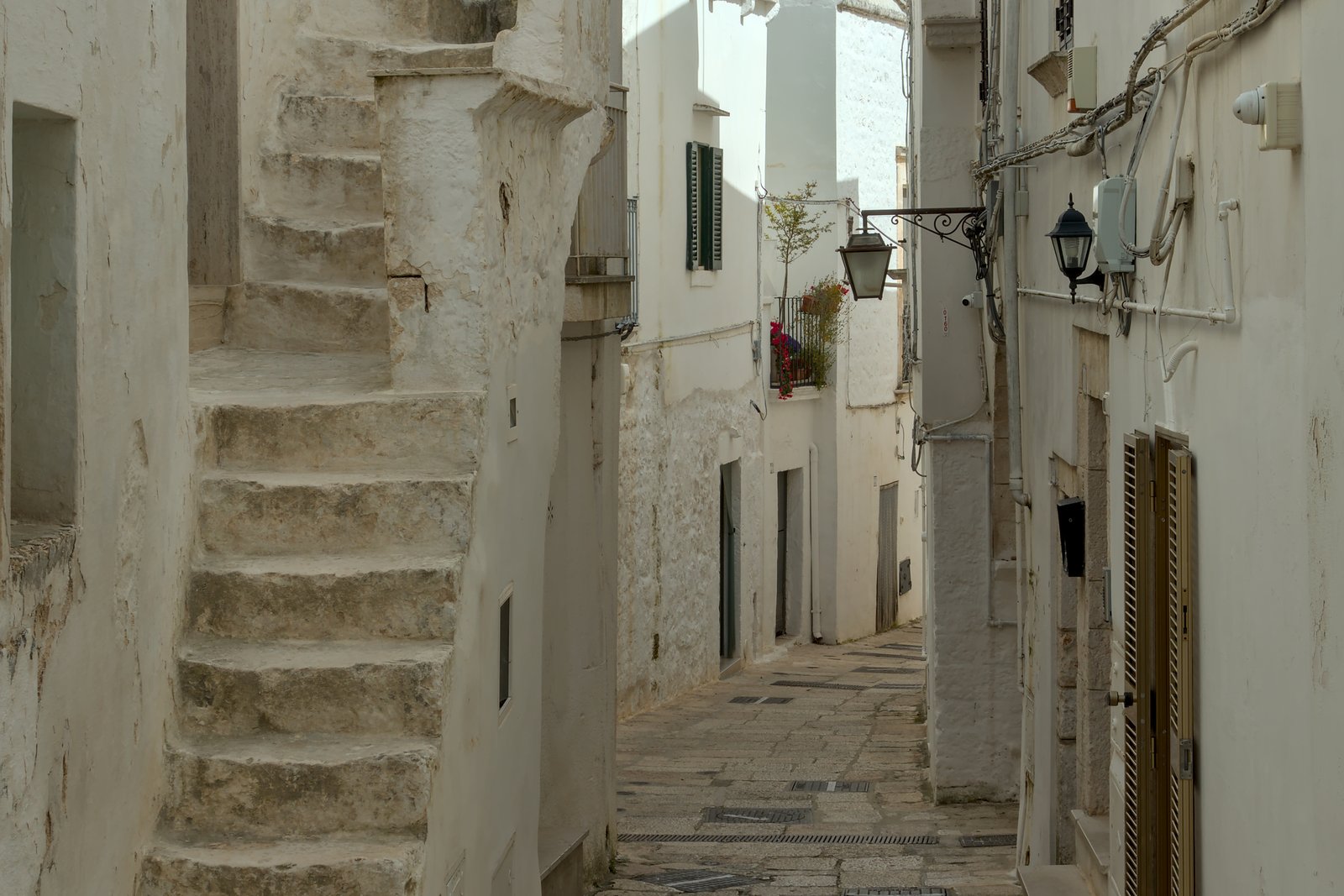
Cisternino keeps its old town on a hilltop, a knot of whitewashed lanes and outside stairs that people still call home, above a valley of olive groves. These lanes are lived in: keep voices low, and leave the steps at people's doors to the people who live there.
In front of you stands Palazzo Lagravinese, a white house with stone balconies and a deep arched loggia. It was a noble family's house of the late eighteenth century, with two carved shields, one of them carrying the year it was built. By the palace's main door, on Via La Fiera, a plaque remembers members of the family, among them two poets and two members of the assembly that wrote Italy's constitution, the town notes. The door is out of sight on the far side. The palace has been restored as a museum. It keeps the thirty one photographs that the photographer Lisetta Carmi gave the town in 2020; she lived in Cisternino for almost fifty years. Among them are the dock workers of Genoa and the face of the poet Ezra Pound. The walk stays outside.
This is Corso Umberto, the spine of U Burie, which in dialect simply means the borgo. It grew up outside the town walls in the sixteenth century, as the town's leading families moved out to build larger houses. The old town keeps the close street pattern of the Middle Ages, and its hill looks over the Valle d'Itria on one side and towards the coast on the other.
On your right, across the road, is the church of San Cataldo. It was paid for by a bequest and built outside the walls.
Cars use the road beside you. Ahead, the lanes are paved with limestone, slippery when wet and uneven in places.
Keep the palace on your left and follow Corso Umberto to the square at its end.
An audio walking tour of Cisternino from Palazzo Lagravinese through Porta Piccola, the clock square and the old quarters to the Torre Grande, the Chiesa Madre, Torre Capece and the belvedere of the Villa Comunale, at your own pace
Cisternino is a hill town of the Valle d'Itria in Puglia, and its old town is still lived in, a close weave of whitewashed lanes, outside stairs and small squares. The walk begins on Corso Umberto I, in the borgo that grew up outside the walls in the sixteenth century, at Palazzo Lagravinese, a family house of the late eighteenth century, restored for use as a museum. It passes through Porta Piccola, the little gate, beside the governor's palace, crosses the clock square, whose tower the town dates to 1850, and turns into Bere Vecchie, one of the quarters of the old town.
The Torre Grande, the great tower, was largely rebuilt in the late fourteenth century. The bishops of Monopoli held the town as its barons, on and off, for centuries, and in 1180 a papal letter confirmed the bishop's possessions, Cisternino's church of Saint Nicholas among them; tradition credits Basilian monks with a church of Saint Nicholas where the Chiesa Madre now stands. The walk then goes down into U Pantene, the low quarter, where butchers keep the custom of the fornelli pronti, passes Torre Capece on the old walls and the Chiesa Nuova of 1860, and ends in the public garden of the Villa Comunale, above the Valle d'Itria, a countryside of olive groves, dry stone walls and trulli whose stretch at Cisternino the state protected for its landscape in 1970.
Route notes
Route and itinerary
About each stop · narration stays in the app
Palazzo Lagravinese
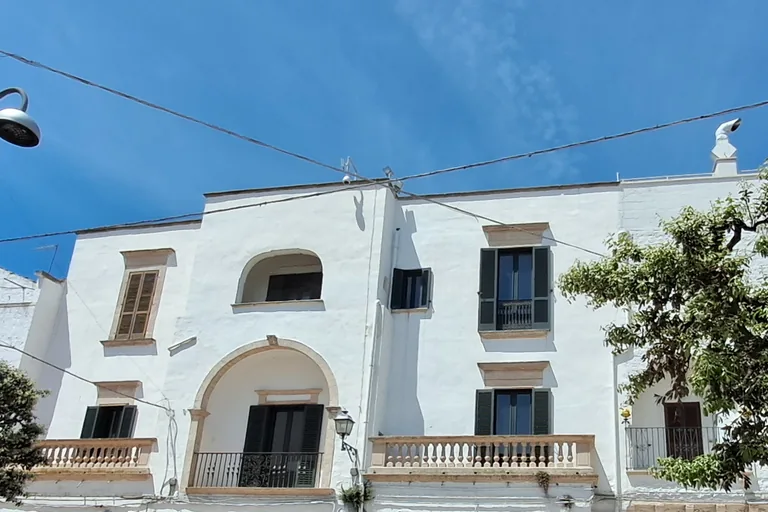
Photo: Mfran22 · Wikimedia Commons source · CC BY-SA 4.0 · Cropped to the recorded 3:2 source rectangle and resized from the exact hash-bound source input. Palazzo Lagravinese is a white palace on Corso Umberto I in Cisternino, a hill town of the Valle d'Itria in the province of Brindisi, and it stands at the edge of the medieval old town.
The route starts here for the building's present role: the town's page records it as a work of historic and artistic interest that was restored and given a new use as a museum, and the national heritage record sets the old town on its hill at about 394 metres above sea level, on the southern Murge.
The walk stays outside the palace; cars use Corso Umberto I beside the stop, and the limestone paving of the lanes ahead turns slippery in the wet.
Porta Piccola and the Governor's Palace
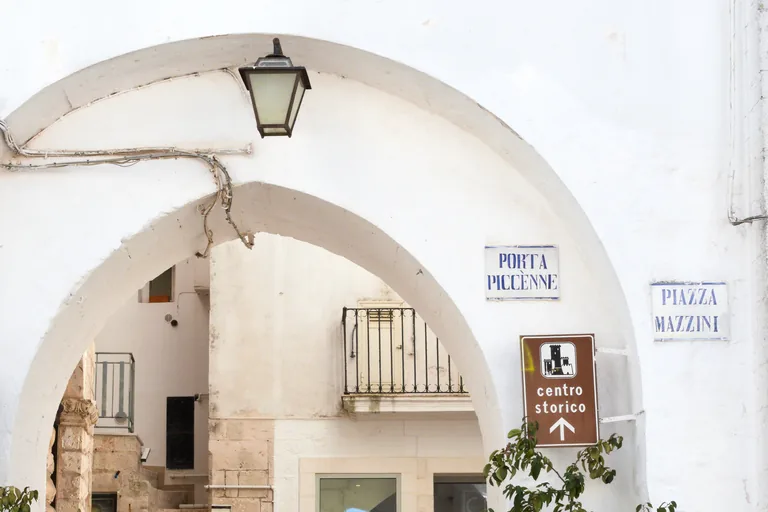
Photo: Mussklprozz · Wikimedia Commons source · CC BY-SA 4.0 · Cropped to the recorded 3:2 source rectangle and resized from the exact hash-bound source input. Porta Piccola, called Porta Piccenne in dialect, is an arched gate on Piazza Mazzini in Cisternino, standing between the governor's palace and the small church of Santa Lucia.
The route stops here at the edge between the two towns: the town's page on the gate says it divides the modern part of Cisternino from the historic part, and its page on the governor's palace says the palace rises against the old town wall, right beside the gate.
The governor's palace is privately owned and Santa Lucia is a working church, so the walk passes both from outside; cars cross the square, and the way through the arch is poorly lit.
Piazza Vittorio Emanuele and the Clock Tower
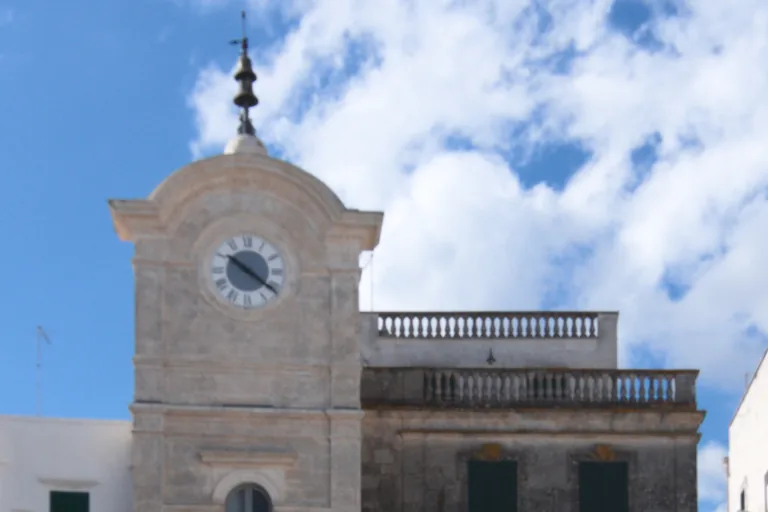
Photo: Mussklprozz · Wikimedia Commons source · CC BY-SA 4.0 · Cropped to the recorded 3:2 source rectangle and resized from the exact hash-bound source input. Piazza Vittorio Emanuele, which the town also calls Piazza dell'Orologio, is a paved square inside the old town of Cisternino, with its clock tower standing on the south side.
The route stops here for the tower's design: the town's page describes a front divided into several orders, framed by two side pilasters and by string courses, and a metal pinnacle on top that stresses its height and slender build.
The square is for pedestrians, and the route leaves it by a narrow lane just beside the clock tower.
Bere Vecchie, the Old Quarter
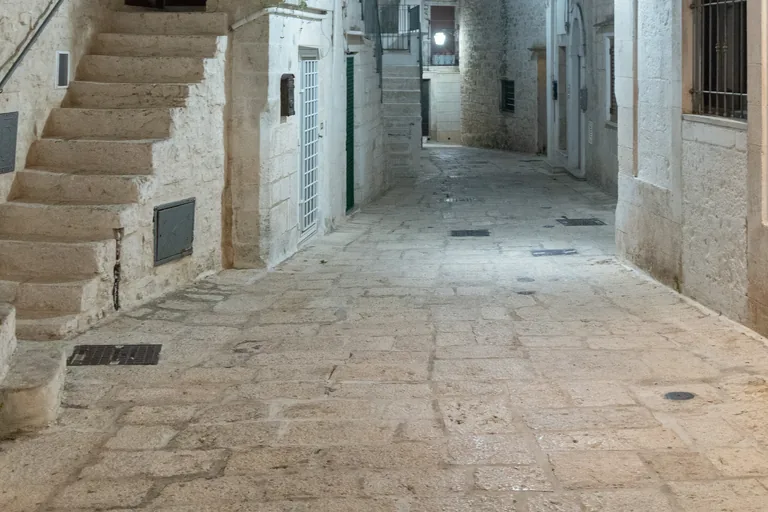
Photo: Giorgio Galeotti · Wikimedia Commons source · CC BY-SA 4.0 · Cropped to the recorded 3:2 source rectangle and resized from the exact hash-bound source input. Bere Vecchie is the quarter of narrow whitewashed lanes in the north west part of Cisternino's old town, spreading around Via Castello and Via Regina Elena.
The route stops here for the quarter's name: the town's page explains that calling it the old borgo set it apart from the new borgo that grew up against the walls in the sixteenth century, and the town's description of the old town counts it among four quarters of houses whitened with lime, stairs, loggias and arches.
These lanes are people's homes: keep voices low, keep off the outside stairs and doorsteps, and look out for residents' cars and scooters on the worn stone.
The Torre Grande and the Chiesa Madre
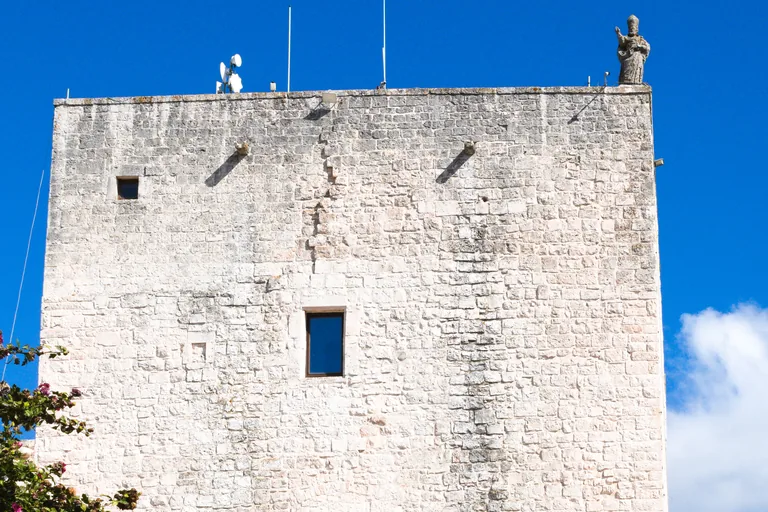
Photo: Mussklprozz · Wikimedia Commons source · CC BY-SA 4.0 · Cropped to the recorded 3:2 source rectangle and resized from the exact hash-bound source input. The Torre Grande is the square stone tower beside the Chiesa Madre of San Nicola in Cisternino, at the corner where Porta Grande, the main gate into the old town, once stood.
The route stops here for the church beside it: the town's pages record that the Chiesa Madre was raised on a place of worship that tradition links to Basilian monks, that its neoclassical front replaced an earlier Romanesque one, and that its saint is Nicholas of Patara, named for the town in today's Turkey where he was born.
The Chiesa Madre still holds services and there is no promise that it is open, and the remains found beneath it are not part of the walk; traffic passes on the roads at this corner.
Piazza Pellegrino Rossi in U Pantene
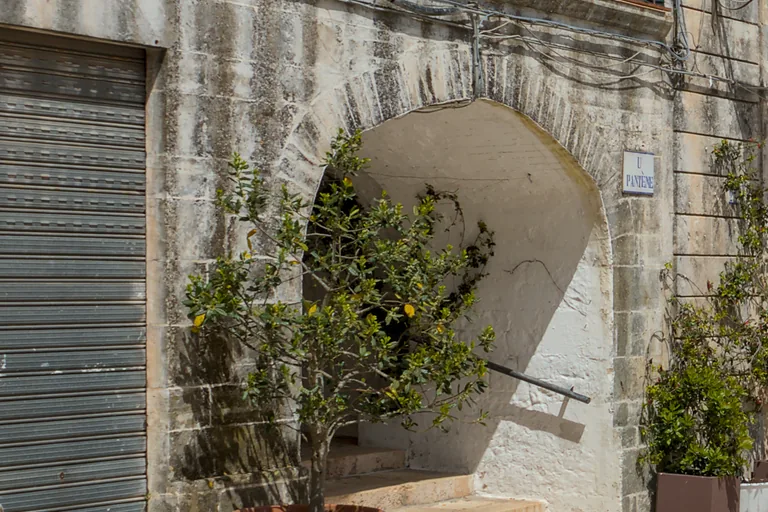
Photo: Benjamin Smith · Wikimedia Commons source · CC BY-SA 4.0 · Cropped to the recorded 3:2 source rectangle and resized from the exact hash-bound source input. Piazza Pellegrino Rossi is a small square in U Pantene, the quarter of Cisternino's old town that spreads to the south, behind the Chiesa Madre.
The route stops here for the square and its custom: the town's page notes the small ceramic buds that decorate the balconies of the little houses around it, and Gambero Rosso describes the fornelli pronti as butchers' shops that keep a spit and embers to cook the meat right where it is sold.
The walk names and recommends no shop or restaurant and does not stop to eat; the passage into the square is dim and may have a few unmapped steps.
Torre Capece and the Chiesa Nuova
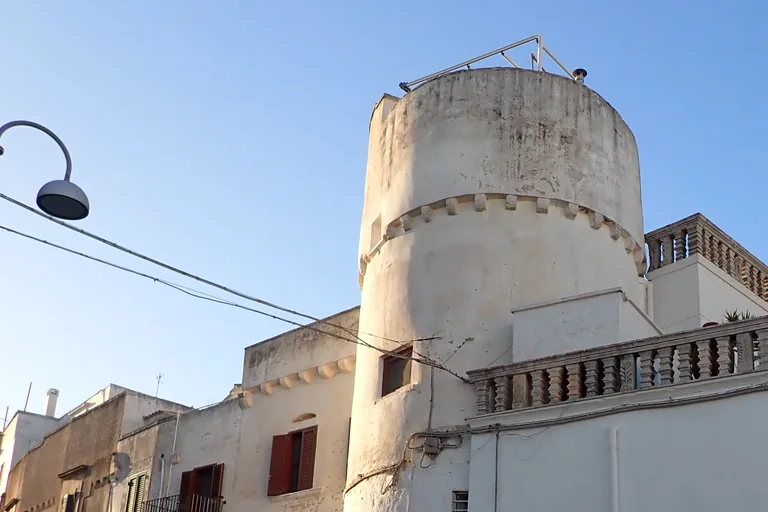
Photo: Patrice78500 · Wikimedia Commons source · CC BY-SA 4.0 · Cropped to the recorded 3:2 source rectangle and resized from the exact hash-bound source input. Torre Capece, once called the tower of the wind, is a round tower of Cisternino's old walls on Piazza Marconi, facing the Chiesa Nuova across the road.
The route stops here for the walls: the town's page says the other towers rose around the Norman Swabian tower at uneven distances, some round and some square, and that the only other round tower left, Torre Amati, stands elsewhere on the walls, built into another palace.
The Chiesa Nuova is a working church, with no promise of entry and no service times, and the tower is part of a palace and is seen only from the street; the next street, Via Manzoni, carries cars.
The Belvedere of the Villa Comunale
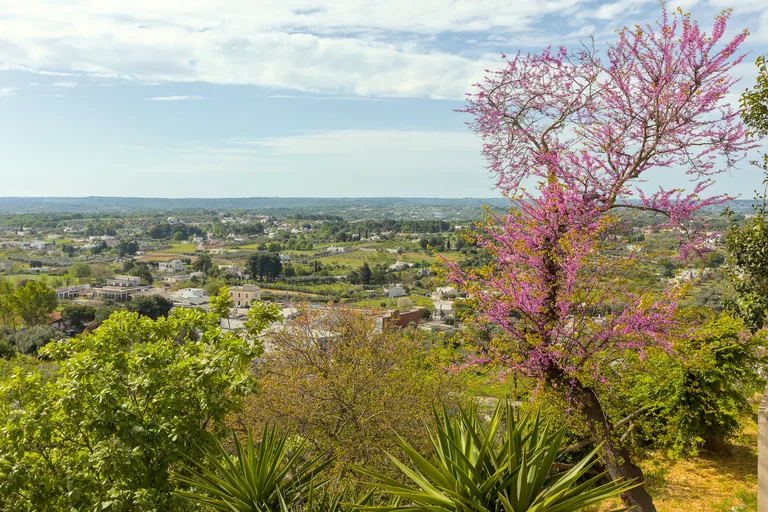
Photo: Benjamin Smith · Wikimedia Commons source · CC BY-SA 4.0 · Cropped to the recorded 3:2 source rectangle and resized from the exact hash-bound source input. The Villa Comunale is Cisternino's public garden on the edge of the old town, and its southern end looks down over the Valle d'Itria.
The route ends here for the countryside the regional landscape plan describes: a mosaic of vineyards, olive groves, woodland and arable fields, held in place by a close mesh of low walls of dry stone and small traditional buildings of stone.
The walk ends in the public garden; the countryside below is lived in and farmed, and the walk goes onto none of it.


Before you go
The walk runs one way for about 1.1 km on foot through the old town of Cisternino: from Palazzo Lagravinese on Corso Umberto I to Piazza Mazzini and through Porta Piccola, along Via Santa Lucia to Piazza Vittorio Emanuele, by Via Regina Elena into Bere Vecchie and down Via Castello to the Torre Grande and the Chiesa Madre, through U Pantene to Piazza Pellegrino Rossi, south to Piazza Marconi, then along Via Manzoni into the Villa Comunale, where it ends at the belvedere.
Access and surfaces
A short one way walk of about 1.1 km on foot; allow about an hour with the audio.
The lanes slope gently and are paved with limestone slabs that turn slippery in the wet and are uneven in places; no steps are mapped on the route, but no step free route was checked.
Three short passages under buildings are dim: the arch of Porta Piccola, a passage into Piazza Pellegrino Rossi, which may have a few unmapped steps, and a passage on the way to Piazza Marconi.
Cars use the road through Piazza Mazzini, the streets by the great tower, the road crossed at Piazza Marconi and Via Manzoni, and residents' vehicles may enter the lanes.
The old town is lived in, so speak quietly, and leave the outside stairs and doorsteps to the homes they belong to, since they are not part of the route.
The walk goes inside nothing: the Chiesa Madre and the Chiesa Nuova are working churches, with no promise that they are open, and the walk ends in the public garden.
Plan the walk
- How long is the Cisternino audio walking tour?
- Allow about 60 minutes. The route runs one way for 1.1 km (0.7 mi) with 8 stops, including walking and listening time, on gently sloping lanes.
- Where does the Cisternino tour start and end?
- It starts on Corso Umberto I in front of Palazzo Lagravinese, outside the old town walls, and ends at the belvedere at the southern end of the Villa Comunale, the public garden, above the Valle d'Itria.
- Does the walk go inside the churches or the palace?
- No. The walk is told from the lanes and squares and goes inside nothing. The Chiesa Madre and the Chiesa Nuova are working churches, so any visit is at their discretion and there is no promise that they are open; the remains found below the Chiesa Madre are not part of the walk. Palazzo Lagravinese is seen from the street.
- Is the route step free?
- No step free route was checked. No steps are mapped, but the limestone lanes slope gently, are uneven in places and slippery in the wet, and the passage into Piazza Pellegrino Rossi may have a few unmapped steps.
Same region
More tours in Puglia and Basilicata
$4.99Stop 1 is free