Alberobello · Puglia, Italy
Alberobello — The Trulli Town
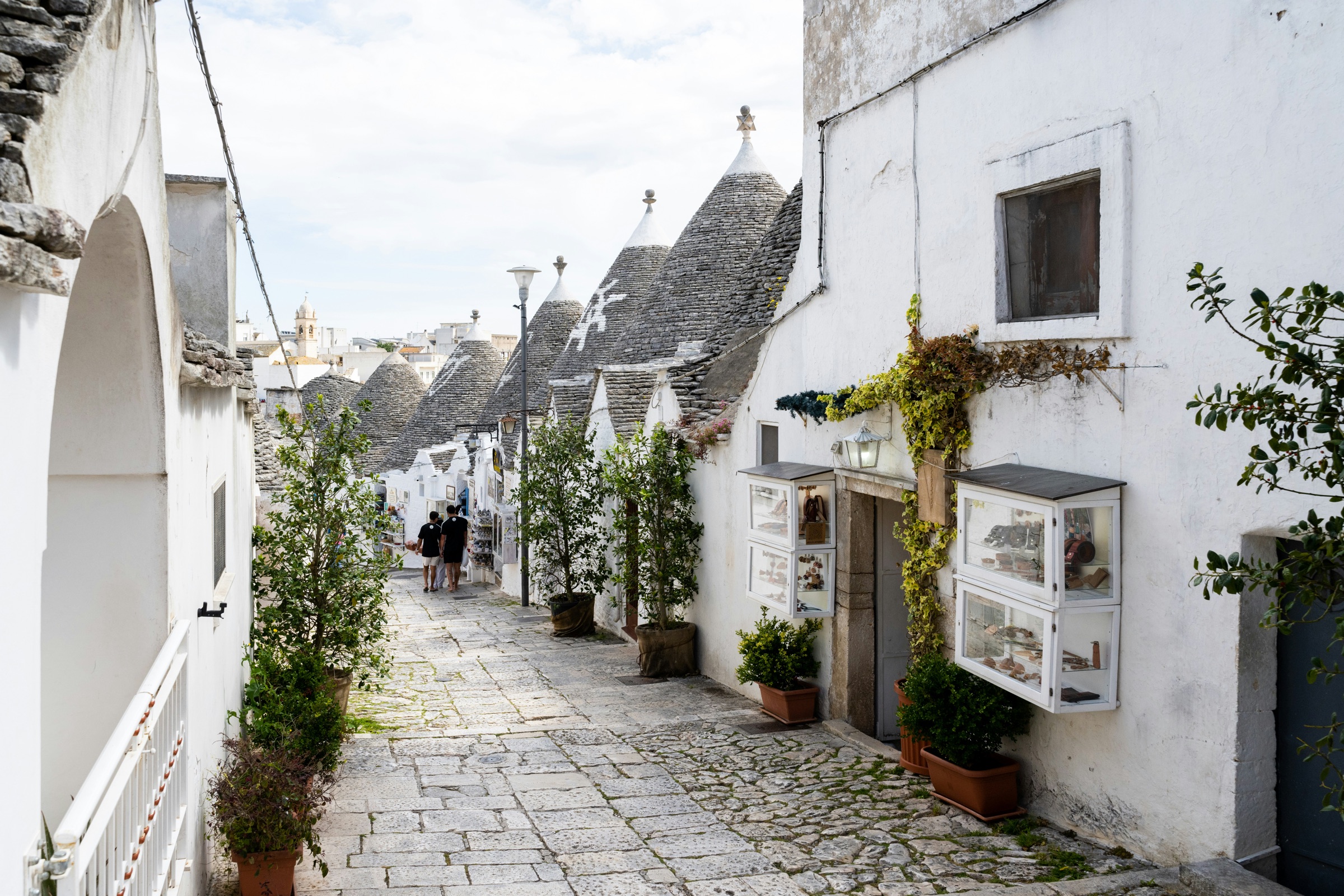
Alberobello's old town is built almost entirely of trulli — conical houses of dry limestone, laid without a drop of mortar.
Narration in English · Stop 1 is free
 Tour no. 08
- Stops
- 9
- Distance
- 1.9 km (1.2 mi)
- Time
- About 95 minutes
- Route
- Easy city route
Listen before you buy
Stop 1 · Belvedere Santa Lucia
Stop 1 is free. Listen before you buy.
The walk
A self-guided audio tour of Alberobello
Alberobello's old town is built almost entirely of trulli — conical houses of dry limestone, laid without a drop of mortar. The reason is a tax dodge: a feudal count had his peasants build so their homes could be pulled apart before a royal inspector arrived, keeping the settlement legally invisible. The town bought its freedom in 1797, put up its first mortared house as a monument to it, and in 1996 UNESCO made the whole loophole a World Heritage Site. This walk climbs the dense Monti slope, crosses the seam of freedom-monuments, threads the quieter Aia Piccola, and ends at the only two-storey trullo ever built.
Route notes
The stops
About each stop · narration stays in the app
Belvedere Santa Lucia
Belvedere Santa Lucia looks across the dense cone roofs of Rione Monti, part of Alberobello's UNESCO-listed trulli landscape. The route starts here so the dry-stone town can be read as a whole before you enter its lanes. The public terrace is free and exposed; the descent into Monti begins by stone steps nearby.
Rione Monti
Rione Monti contains more than a thousand trulli, their limestone walls laid without mortar and their roofs built as corbelled cones. Walking through the district turns the construction method seen from the belvedere into something close enough to inspect. The lanes are steep, uneven and busiest around midday, with many trulli operating as shops.
Church of Sant'Antonio
The Church of Sant'Antonio adapts the trullo form to a twentieth-century church, enlarging the familiar conical roof over a sacred interior. It marks the top of the Monti climb and shows how Alberobello extended a domestic building tradition to a public monument. The exterior is always visible; entry depends on worship and opening hours, and the final approach is uphill.
Casa d'Amore
Casa d'Amore was built in 1797 by Francesco D'Amore as the town's first house formally permitted to use mortar after feudal rule ended. Its façade inscription makes the small building the clearest civic marker of Alberobello's new legal freedom. The building is viewed from the public square; any interior access follows the current tourist-office hours.
Piazza XXVII Maggio
Piazza XXVII Maggio takes its name from 27 May 1797, when Alberobello was elevated from feudal settlement to royal town. The route pauses here because the independence date survives not only in archives but in the town's everyday street plan. The square is free, central and mostly level, though events and café seating can change the clear walking line.
Museum of the Territory (Casa Pezzolla)
The Museum of the Territory occupies Casa Pezzolla, a linked complex of trulli that makes rooms, roofs and domestic connections visible from within. It adds lived scale to the route after the legal story of Casa d'Amore and the open civic square. The complete stop works from the public exterior; entering the museum requires a ticket and current opening hours.
Rione Aia Piccola
Rione Aia Piccola is the quieter UNESCO-listed trulli district, with hundreds of cones still forming a largely residential neighbourhood. Its ordinary homes provide a necessary contrast with the heavily commercial lanes of Rione Monti. These are lived-in streets, so keep voices low and expect narrow, sloping stone lanes with little shade.
Basilica of Saints Cosmas and Damian
The Basilica of Saints Cosmas and Damian is Alberobello's principal church, dedicated to the patron saints whose initials also appear among local roof symbols. Its conventional masonry and twin towers deliberately break the trullo skyline and connect the walk to the town's devotional life. The forecourt is public; interior access depends on services and opening hours.
Trullo Sovrano
Trullo Sovrano is Alberobello's exceptional two-storey trullo, enlarged in the eighteenth century and built with an internal stone stair. The route ends here because the building pushes the dry-stone form beyond the single-room houses seen earlier. The exterior is free to view; museum entry is ticketed, has variable hours and includes interior thresholds.
Local context
Before you go
The published route starts at Belvedere Santa Lucia, Piazza Gian Girolamo II, 70011 Alberobello BA, Italia. It begins at Belvedere Santa Lucia and ends at Trullo Sovrano.
On the ground
Access and surfaces
Compact but hilly: the two trulli districts are slopes of narrow, uneven stone lanes and short stairways, steepest in Rione Monti (stops 2-3). The central squares and the Trullo Sovrano approach are gentler. Interiors (the museum, the Trullo Sovrano, churches) are ticketed or keep variable hours; the narration works from the exterior throughout. Rione Monti is heavily shop-lined and busy midday; Aia Piccola is residential — walk it quietly. Little shade on the slopes in summer.
Frequently asked
Plan the walk
- How long is the Alberobello audio walking tour?
- Allow about 95 minutes. The self-guided route covers 1.9 km (1.2 mi) in 9 stops, including walking and listening time.
- Where does the Alberobello tour start and end?
- It starts at Belvedere Santa Lucia, Piazza Gian Girolamo II, 70011 Alberobello BA, Italia. The published route begins at Belvedere Santa Lucia and ends at Trullo Sovrano.
- Will the Alberobello audio tour work offline?
- Yes, after download. Audio, stop text, images, and GPS triggering work without data; the live map background still needs a connection.