Lecce · Puglia, Italy
Lecce — Centro Storico
A self-guided audio tour through Lecce's Roman remains, Baroque churches, carved limestone, and Adriatic defenses.
Narration in English · Stop 1 is free
 Tour no. 02
- Stops
- 9
- Distance
- 2.3 km (1.4 mi)
- Time
- About 115 minutes
- Route
- Easy city route
Listen before you buy
Stop 1 · Porta Napoli
Stop 1 is free. Listen before you buy.
The walk
A self-guided audio tour of Lecce
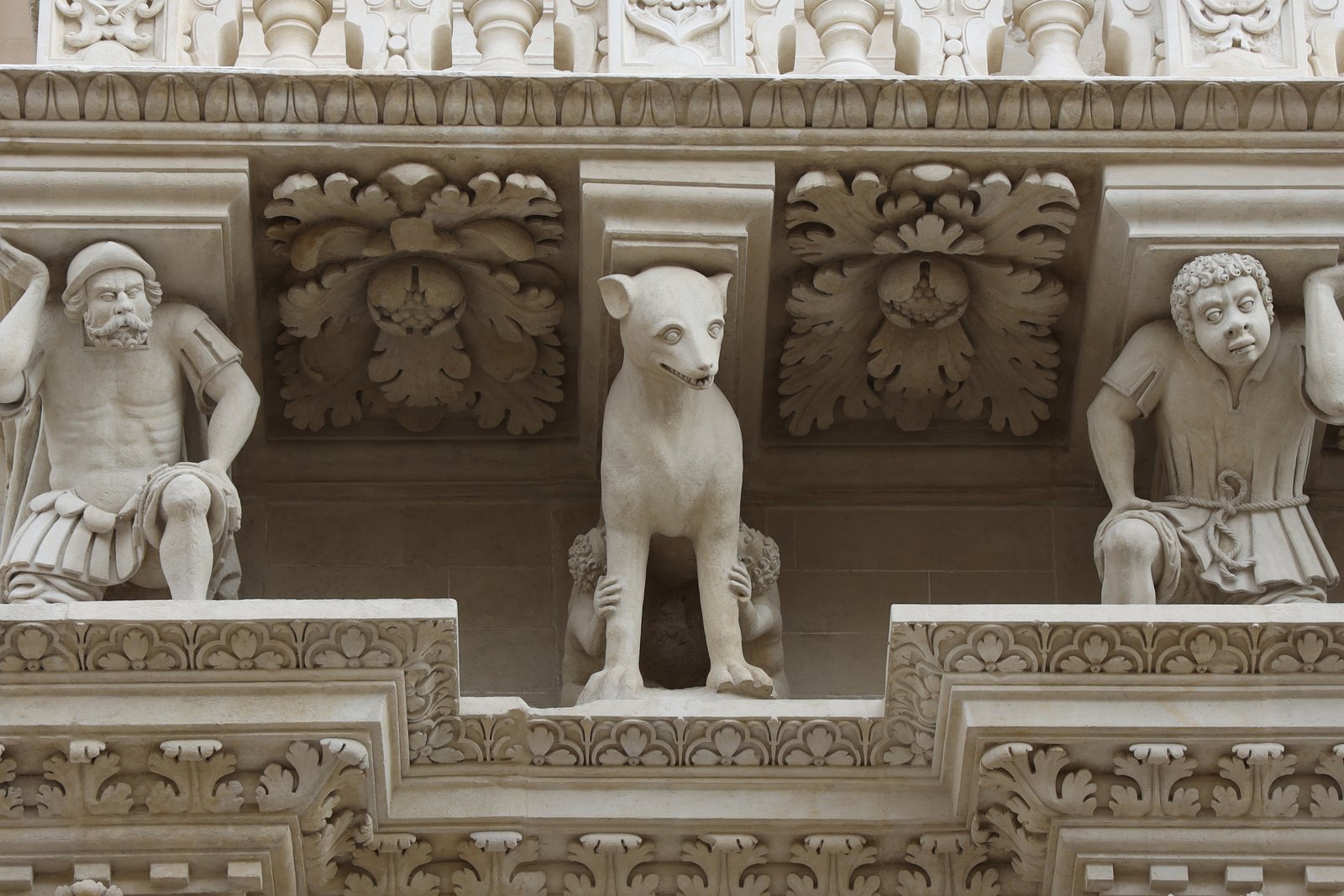
Lecce's center is built from pietra leccese, a pale local limestone that made deep carving possible. On its Baroque churches, animals, faces, flowers, and curling leaves turn façades into sculpture.
The route runs from Porta Napoli to Porta San Biagio. Along the way, the Roman amphitheatre sits inside the modern city, Santa Croce shows what local stone could do, and gates and fortifications explain why Lecce kept watching the Adriatic.
Route notes
The stops
About each stop · narration stays in the app
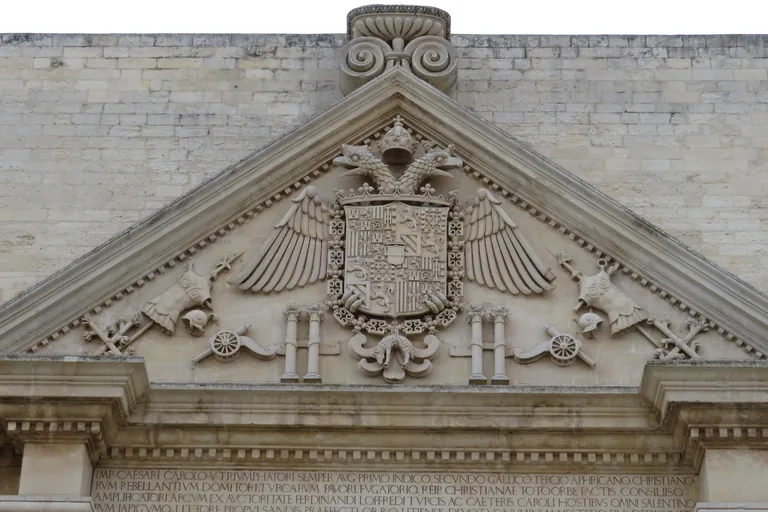
Photo: Enric · Wikimedia Commons source · CC BY-SA 4.0 · Cropped to the recorded 3:2 source rectangle and resized from the original. Porta Napoli
Porta Napoli is Lecce's 1548 triumphal gateway, built in honour of Charles V where the road toward Naples met the city walls. The route begins here because the arch makes the old city's defensive threshold legible before the walk moves into its religious and civic centre. It is an open-air monument with no ticket or opening hours, so it works as a flexible starting point.
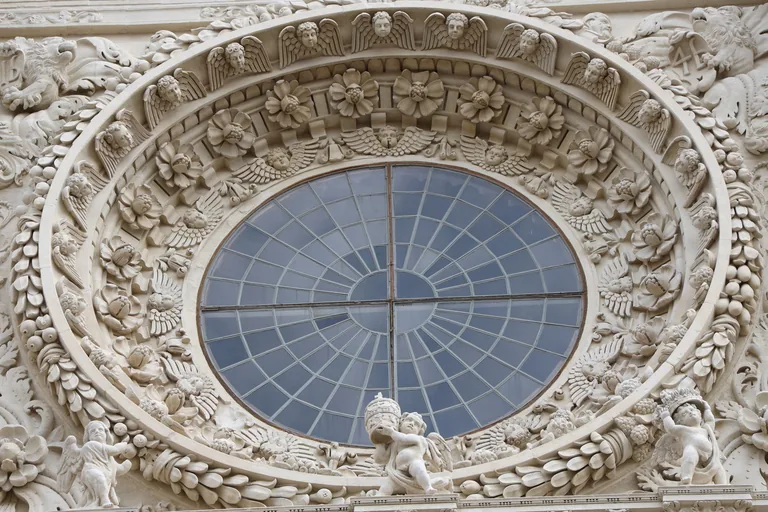
Photo: Fabrizio Garrisi · Wikimedia Commons source · CC BY-SA 4.0 · Resized from the original; no source crop. Basilica of Santa Croce
Santa Croce is the Celestines' basilica, rebuilt on this site from 1549 after their earlier church and convent were removed for the castle works. It follows Porta Napoli to show how imperial fortification and Lecce's carved-stone church building reshaped the same centre. The façade is fully visible from the public street; check LeccEcclesiae's current access and ticket information only if you want to go inside.
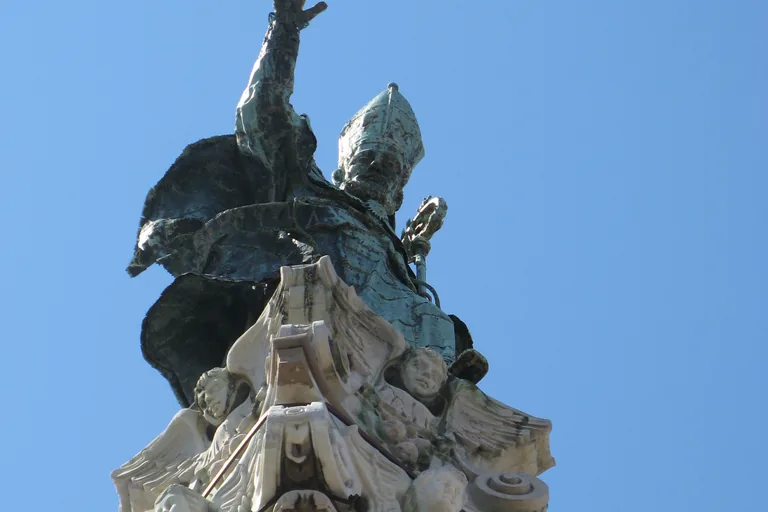
Photo: Terrasque · Wikimedia Commons source · CC BY-SA 3.0 · Cropped to the recorded 3:2 source rectangle and resized from the original. Piazza Sant'Oronzo
Piazza Sant'Oronzo is Lecce's main civic meeting place, shared by the patron saint's column, the Sedile, San Marco, later commercial buildings, and the edge of the Roman amphitheatre. The route pauses here before the amphitheatre because the square shows how ancient remains and the modern city were made to occupy one public space after major twentieth-century demolitions. The square regularly hosts performances and public events, so check the city programme if unobstructed sightlines matter to your visit.
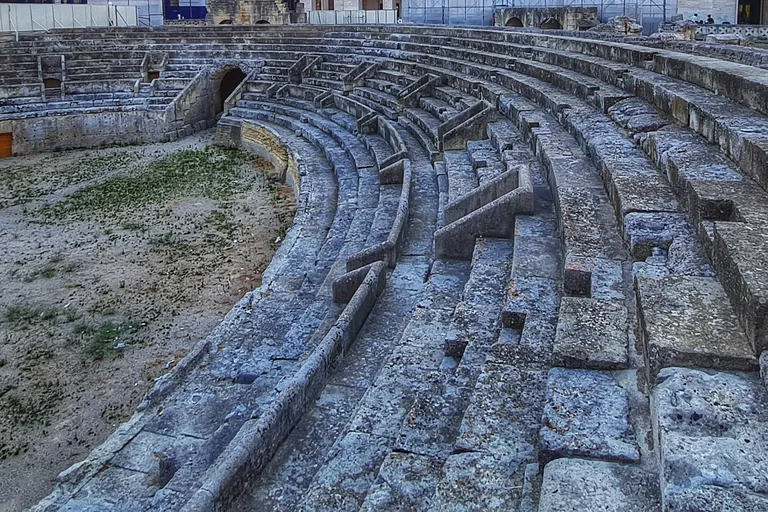
Photo: NalaRome · Wikimedia Commons source · CC BY-SA 4.0 · Cropped to the recorded 3:2 source rectangle and resized from the original. Roman Amphitheatre of Lecce
The Roman Amphitheatre of Lecce was an arena for gladiatorial contests and animal hunts, probably begun in the Augustan period and later modified. It is a separate stop because the exposed arena gives the route its clearest evidence of imperial Lupiae beneath modern Lecce, even though only about one third is visible. The main remains can be understood from the piazza-level edge; check the state museum listing before planning a ticketed interior visit, since access conditions can change.
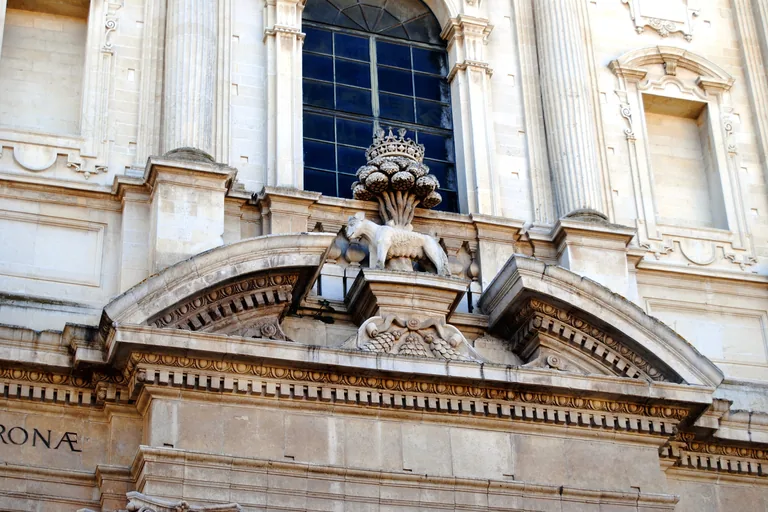
Photo: Travel dreamer · Wikimedia Commons source · CC BY-SA 4.0 · Cropped to the recorded 3:2 source rectangle and resized from the original. Chiesa di Sant'Irene
Chiesa di Sant'Irene is the Theatine church built from 1591 to 1639 for the city's former patron, with a disciplined Roman-Baroque façade rather than Santa Croce's dense sculpture. The route includes it to compare two different ways Lecce's religious orders used scale, local stone, and civic patronage. It stands directly on the historic centre's main east-west axis; the façade is the reliable outdoor view, while worship and visitor access should be checked on the day.
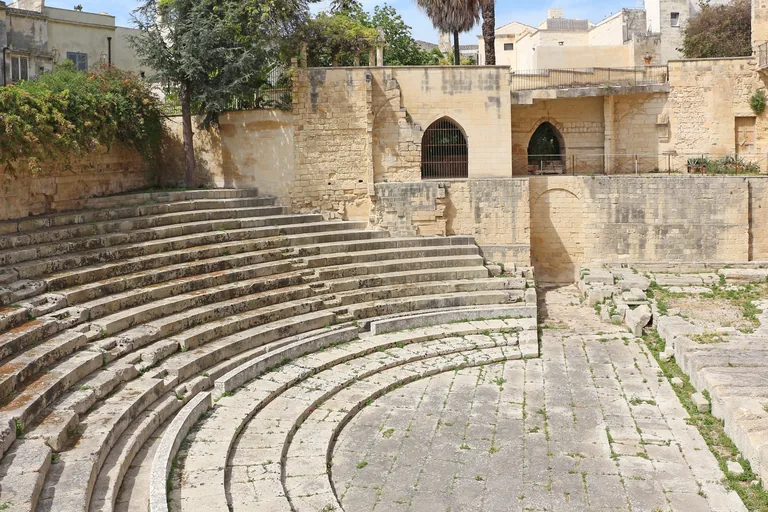
Photo: Bernard Gagnon · Wikimedia Commons source · CC0 1.0 · Cropped to the recorded 3:2 source rectangle and resized from the original. Teatro Romano
Teatro Romano comprises the remains of imperial Lupiae's performance theatre, built partly into the rock and now enclosed by later streets and buildings. It follows Sant'Irene to reveal a Roman monument at the scale of a neighbourhood block rather than the open spectacle of Piazza Sant'Oronzo. Reach it by the narrow street beside Santa Chiara and allow a few minutes to find the overlook; the surviving ruins do not present themselves from a broad square.
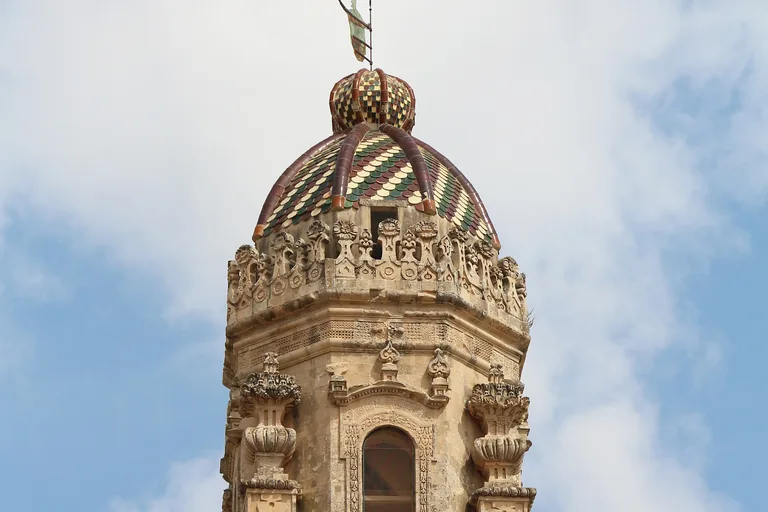
Photo: Bernard Gagnon · Wikimedia Commons source · CC0 1.0 · Cropped to the recorded 3:2 source rectangle and resized from the original. Piazza del Duomo
Piazza del Duomo is Lecce's enclosed cathedral court, framed by the cathedral's two façades, bell tower, episcopal palace, seminary, and monumental entrance screens. The route includes the whole ensemble because it makes the city's seventeenth-century religious planning visible as an arranged space, not a single façade. The square supplies the essential view; cathedral, crypt, bell tower, and museum access have separate religious or ticketed conditions, so check LeccEcclesiae before adding interiors.
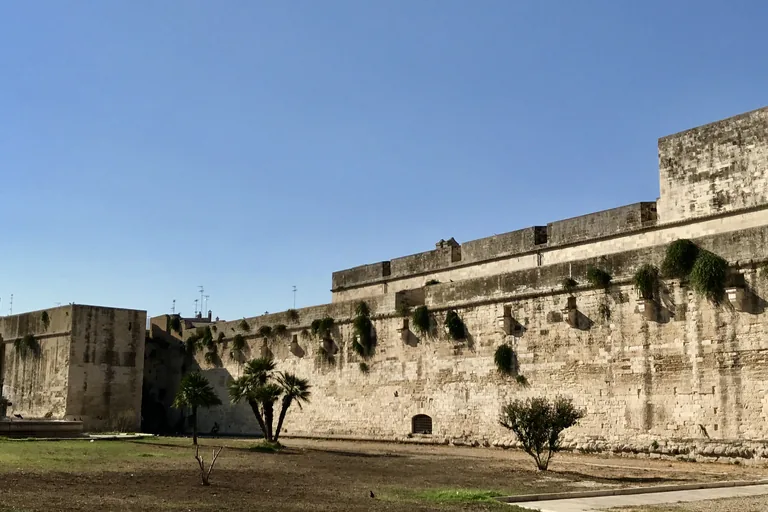
Photo: Sergio Spolti · Wikimedia Commons source · CC BY-SA 4.0 · Cropped to the recorded 3:2 source rectangle and resized from the original. Castello di Carlo V
Castello di Carlo V is a Renaissance bastioned fortress built around older medieval fabric during the 1539–1549 strengthening of Lecce. Near the end of the route, it returns to the defensive programme introduced at Porta Napoli and shows its scale in walls, pointed bastions, and the former moat line. The exterior is enough for this stop; the Ministry currently lists the central courtyard as free and the rooms as guided-admission spaces, so verify opening times before going inside.
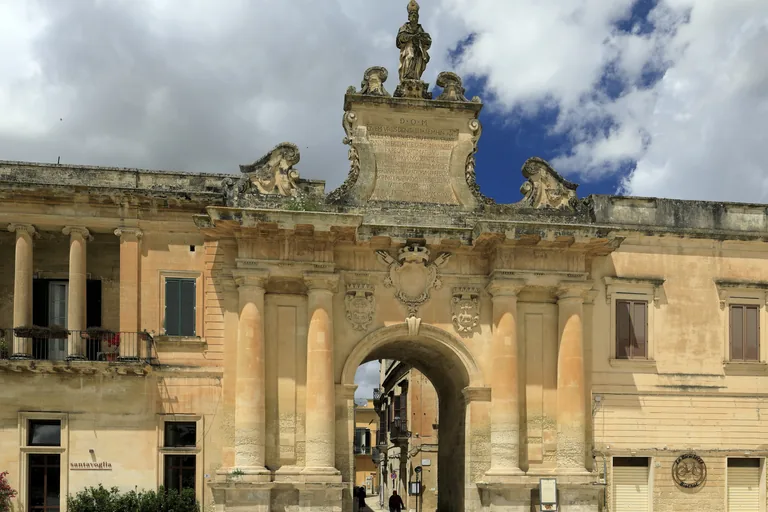
Photo: Falk2 · Wikimedia Commons source · CC BY-SA 4.0 · Cropped to the recorded 3:2 source rectangle and resized from the original. Porta San Biagio
Porta San Biagio is the 1774 rebuilding of an older southern city gate, crowned by the saint who gave it its name. It closes the route by setting a late-eighteenth-century ceremonial entrance against Porta Napoli's sixteenth-century imperial arch. The gate is open-air, but the surrounding streets become a nightlife corridor in the evening; visit earlier if you want a quieter final view.


,_cara_exterior,_front%C3%B3_amb_l%27escut_de_Carles_V.jpg)


_01.jpg)
_05.jpg)
.jpg)

Local context
Before you go
Pietra leccese is soft when quarried and hardens after exposure. Most of the route is in the pedestrianized center, so the practical choices are timing and heat: walk early or late in summer, and leave time for optional church interiors.
On the ground
Access and surfaces
The 2.3 km (1.4 mi) route starts outside Porta Napoli and ends at Porta San Biagio. The center is mostly pedestrianized, but stone paving is uneven in places. Church and museum entry is optional; every stop can be heard from a public viewpoint.
Frequently asked
Plan the walk
- How long is the Lecce audio walking tour?
- Allow about 115 minutes. The self-guided route covers 2.3 km (1.4 mi) in 9 stops, including walking and listening time.
- Where does the Lecce tour start and end?
- It starts outside Porta Napoli and ends at Porta San Biagio. The route crosses the historic center and does not require entry to any church or museum.
- Will the Lecce tour work offline?
- Yes, after download. Audio, stop text, images, and GPS triggering work without data; the live map background still needs a connection.
- Does the tour include admission tickets?
- No. Every stop works from a public viewpoint, and any optional church or museum admission is paid separately.