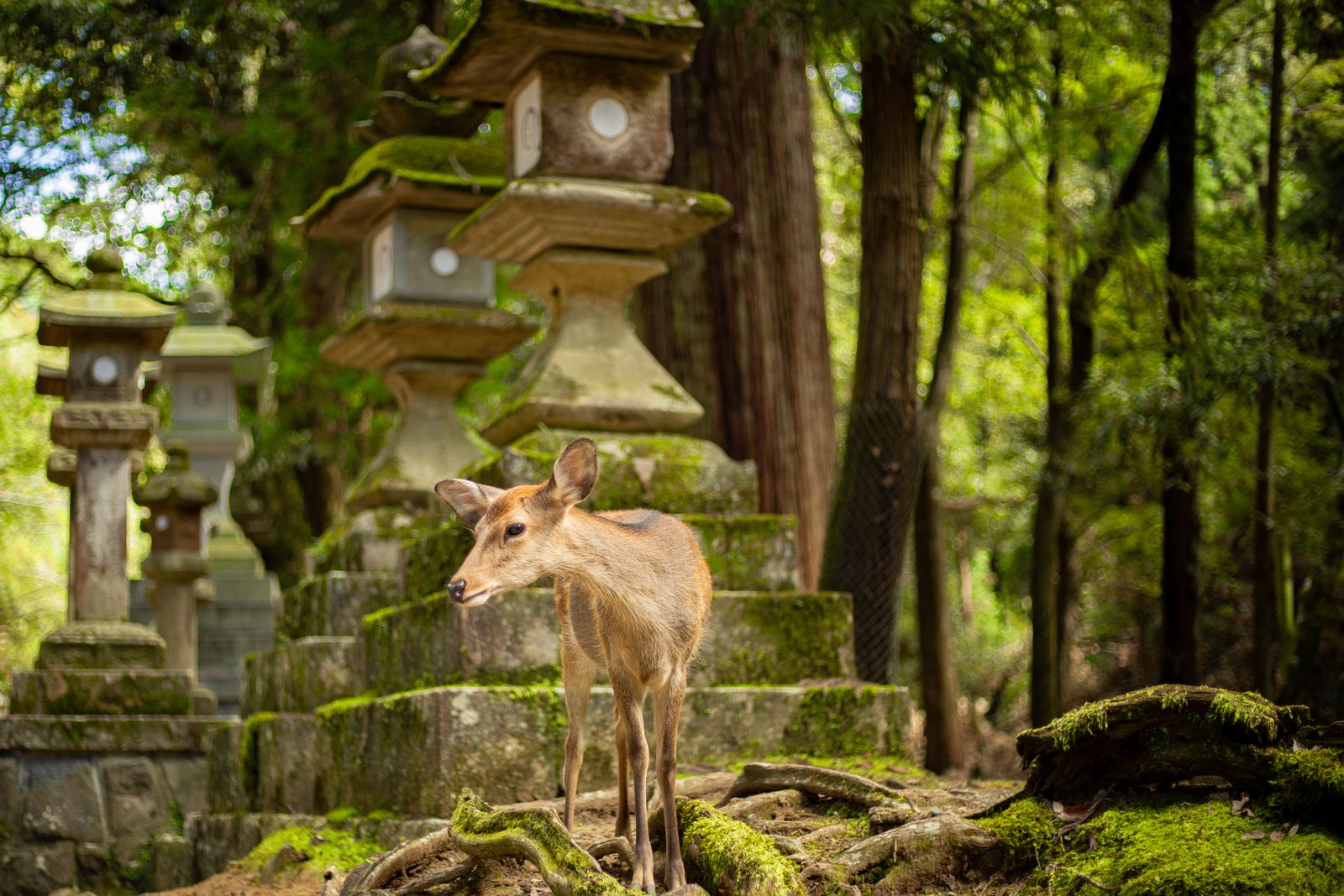
Nara · Nara Prefecture, Japan
Nara — Where the Temple Grounds Became a Town and a Park
Ian G Shingler, Wikimedia Commons; cropped and resized by ChapterWalks · CC BY-SA 4.0
An audio walk through Nara's old temple grounds, from Kofukuji past Sarusawa Pond and the lanes of Naramachi to the deer park and Todaiji's Great South Gate.
Narration in English · Stop 1 is free
- 8 stops
- 3.1 km (1.9 mi)
- About 110 minutes
- Easy city route
Stop 1 · Kofukuji's Central Golden Hall
Stop 1 is free. Listen before you buy.
Read Stop 1Hide Stop 1 text
Transcript · Stop 1
Nara was once the capital of Japan, and when the court moved away, its great temples stayed. Over the centuries their grounds turned into a town of narrow lanes and a wide park where deer wander among the halls. This walk goes from a golden hall to the gate of the Great Buddha.
Beyond the low fence and the lawn stands Kofukuji's Central Golden Hall, red pillars and white walls under a double roof. In 710 the court moved to a new capital called Heijokyo, in what is now the city of Nara, and it stayed Japan's capital for most of the eighth century. That same year Fujiwara no Fuhito moved an older temple into the new capital and named it Kofukuji. By the temple's own tradition, its story began earlier, with a hall that Kagami no Okimi built to pray for her sick husband, Fujiwara no Kamatari. Kofukuji means the temple that generates blessings. As the Fujiwara clan's own temple, it grew so strong that it came to rule the whole province of Yamato.
By the temple's tradition, Fuhito himself founded the Central Golden Hall, the most important building at the heart of the temple. It burned again and again. In 1180 the whole temple burned in a war fire set by the troops of Taira no Shigehira. After a later fire, there was no money to rebuild for about a hundred years, until the townspeople paid for a smaller, temporary hall. Being only temporary, it was built partly of pine, a wood unsuited to it, and it aged fast. The temporary hall was taken down, and the hall rebuilt in its first form was dedicated in October 2018.
Kofukuji is a working temple, so keep your voice low; its halls are seen from the paths, and this walk enters none of them. From this point on, deer wander through the grounds. The Nara Deer Preservation Foundation asks visitors never to give the deer human food, and the park has no rubbish bins. Carry your rubbish with you. Nara summers are hot and wet, so carry water, rest in the shade of the trees, and take care on gravel paths after rain.
Step back to the gravel path behind you, follow it east with the hall on your left; at its end turn left, then right along the path past the tall cover.
An audio walking tour of Nara, from Kofukuji past Sarusawa Pond and the lanes of Naramachi to the first torii of Kasuga Taisha and Todaiji's Great South Gate, at your own pace
Nara was Japan's capital from 710 to 784, and when the court moved on, its great temples kept their ground. This walk begins a short way from Kintetsu Nara station at Kofukuji, the Fujiwara clan's temple, where the Central Golden Hall was raised again in its early form and dedicated in 2018, and pauses beside the tall cover that now hides the temple's five storey pagoda while Nara Prefecture retiles its roof, work planned to run into the 2030s. It then drops to Sarusawa Pond, dug as the temple's pond for setting living creatures free, where the small Uneme shrine keeps the legend of a court lady said to have drowned in its water.
South of the pond the route enters Naramachi, a quarter of narrow lived in lanes that grew up inside Gangoji's former grounds from the late sixteenth century, and reaches the temple's east gate; Gangoji traces its beginnings to a temple started at Asuka in 588. Back on Sanjo dori it comes to the first torii of Kasuga Taisha, a shrine founded in 768 at the foot of Mikasayama, then crosses the lawns of Nara Park among the deer to the museum building completed in 1894, and ends at Todaiji's Great South Gate, which the monk Chogen rebuilt and completed in 1203 along with the pair of guardian figures inside it.
Route notes
Route and itinerary
About each stop · narration stays in the app
Kofukuji's Central Golden Hall
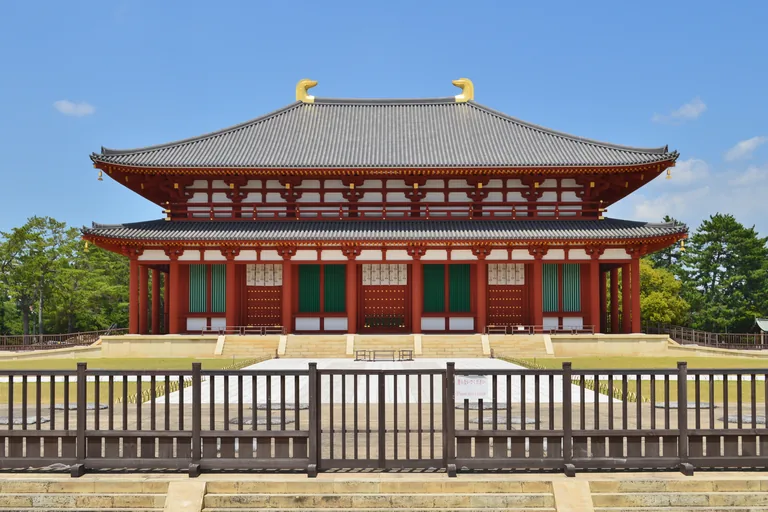
Photo: Saigen Jiro · Wikimedia Commons source · CC0 1.0 · Cropped to the recorded 3:2 source rectangle and resized from the exact hash-bound source input. Kofukuji's Central Golden Hall stands at the heart of the temple's grounds in central Nara, seen from the restored base of the middle gate on the paved axis to its south.
The route starts here for the old capital and its clan temple: the temple's own page says the rebuilt hall followed an excavation, with its pillars raised in 2010 and its roof frame set in 2014, and UNESCO lists Kofukuji among the eight component parts of the Historic Monuments of Ancient Nara, inscribed in 1998.
It is a working temple told from the paths with no promise of entry to any hall; deer roam the grounds from here on and there are no rubbish bins in the park, so carry your rubbish with you.
The Pagoda Under Its Cover
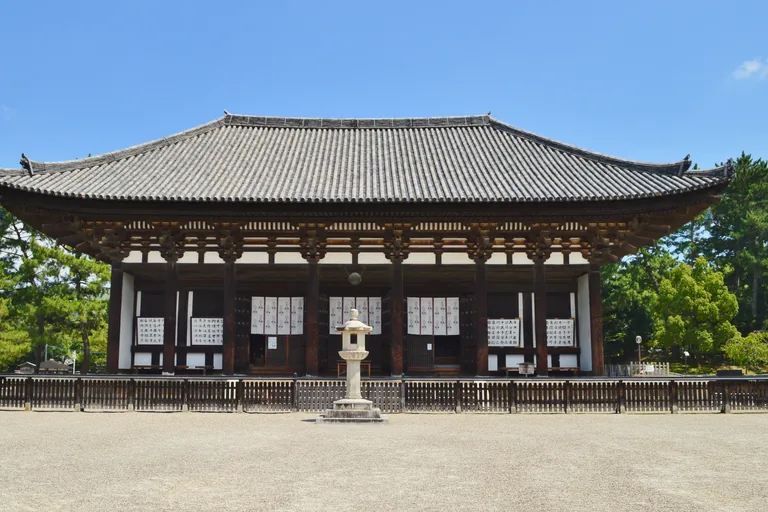
Photo: Saigen Jiro · Wikimedia Commons source · CC0 1.0 · Cropped to the recorded 3:2 source rectangle and resized from the exact hash-bound source input. Kofukuji's five storey pagoda stands on the east side of the temple's grounds in Nara, closed inside a tall repair cover, with the East Golden Hall beside it.
The route stops here for a National Treasure out of sight: Nara Prefecture carries out the repair for the temple through its own conservation office, retiling the whole roof, mending the timber of the eaves and replastering the walls, with the work planned into the 2030s.
The pagoda cannot be seen while the cover stands and the East Golden Hall is seen only from outside; the works site is fenced, so keep to the gravel path beside it.
Sarusawa Pond and the Uneme Shrine
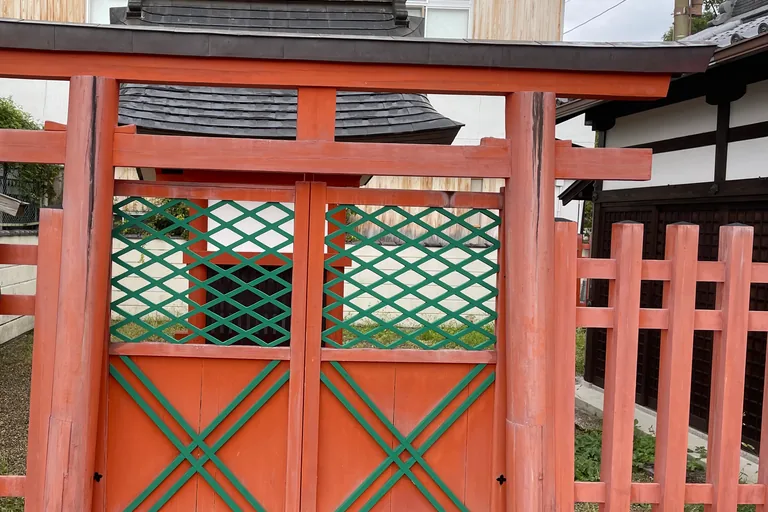
Photo: Higa4 · Wikimedia Commons source · CC0 1.0 · Cropped to the recorded 3:2 source rectangle and resized from the exact hash-bound source input. Sarusawa Pond lies just south of Kofukuji's grounds in central Nara, below Sanjo dori, with the small Uneme shrine at its north western corner.
The route stops here for the pond and its legend: encyclopedias describe a small pond made for Kofukuji as a pond where living creatures were set free, modelled on a pond at a Buddhist site in India, and tell of a willow beside it where the court lady is said to have hung her robe.
The Uneme shrine is a working shrine of Kasuga Taisha told from the road; the Fifty Two Steps down from Sanjo dori have no handrail, and a way without steps follows Sanjo dori west to this corner.
The Naramachi Lanes at Koshindo
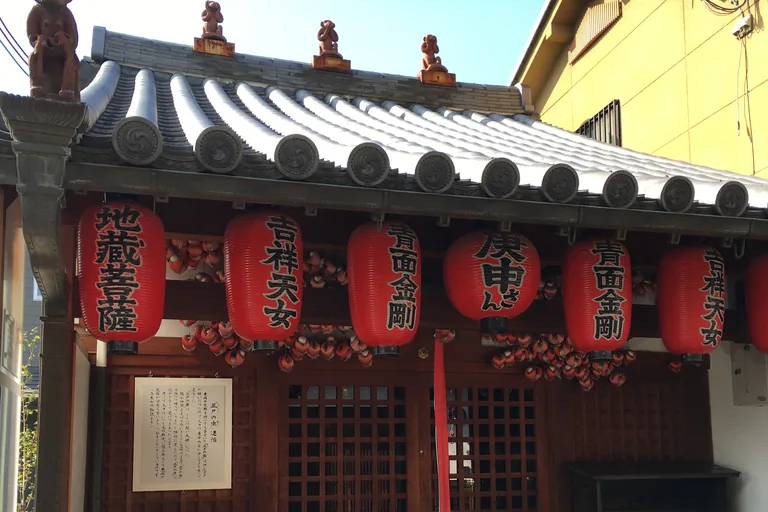
Photo: Kochizufan · Wikimedia Commons source · CC BY-SA 4.0 · Cropped to the recorded 3:2 source rectangle and resized from the exact hash-bound source input. Koshindo is a small hall beside a narrow alley in Naramachi, the lived in quarter of lanes south of Sarusawa Pond in Nara.
The route stops here for the town that grew on temple land: a Japan Tourism Agency text prepared with Gangoji says the temple's grounds once covered 33 hectares, and that districts such as Imamikado cho and Shimomikado cho still carry the names of temple gates that once stood there.
These lanes are people's homes, so keep voices low, stay in the alley and leave doors, windows and the hall's charms alone; on the way from the pond, Naramachi odori is crossed where there is no signal.
Gangoji's East Gate
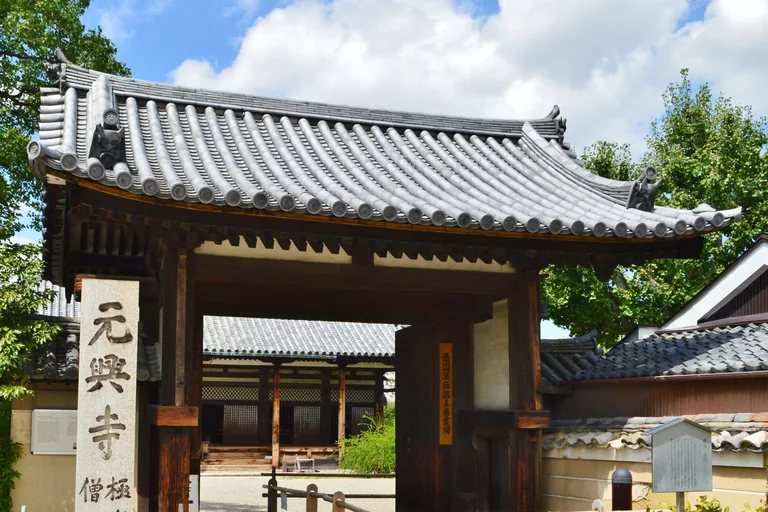
Photo: Saigen Jiro · Wikimedia Commons source · CC0 1.0 · Cropped to the recorded 3:2 source rectangle and resized from the exact hash-bound source input. Gangoji's east gate opens onto a quiet street in Naramachi, Nara, across a small gravel forecourt, with the temple's main hall beyond it.
The route stops here for the temple that came from Asuka: a Japan Tourism Agency text prepared with the temple says its name means Original Temple of the Blossoming of the Dharma, and that the court granted it about 2,000 hectares of land to support itself once it had moved to Nara.
It is a working temple and the walk stays outside the gate, with no promise of entry; keep voices low, since the streets around it are lived in.
The First Torii of Kasuga Taisha
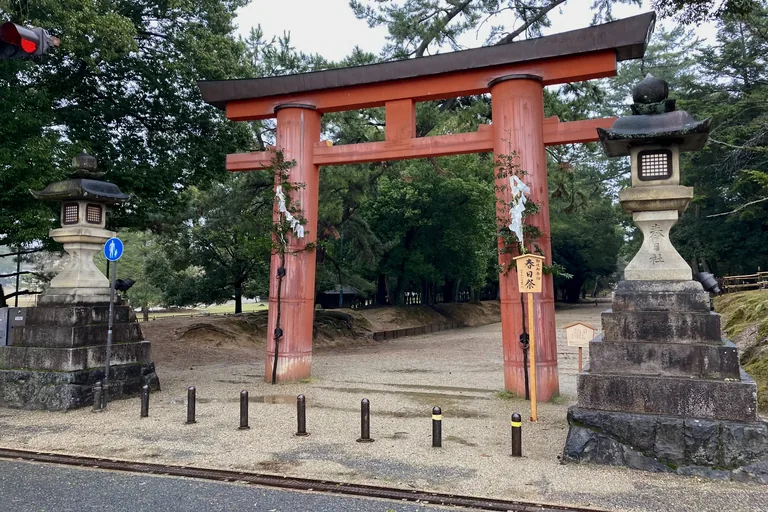
Photo: あきはゆうぐれ · Wikimedia Commons source · CC BY-SA 4.0 · Cropped to the recorded 3:2 source rectangle and resized from the exact hash-bound source input. The first torii of Kasuga Taisha stands where Sanjo dori meets the edge of Nara Park, at the start of the straight gravel approach to the shrine.
The route stops here for the shrine and its deer: the shrine's guide lists the torii as an Important Cultural Property and says it now marks the edge of Sanjo dori, the city's main street, and Nara Prefecture's park office records that Nara's deer were designated a natural monument in 1957.
The deer are wild animals: give them only the crackers sold for them, keep food, bags and paper away from them, and keep clear of stags from September to November and of mothers with fawns from mid May to June; cross the main road only at the signals.
The Meiji Museum Building
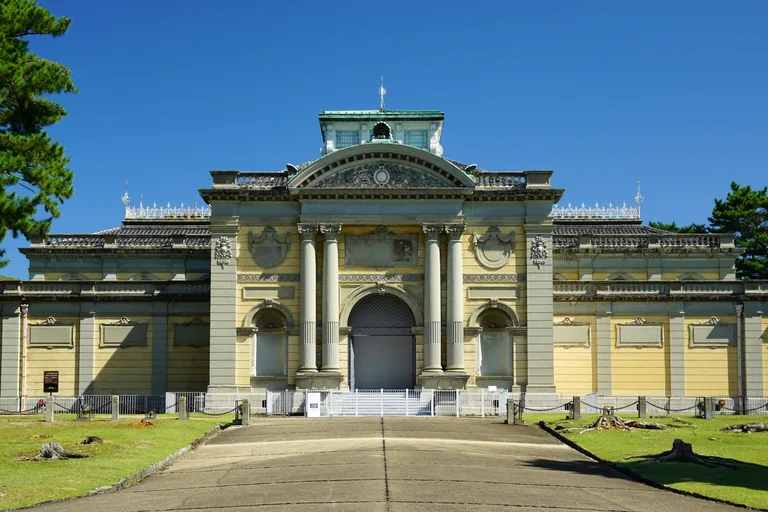
Photo: 663highland · Wikimedia Commons source · CC BY 2.5 · Cropped to the recorded 3:2 source rectangle and resized from the exact hash-bound source input. The Meiji building of the Nara National Museum is reached by a straight drive over the lawns of Nara Park, south of Noborioji.
The route stops here for the park's museum: a national government list of Meiji era buildings says the building, now called the Nara Buddhist Sculpture Hall, was designated an Important Cultural Property in 1969, and a historical dictionary describes it as a single storey building of brick.
It is told from the open park ground at the west end of the drive, with no promise of entry; the route leaves by the park footway north to Noborioji, not through the building's front gate.
Todaiji's Great South Gate
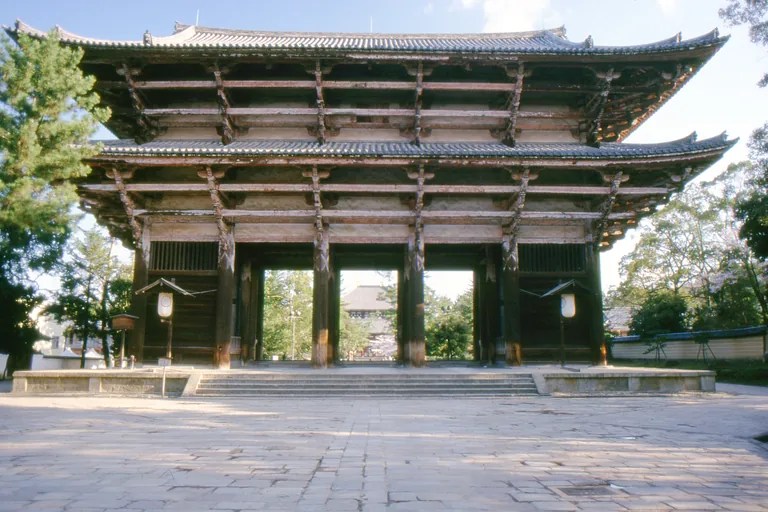
Photo: Bigjap · Wikimedia Commons source · CC BY-SA 3.0 · Cropped to the recorded 3:2 source rectangle and resized from the exact hash-bound source input. The Great South Gate is the main gate of Todaiji in Nara, at the top of a stone paved approach north of Noborioji.
The route ends here for the temple of the Great Buddha: Todaiji says the original gate of the eighth century was blown down by a great wind in the Heian period, and that the eighteen great round pillars of today's gate reach about 19 metres up into the roof.
The walk ends at the gate with no promise of entry to the temple or its hall; deer gather thickly on the approach, so hold food and paper close and out of reach; for the bus or the walk back to the stations, use the signals to cross Noborioji.


Before you go
The walk is a line of about 3.1 km on foot from Kintetsu Nara station to the city loop bus stop below Todaiji's Great South Gate: through Kofukuji's grounds to the pagoda's cover, down to Sarusawa Pond, south into the lanes of Naramachi to Koshindo and Gangoji's east gate, back north and east along Sanjo dori to the first torii of Kasuga Taisha, across the lawns of Nara Park to the museum's Meiji building, and along Noborioji to Todaiji's gate.
Access and surfaces
Allow about 110 minutes with the audio, over about 3.1 km between the stops; with the walk from Kintetsu Nara station at the start and to the bus stop at the end it comes to nearly 4 km.
Kofukuji's grounds have short flights of steps, and the Fifty Two Steps down to Sarusawa Pond have no handrail; a way without steps follows Sanjo dori west to the pond's corner.
Paths in the temple grounds and the park are gravel, grass and paving, and slippery after rain.
Sanjo dori, and Naramachi odori once, are crossed where there are no signals, so look both ways; the main roads by the Kasuga torii and near Todaiji are crossed only at the lights.
Deer roam freely from the opening stop.
They are wild animals: never give them your own food, keep bags, maps and paper away from them, and keep clear of stags from September to November and of mothers with fawns from mid May to June.
Summers are hot and humid and rain is common, so carry water.
The temples and the shrine are in daily use and the lanes of Naramachi are people's homes: keep voices low and look from the street or the path.
The walk enters no temple hall, shrine, museum or other building, and makes no promise that any of them is open.
Plan the walk
- How long is the Nara audio walking tour?
- Allow about 110 minutes. The route covers 3.1 km (1.9 mi) in 8 stops, including walking and listening time, on gravel, grass and paved paths, with short flights of steps in Kofukuji's grounds and a way round the steps down to Sarusawa Pond.
- Where does the Nara walk start and end?
- It starts a short walk from Kintetsu Nara station, at Kofukuji's Central Golden Hall, and ends at Todaiji's Great South Gate. The city loop bus stops near the end, and it is about twenty minutes on foot back to Kintetsu Nara station along Noborioji.
- Can I see Kofukuji's five storey pagoda on the walk?
- No. The pagoda is closed inside a tall repair cover, and Nara Prefecture plans the work to run into the 2030s. The walk stops beside the cover and tells the pagoda's story there, but the tower itself cannot be seen.
- How should I behave around the deer?
- Treat them as the wild animals they are. The Nara Deer Preservation Foundation says deer can bite, strike, butt or charge. Give them only the crackers sold for them, keep food, bags and paper away from them, and keep clear of stags from September to November and of mothers with fawns from mid May to June.
- Does the walk go inside the temples or the museum?
- No. The walk is told from paths, streets and gates and enters no temple hall, shrine, museum or other building. Kofukuji, Gangoji, Kasuga Taisha and Todaiji are in daily use, so any visit is on their own terms, with no promise that they are open.
Same region
More tours in Japan
$4.99Stop 1 is free