Kanazawa · Ishikawa Prefecture, Japan
Kanazawa — The Edges of the Castle Town
An audio walk along the edges of the Maeda castle town, from a shrine gate of 1875 past the market, two teahouse quarters and an old bridge to the temple lanes.
Narration in English · Stop 1 is free
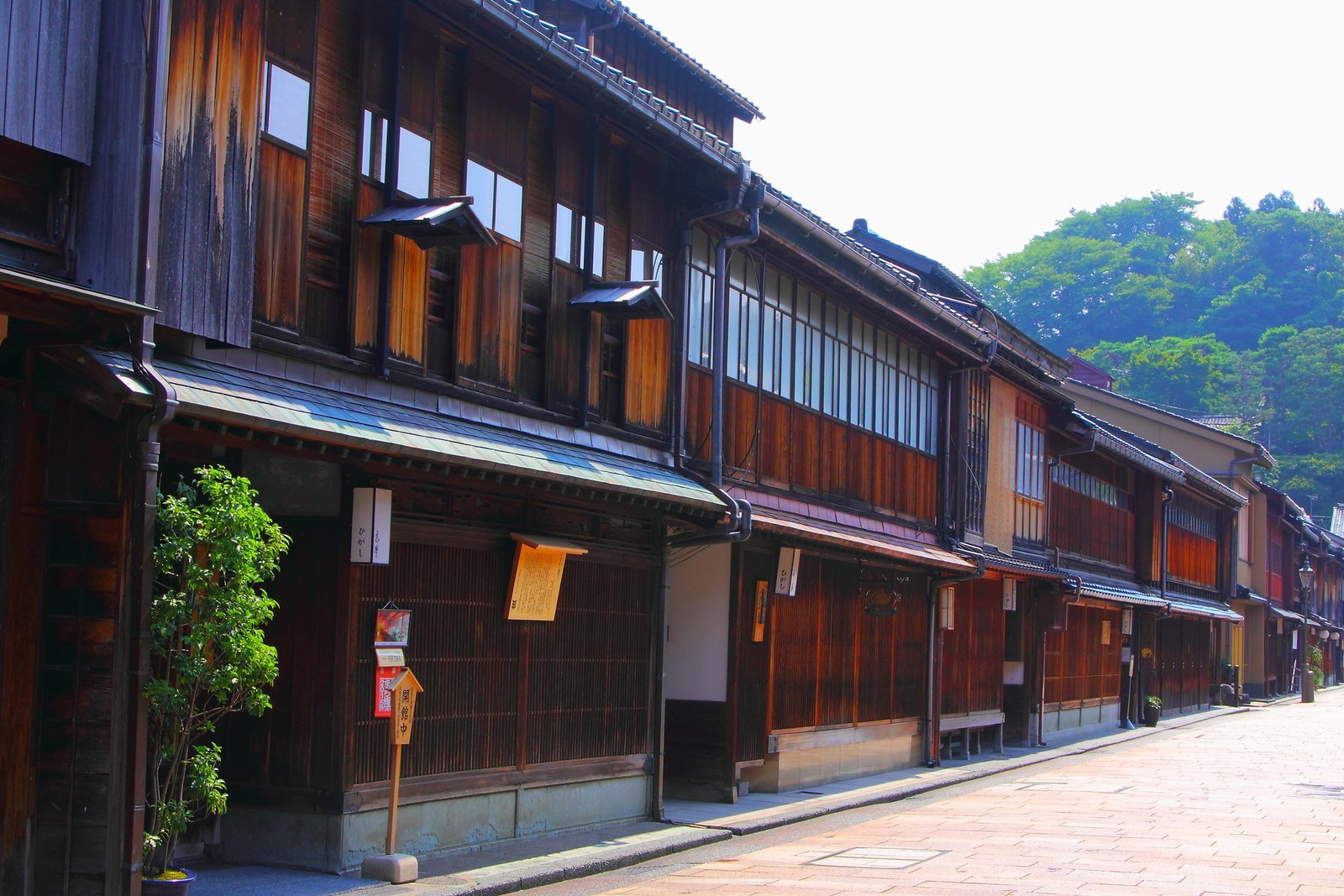 Tour no. 52
- Stops
- 8
- Distance
- 2.7 km (1.7 mi)
- Time
- About 85 minutes
- Route
- Easy city route
Listen before you buy
Stop 1 · Oyama Shrine Gate
Stop 1 is free. Listen before you buy.
Read Stop 1Hide Stop 1 text
Transcript · Stop 1
Kanazawa was the castle town of the Maeda lords, who ruled it from 1583. The town sits on a plateau between two rivers, the Sai and the Asano. Across the Asano, whole streets of old teahouses and temples are protected today as districts of traditional buildings.
Behind the tall stone torii, a traditional Japanese gate, a broad flight of stone steps climbs to the shrine gate: three round arches faced in stone at the bottom, two smaller storeys of white plaster and dark trim above them, the top one set with windows of coloured glass, and a thin spire on the roof.
The Maeda ruled the Kaga domain — roughly today's Ishikawa and Toyama — fourteen heads of the family in turn. Kaga's official yield was one million koku of rice, more than any other domain. A koku was about a hundred and eighty litres of unmilled rice. The lords made all their samurai live in Kanazawa, and samurai estates took nearly seventy percent of the city's land. Japan's tourism agency describes the plan this way: the upper ranks were given land close to the lord's residence in the castle, "while commoners lived near the town's edges".
The shrine is dedicated to Maeda Toshiie, the domain's founder, and his wife Matsu. It was built in 1873, soon after the rule that kept a lord from being honoured openly at a shrine was lifted.
The gate was finished two years later. It mixes Japanese, Chinese and Western styles; when it was built, the city says, such a gate had no precedent. The three arches are framed entirely in wood by Japanese building methods and faced with tomuro stone, the stone of the Kaga domain. The top storey's coloured glass was once lit so the gate served as a lighthouse for ships off the coast at Kanaiwa. The gate was built by a local master carpenter, Tsuda Yoshinosuke.
The Maeda loved Noh, a form of Japanese musical theatre, and encouraged ordinary people to learn it. Kanazawa earned a reputation as a place where "Noh falls from the heavens", because carpenters chanted it while they worked on the rooftops.
From the torii, the walk turns left along the street and heads north, through blocks that grew up around the castle, toward the covered lanes of the town's market.
The walk
An audio walking tour of Kanazawa from the gate of Oyama Shrine past Omicho Market, the novelist Izumi Kyoka's street, Kazuemachi, the Asanogawa Ohashi, the Higashi teahouse street and Utasu Shrine to the temple lanes at Zenshoji, at your own pace
The Maeda lords held the Kaga domain from Kanazawa, their castle town, from 1583 to 1869, and Japan's tourism agency explains that the upper ranks were housed close to the castle and the commoners out toward the edges of town. This walk keeps to those edges on the east side of the city. It begins below Oyama Shrine, raised in 1873 for Maeda Toshiie, the founder of the domain, and dedicated today to him and his wife Matsu; its gate of 1875 blends Japanese, Chinese and Western styles. It goes on through Omicho Market, which the market's own association traces to 1721, when the domain gathered the riverside markets near the castle, and reaches the narrow street where the novelist Izumi Kyoka was born in 1873.
From there a flight of stone steps, Kuragari zaka, leads down to Kazuemachi on the Asano river, a teahouse quarter whose residents won its old name back in 1999. The walk crosses the Asanogawa Ohashi, a concrete bridge of three arches finished in 1922 for the city's trams, and follows the stone paved main street of the Higashi teahouse quarter, licensed by the domain in 1820, where the house called Shima dates from the quarter's beginning. It passes Utasu Shrine, where, as Oyama Shrine's history tells it, the founder's son and heir honoured his father under the name of other gods, and ends among the temples at the foot of Utatsuyama, before the two storey gate of Zenshoji that people there call the Red Gate.
Route notes
Route and itinerary
About each stop · narration stays in the app
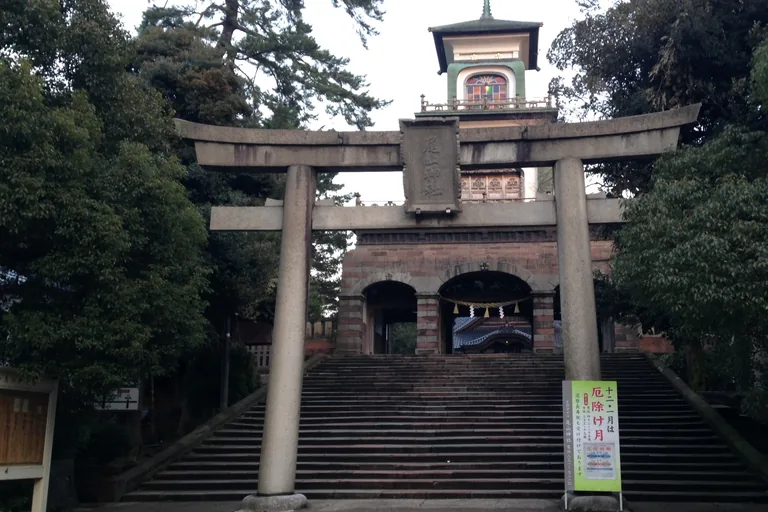
Photo: そらみみ · Wikimedia Commons source · CC BY-SA 4.0 · Cropped to the recorded 3:2 source rectangle and resized from the exact hash-bound source input. Oyama Shrine Gate
Oyama Shrine stands near the old castle in the middle of Kanazawa, and this stop is on the street at the stone torii, at the foot of the broad steps that climb to its front gate. The route starts here for the gate: the city's plaque lists it as an Important Cultural Property designated by the national government, with panes of glass in five colours on all four sides of its third storey, and the encyclopedia records that the shrine went up on the site of a palace in an outwork of Kanazawa Castle. The walk does not climb the steps, and the gate's upper storey is closed to the public; the street at the foot of the steps is narrow, so keep to the edge when cars pass.

Photo: Daderot · Wikimedia Commons source · CC0 1.0 · Cropped to the recorded 3:2 source rectangle and resized from the exact hash-bound source input. Omicho Market
Omicho Market is a covered market of narrow aisles near Kanazawa Castle, lined with about 180 stores selling fish, vegetables, fruit and meat, and places to eat. The route stops here for the market's later story: the government's Highlighting Japan magazine reports that once a wholesale market opened elsewhere, Omicho became mainly a market of retail shops and food stores, and that after a redevelopment begun in 2007 a five storey building was finished at one corner of the market in 2009. The aisles are crowded around midday and at weekends and the floor can be wet near the fish stalls, so keep to the side of the stalls and give way to sellers moving boxes; shops keep their own hours and some close on certain days.
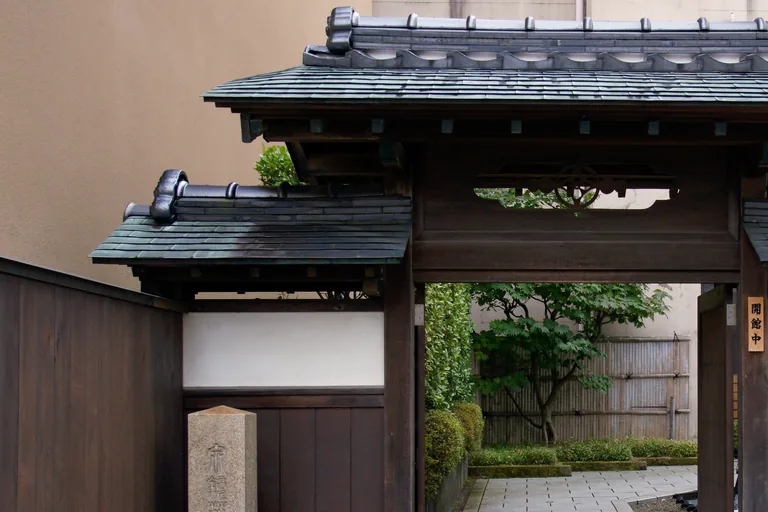
Photo: 663highland · Wikimedia Commons source · CC BY 2.5 · Cropped to the recorded 3:2 source rectangle and resized from the exact hash-bound source input. The Kyoka Lane and Kuragari Zaka
The Izumi Kyoka Memorial Museum stands behind a small wooden gate on Shimoshincho, a narrow street of low houses near the Asano river in the east of Kanazawa. The route stops here for the writer: the encyclopedia gives his given name at birth as Izumi Kyotaro and records that the museum to him opened in 1999 on the site of the house where he was born. The street has no pavement and cars do pass, so keep to the edge; the walk enters neither the museum nor the little shrine beside it, and the way on goes down Kuragari zaka, a stone stair without a handrail along much of it and slippery when wet.
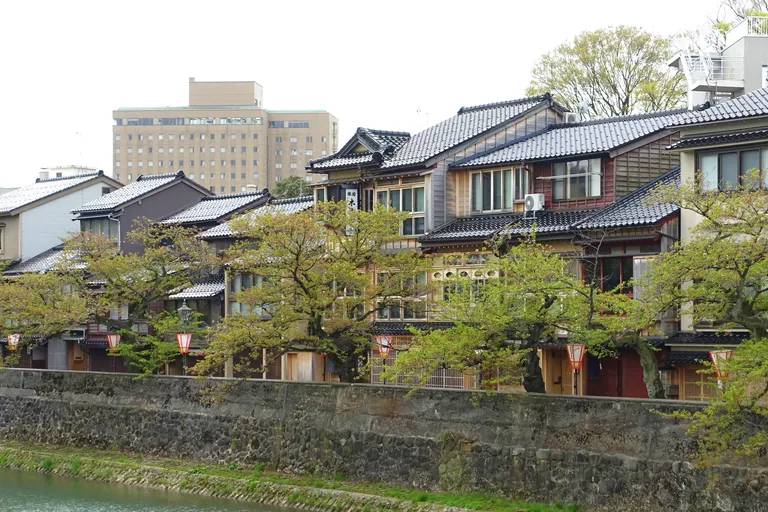
Photo: Daderot · Wikimedia Commons source · CC0 1.0 · Cropped to the recorded 3:2 source rectangle and resized from the exact hash-bound source input. Kazuemachi
Kazuemachi is a quarter of wooden townhouses on the flat ground between the Asano river and a slope in the east of Kanazawa, next to the Asanogawa Ohashi, the main road's bridge. The route stops here for the quarter's plan: the prefecture's record describes a district about 150 metres from east to west, built on a front street along the river, a back street parallel to it and a few alleys crossing both, with old moat channels still flowing as waterways near its east and west ends, and on the back street some houses keep the gentle roof pitch of their old stone weighted board roofs. The riverside street is narrow, stone paved and shared with occasional cars and bicycles, and the houses are homes and private teahouses, so keep to the house side and keep voices low.
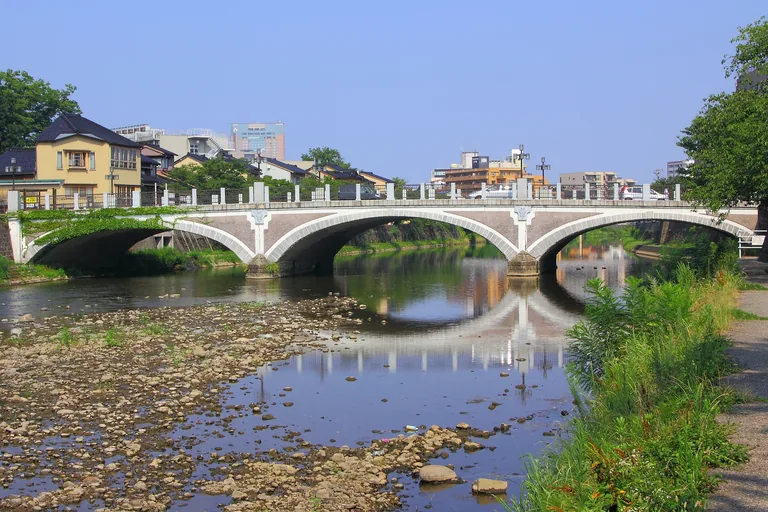
Photo: Kakidai · Wikimedia Commons source · CC BY-SA 4.0 · Cropped to the recorded 3:2 source rectangle and resized from the exact hash-bound source input. Asanogawa Ohashi
The Asanogawa Ohashi carries the main road over the Asano river in the east of Kanazawa, linking the Kazuemachi bank with the Higashi teahouse quarter on the far side. The route stops here for the bridge's build: the national register lists it as a reinforced concrete bridge of three filled arches, 55 metres long and 17 metres wide, on a crossing that has been a key route since the domain's time, and records its registration as a cultural property in 2000. The pavements run along a busy four lane road with buses and cars passing close, so stay on the pavement, keep out of the way of cyclists and use the signal controlled crossing by the police box at the north end.
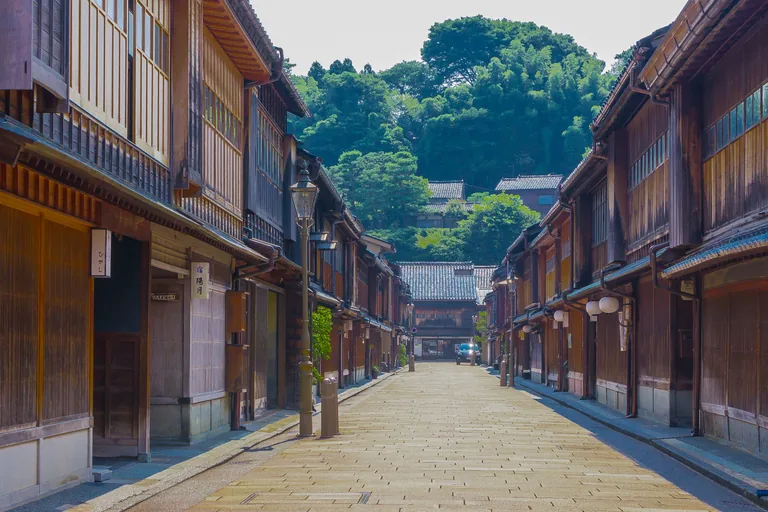
Photo: Kakidai · Wikimedia Commons source · CC BY-SA 4.0 · Cropped to the recorded 3:2 source rectangle and resized from the exact hash-bound source input. The Higashi Teahouse Street
The Higashi teahouse district is a quarter of old wooden houses on the east bank of the Asano river in Kanazawa, along a straight stone paved main street and the lanes around it. The route stops here for the houses: the prefecture's record says that about two thirds of the 140 buildings in the district are traditional, many of them built between the quarter's founding and the early Meiji years, that nine in ten of those are houses in the teahouse style, and that a few still keep their large front doors. The street is busy with visitors through the day and lined with homes and working teahouses; the city has banned littering and smoking in the street here since March 2015, and houses that open to visitors charge entry and keep their own hours, so check locally.
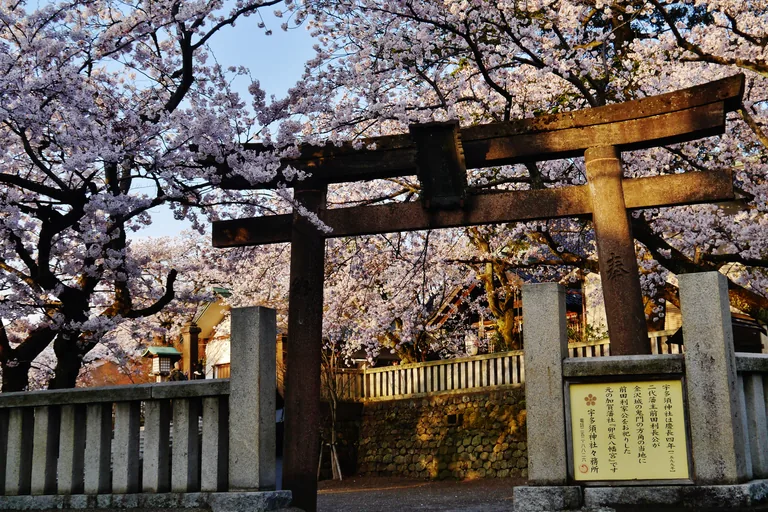
Photo: Zairon · Wikimedia Commons source · CC BY-SA 4.0 · Cropped to the recorded 3:2 source rectangle and resized from the exact hash-bound source input. Utasu Shrine
Utasu Shrine is a small neighbourhood shrine at a lane corner in the Higashiyama area of Kanazawa, a short walk from the Higashi teahouse street, its grounds raised behind a stone wall. The route stops here for the shrine's names: the prefecture's shrine association says people know it as Bishamon san, that it changed its name more than once in the Meiji years, took its present name in 1900 and became a prefectural shrine in 1902. The lane is narrow with no pavement and rises gently, and local cars and vans pass slowly, so keep to the side; the stop does not need you to climb into the grounds.
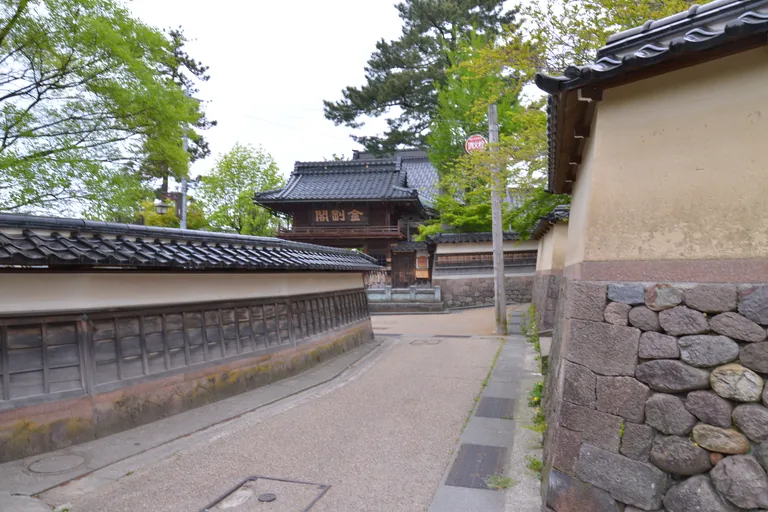
Photo: Isoyan · Wikimedia Commons source · CC BY-SA 3.0 · Cropped to the recorded 3:2 source rectangle and resized from the exact hash-bound source input. The Temple Lanes at Zenshoji
The temple district at the foot of Utatsuyama spreads over the lower slopes of the hill north of the Asano river in Kanazawa, a quarter of temple lanes between long earthen walls. The route ends here for the district's scale: the prefecture's record says it covers about 22 hectares, some 690 metres from east to west and 840 metres from north to south, and holds 37 temples and 2 shrines, where many main halls date from the Edo period and some roofs keep the gentle pitch of their first stone weighted board roofs. The lanes are narrow and uneven in places, with no pavement and slow local cars, so keep to the side; from the gate they run downhill to the main road and its bus stops, and to the teahouse street and the river.


Local context
Before you go
The walk is a line of about 2.7 km on foot across the east side of Kanazawa, from the street below Oyama Shrine near the old castle, north through Omicho Market, east to the Asano river and along it, over the Asanogawa Ohashi to the Higashi teahouse street, and up through the temple lanes at the foot of Utatsuyama. It ends by Zenshoji's gate, a short walk above the teahouse street and the main road, where there are bus stops.
On the ground
Access and surfaces
A line of about 2.7 km on foot; allow about an hour and a half with the audio. The ground is mostly flat. Between the third and fourth stops the route goes down Kuragari zaka, a narrow stair of uneven stone between walls, slippery when wet; to avoid the steps, follow the street on to the main road and walk down to the river by the big bridge, a little longer. The teahouse streets are paved with stone, and the temple lanes at the end climb gently and are narrow and uneven in places, shared with slow local cars. Omicho Market's covered aisles are narrow and crowded around midday and at weekends, and the floor can be wet near the fish stalls, so keep to the side of the stalls. Traffic on the main roads and on the bridge is heavy: cross at the signals. Kanazawa is often wet, and snowy in winter, so bring an umbrella. Kazuemachi and the Higashi teahouse street are lived in, so keep voices low; the city bans littering and smoking in the street in the Higashi teahouse district. The walk needs no ticket and enters no teahouse, museum, shrine or temple; those that open to visitors charge for entry and keep their own hours, so check locally. There are public toilets near the Higashi teahouse street.
Frequently asked
Plan the walk
- How long is the Kanazawa audio walking tour?
- Allow about 85 minutes. The route covers 2.7 km (1.7 mi) in 8 stops, including walking and listening time, mostly on flat streets, with one flight of stone steps and a gentle climb at the end.
- Where does the Kanazawa tour start and end?
- It starts on the street at the stone torii below the gate of Oyama Shrine, near the old castle, and ends in the temple lanes at the foot of Utatsuyama by the gate of Zenshoji, a short walk above the Higashi teahouse street and the main road with its bus stops.
- Is the route step free?
- Not entirely. Between the third and fourth stops it goes down Kuragari zaka, a narrow stair of stone between two walls. A step free way round follows the street on to the main road and down to the river by the big bridge, which is a little longer.
- Can I go inside the teahouses?
- The walk is told from the street and needs no ticket. Some houses on the teahouse streets still work as teahouses and receive guests only by introduction, and many are now cafes and shops; houses that open to visitors charge for entry and keep their own hours, so check locally.