Udaipur · Rajasthan, India
Udaipur — A Capital by the Lake
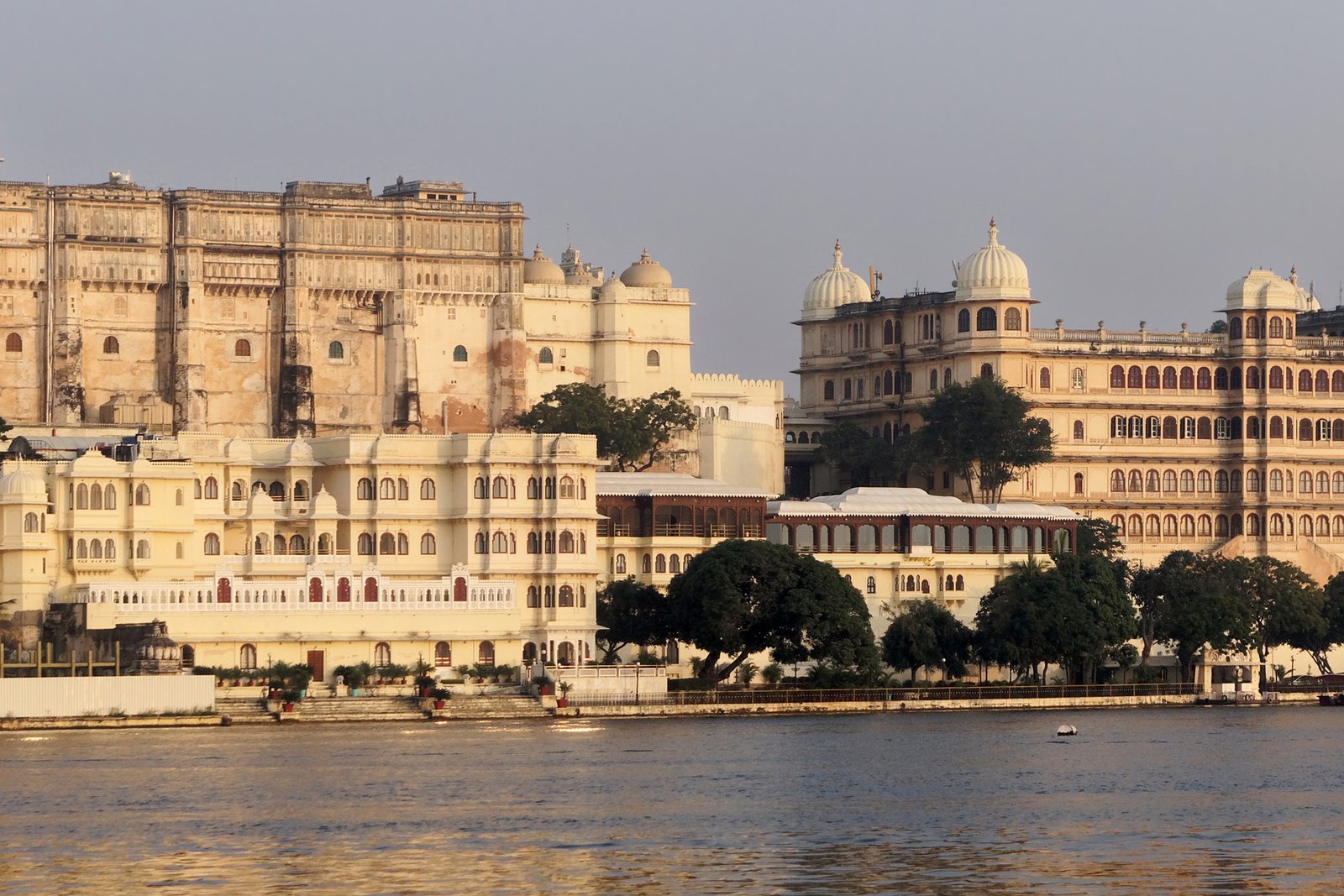
Jakub Hałun, Wikimedia Commons; cropped and resized by ChapterWalks · CC BY-SA 4.0
An audio loop through old Udaipur, from a temple of 1652 down to the ghats of Lake Pichola, over the water to the City Palace view and back by the Chand Pol.
Narration in English · Stop 1 is free
- 6 stops
- 2.6 km (1.6 mi)
- About 80 minutes
- Easy city route
Stop 1 · Jagdish Temple
Stop 1 is free. Listen before you buy.
Read Stop 1Hide Stop 1 text
Transcript · Stop 1
From these lanes the old city runs down to the water. Across it the wooded hills close Lake Pichola in on its western side. The walk goes down to the lake, crosses it on foot and comes back through the old city gate; it is told from the streets.
At the head of the broad stone steps stand two stone elephants, trunks raised, with a white gateway between them. Behind it rises the tall carved main spire, with the smaller spires of the shrines around it.
Udai Singh, a Maharana of Mewar, began a new capital here in the 1550s. The Mewar foundation's account says the old capital, Chitor, stood on a hill that was easy to besiege and hard to defend. Udai Singh chose the Girwa valley among hills that protected it and a ridge east of Lake Pichola. The Mewar foundation's account says he settled working families near his palace and granted them land: goldsmiths, brass workers, sword smiths, weavers, cloth dyers and painters among them. They lived in their own quarters.
The temple is dedicated to Jagannath, the Lord of the World, a form of Vishnu. It was built by Jagat Singh the First and finished in 1652. Its old name was the temple of Jagannath Rai, and people call it Jagdish ji. Thirty two marble steps lead up. The tall spire stands over the sanctum, with the hall in front, and the four smaller shrines around it are for Surya the sun god, Shiva, Ganesha and the goddess Shakti.
The temple has a large brass image of Garuda, the eagle that carries Vishnu. This is a working temple. The priests come from one family who have served it over the generations. At the morning and evening prayers, the aarti, you may hear the bells from the chowk. If you choose to go up, shoes come off before you enter, and the image of the god inside is not for photographs.
Turn left along the road, then right into the Lal Ghat lane; follow it as it bends left, then right down the steps and right again onto the ghat. Keep to the side: scooters use these lanes.
An audio walking tour of Udaipur from the Jagdish Temple down to Lal Ghat and Gangaur Ghat, over Lake Pichola by footbridge to the City Palace view at Ambrai Ghat, and back through the Chand Pol, at your own pace
Udaipur grew from the 1550s as the new capital of Mewar, which its ruler Udai Singh moved here from the hill of Chitor to a ridge above Lake Pichola, settling goldsmiths, sword smiths, weavers and dyers near his palace, as the Mewar house tells it. This loop begins in Jagdish Chowk below the Jagdish Temple, which Jagat Singh the First finished in 1652 for Jagannath, a form of Vishnu, and goes down through the lanes to Lal Ghat. From the steps there it looks along the shore to Bagore ki Haveli, the eighteenth century house of the chief minister Amar Chand Badwa, which the West Zone Cultural Centre restored as a museum after taking it over in 1986.
Next door is Gangaur Ghat, whose triple gate carries a palace of glass inlay added in 1878; in spring, at the festival of Gangaur, decorated images of the goddess Gauri are carried through the old streets down to the lakeside ghats. The walk then crosses the lake by a footbridge. A Banjara made the lake in the fourteenth century, the story goes, and Udai Singh raised its embankment in 1560. From Ambrai Ghat on the far bank it looks back across the water at the City Palace, many palaces joined together and enlarged by nearly every ruler who followed Udai Singh, and it returns over the road bridge at the Chand Pol, a gate in the wall that the gazetteer of 1908 describes round the city on every side but the lake.
Route notes
Route and itinerary
About each stop · narration stays in the app
Jagdish Temple
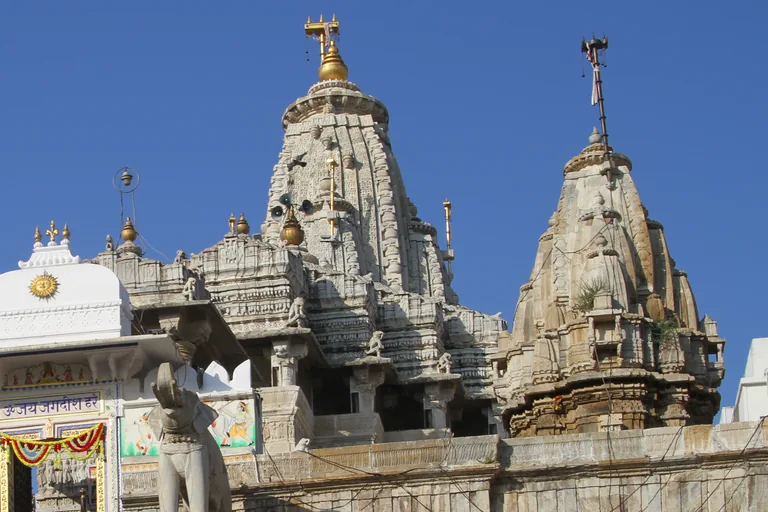
Photo: Gerd Eichmann · Wikimedia Commons source · CC BY-SA 4.0 · Cropped to the recorded 3:2 source rectangle and resized from the exact hash-bound source input. The Jagdish Temple rises above Jagdish Chowk in the old city of Udaipur, a working temple to Jagannath reached from the street by a broad stair of marble steps.
The route starts here for the temple's design and worship: the plaque at the temple describes a temple of the Nagar style with small shrines on all four sides, and Rajasthan's temple department says that worship follows the pattern of the Jagannath temple at Puri and that each stone elephant beside the stair is made of eleven blocks of stone.
The walk stays in the chowk at the foot of the steps, a busy junction where scooters, motorbikes and cars pass close, so keep to the edge when you move off.
Bagore ki Haveli from Lal Ghat
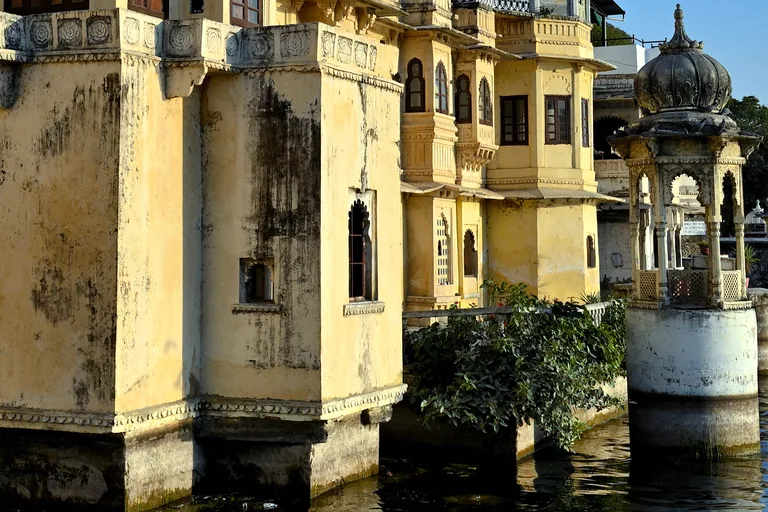
Photo: Sharvarism · Wikimedia Commons source · CC BY-SA 4.0 · Cropped to the recorded 3:2 source rectangle and resized from the exact hash-bound source input. Bagore ki Haveli is an eighteenth century mansion on the shore of Lake Pichola in the old city, and this stop looks along the water to it from the stone steps of Lal Ghat.
The route stops here for the house's lake front: the national arts centre's survey records foliated arch openings, projecting eaves carried on ornamented stone brackets and a parapet with a decorative pattern along the top, and the West Zone Cultural Centre keeps its headquarters in the house.
The steps of Lal Ghat may be slippery and uneven, so stay clear of the water's edge; the ghats along this shore are part of daily life for the people who live here, and the walk only looks along the shore.
Gangaur Ghat
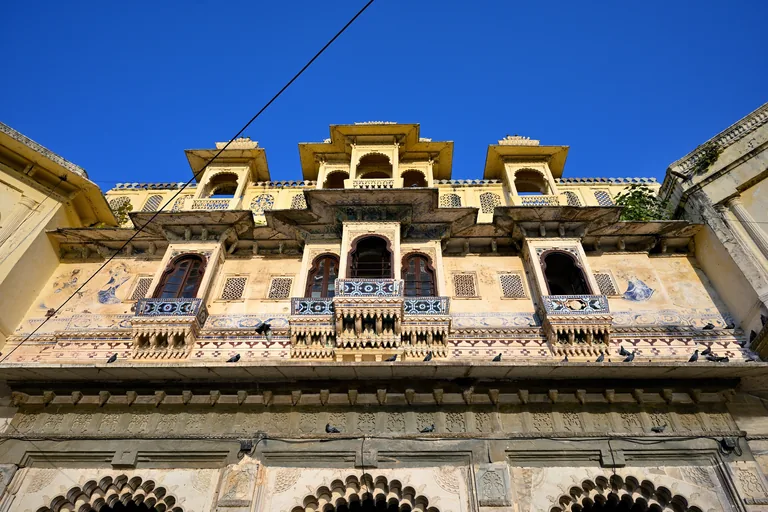
Photo: Sharvarism · Wikimedia Commons source · CC BY-SA 4.0 · Cropped to the recorded 3:2 source rectangle and resized from the exact hash-bound source input. Gangaur Ghat is a stone terrace on the east shore of Lake Pichola in the old city of Udaipur, reached from the lanes through the triple gate of the Bagore house's mansion.
The route stops here for the gate and the festival: the West Zone Cultural Centre calls the tripolia, the three gates, the front part of the mansion, leading down to the ghat, and India's tourism ministry links Gangaur with the Mewar Festival, the city's welcome to spring, with Jagdish Chowk and this ghat among its venues.
The steps down to the water may be slippery and uneven, so keep well back from the edge; the ghat is in daily use by people who live nearby, and the walk stays on the terrace.
Lake Pichola from the Daiji Bridge
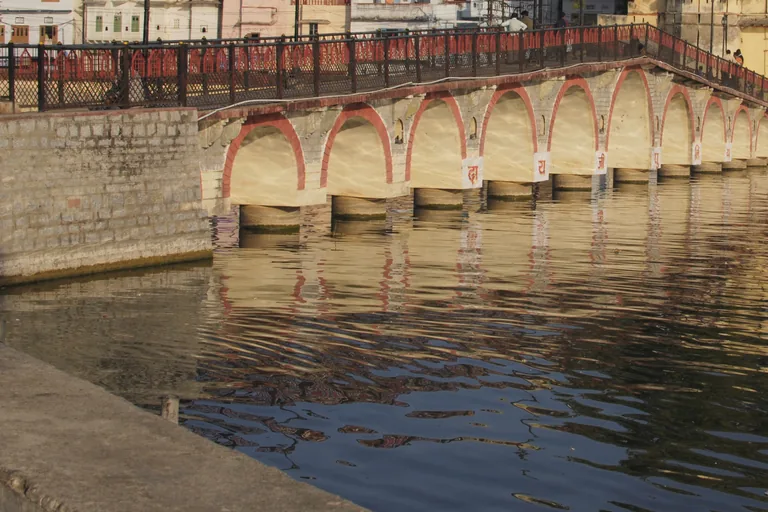
Photo: Selmer van Alten · Wikimedia Commons source · CC BY 2.0 · Cropped to the recorded 3:2 source rectangle and resized from the exact hash-bound source input. Lake Pichola lies along the west side of the old city of Udaipur, and this stop is in the middle of the footbridge that crosses it from the ghats of the old city to the far bank.
The route stops here for the lake's water: India's tourism ministry writes that Udai Singh built a stone masonry dam about fifteen metres high, which made the lake larger and gave the city and the land around it a steadier supply of water.
The footbridge is narrow and shared with people crossing both ways, so stand by the railing and leave the middle free; at its far end a few steps lead down to the lane.
The City Palace from Ambrai Ghat
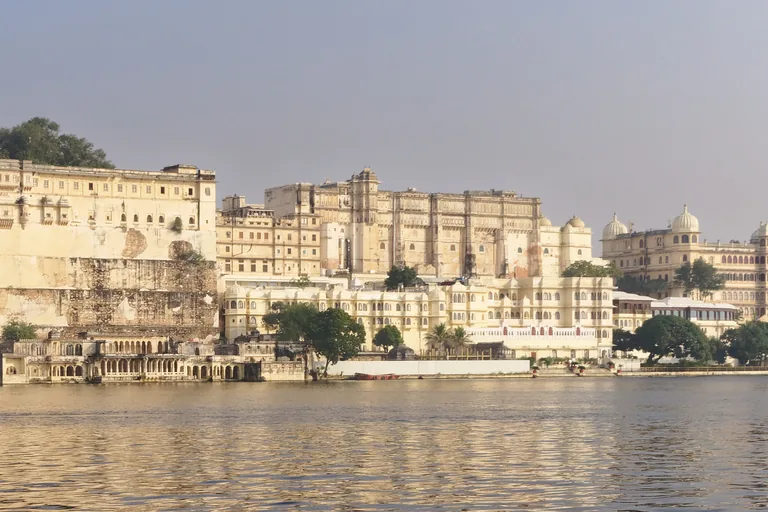
Photo: Jakub Hałun · Wikimedia Commons source · CC BY-SA 4.0 · Cropped to the recorded 3:2 source rectangle and resized from the exact hash-bound source input. The City Palace runs along the ridge above the east bank of Lake Pichola, and this stop looks across the water to its long front from Ambrai Ghat on the far shore.
The route stops here for the palace's architecture: India's tourism ministry describes it as drawing on the forts of Rajasthan, the grandeur of the Mughal court and the designs of the European Renaissance, and the national arts centre's survey records a building of Indo Persian features, arched and post and beam construction together, in stone and plaster.
Ambrai Ghat is reached over a zebra crossing on a road with traffic, and its stone steps turn slippery close to the water, so stay clear of the edge; the palace's museum and hotels are not part of the walk.
Chand Pol
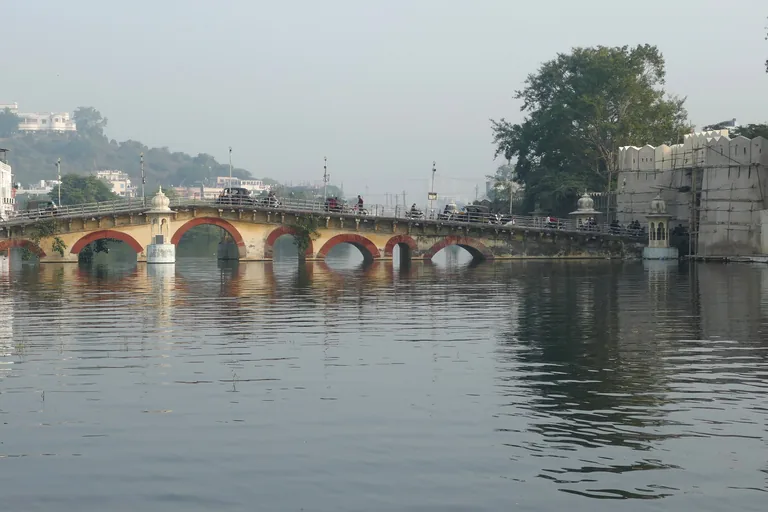
Photo: Ji-Elle · Wikimedia Commons source · CC BY-SA 4.0 · Cropped to the recorded 3:2 source rectangle and resized from the exact hash-bound source input. The Chand Pol is a gate in the old city wall of Udaipur at the north end of Lake Pichola, where a road bridge crosses the water to the quarter on the far bank.
The route ends here for the gate and the bridge as they are built: the national arts centre's surveys record a gate of brick and stone with a battlemented parapet and turrets of many angles, built in the Indo Persian manner, and a bridge whose round arches are made of stone.
The bridge carries scooters, motorbikes and cars and has no separate pavement, so keep to the side and stop on the narrow waterside walkway beside the gate; from there the lanes lead back south to Jagdish Chowk, where the walk began.


Before you go
The walk is a loop of about 2.6 km on foot through the old city of Udaipur, on the east shore of Lake Pichola: from Jagdish Chowk down the lanes to Lal Ghat and Gangaur Ghat, over the footbridge to Ambrai Ghat on the far bank, north along the water to the road bridge at the Chand Pol, and back through the gate and the lanes to the chowk where it began.
Access and surfaces
A loop of about 2.6 km on foot; allow about an hour and twenty minutes with the audio.
The old city slopes down from Jagdish Chowk to the lake, and at Lal Ghat and Gangaur Ghat the route goes down stone steps to the water and back up; the steps may be slippery and uneven, so stay clear of the water's edge.
The footbridge has a few steps down at its far end.
The way back crosses a road bridge at the Chand Pol that carries scooters and cars and has no separate pavement, so keep to the side, and on the far bank the route follows a busy road for a short way and crosses it at a zebra crossing.
The lanes are narrow and shared with scooters and motorbikes.
There is little shade and the middle of the day is hot for much of the year, so carry water.
No step free route was checked.
The ghats are in daily use by the people who live here.
The walk needs no ticket and is told from the streets, the ghats and the bridges; the museums on the way charge for entry and their hours change, so check locally.
Plan the walk
- How long is the Udaipur audio walking tour?
- Allow about 80 minutes. The route is a loop of 2.6 km (1.6 mi) with 6 stops, including walking and listening time, with stone steps down to the water and back up at two ghats.
- Where does the Udaipur tour start and end?
- It starts and ends in Jagdish Chowk, at the foot of the Jagdish Temple's steps in the old city. The last stop is on the waterside walkway beside the Chand Pol, and from there the lanes lead back south to the chowk.
- Is the route step free?
- No step free route was checked. The route goes down stone steps to the water at Lal Ghat and at Gangaur Ghat and back up again, and the footbridge over the lake has a few steps down at its far end.
- Does the walk go inside the temple or the palace?
- No. The walk is told from the streets, the ghats and the bridges and needs no ticket. The Jagdish Temple is a working temple, where by custom shoes are taken off before going in and the image of the god is not photographed. The City Palace museum charges for entry and its hours change, so check locally.
Same region
More tours in India
$4.99Stop 1 is free