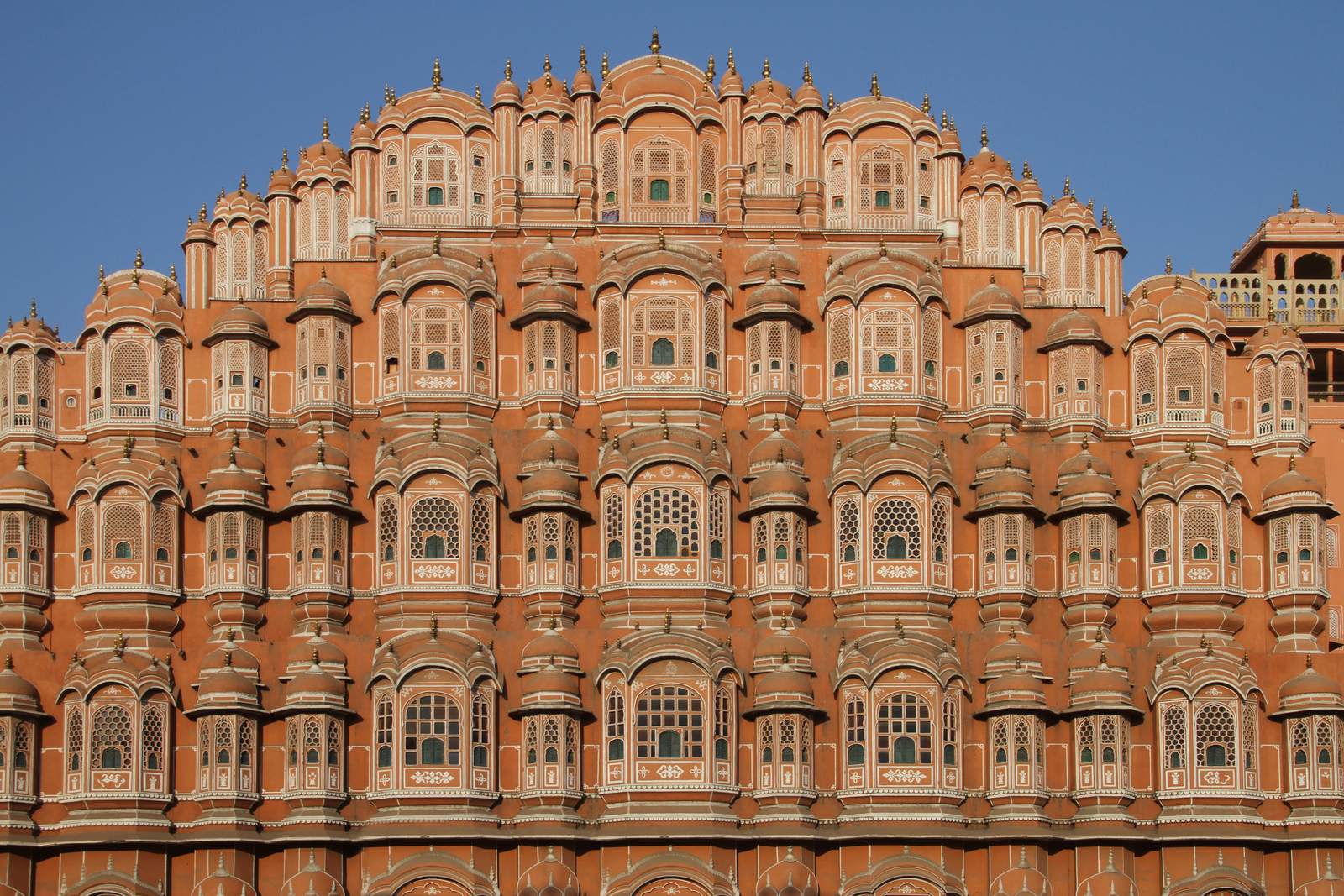
Jaipur · Rajasthan, India
Jaipur — The Bazaars of the Planned City
Gerd Eichmann, Wikimedia Commons; resized by ChapterWalks · CC BY-SA 4.0
An audio walk through the planned bazaars of Jaipur's walled city, from New Gate past the Hawa Mahal and the palace gate to the Isarlat tower.
Narration in English · Stop 1 is free
- 6 stops
- 2.1 km (1.3 mi)
- About 95 minutes
- Easy city route
Stop 1 · New Gate
Stop 1 is free. Listen before you buy.
Read Stop 1Hide Stop 1 text
Transcript · Stop 1
Jaipur's old city was drawn on paper before it was built: long straight bazaars, great squares where they cross, and a wall with gates around them all. It was laid out for trade, and the shops along those bazaars still open onto the street. This walk follows them from a gate in the wall to the gate of the palace at the city's heart, and on to a tower nearby.
New Gate stands in front of you, a pink gateway painted with white flowers and vines: a tall arch in the middle, a smaller arch on each side. Two bazaars meet at this corner and run along the inside of the wall: Bapu Bazaar to the east, on your left as you face the gate, and Nehru Bazaar to the west.
In 2019 UNESCO added the walled city of Jaipur to its World Heritage List, for its town planning and for its crafts. As the city's nomination to UNESCO describes it, a crenellated wall about six metres high ringed the city, with seven original gates and two added later. The same nomination records that the gates were shut every night by rule, a practice that ended only in the 1940s. New Gate was not one of the first gates: a thesis written from the state's old records says it began as a small postern in the wall, and was made larger only in the nineteenth century.
India's tourism ministry lists Bapu Bazaar for its shoes of camel skin and its Rajasthani textiles. UNESCO's description calls Jaipur a city designed to be a commercial capital, which has kept its trading, craft and cooperative traditions.
A few things before you set off. The bazaars carry cars, auto rickshaws, motorbikes and cattle, and there are few signals on this walk: cross steadily, with other people on foot where you can, and at the signals where there are any. Walk under the arcades where they are clear. Keep your bag close in the crowds. Shopkeepers will invite you in, and a polite no is enough. The bazaars are generally closed on Sundays. From April to June the middle of the day is very hot, and the monsoon rains fall from about July to September; November to February are the coolest months for this walk. Walk it in daylight, and carry water.
Now walk east along Bapu Bazaar, the bazaar on your left as you face the gate, and keep to its north side, the side away from the wall. It runs straight beside the wall, under the arcades of its shops, past side streets that lead off into the old city: walk steadily across their mouths. At its far end it meets a much wider street running north, Johari Bazaar, beside a second gate in the wall, Sanganeri Gate. Stay on this side of Johari Bazaar, walk a few steps north along it, and stop to look back at the gate.
An audio walking tour of Jaipur's walled city, from New Gate along Bapu Bazaar to Sanganeri Gate, up Johari Bazaar to the Hawa Mahal, and along Tripolia Bazaar past the palace gate to the Isarlat tower, at your own pace
Sawai Jai Singh II, ruler of Amber, founded Jaipur in 1727 on the plain below the hills, and UNESCO, which added the walled city to the World Heritage List in 2019, describes a capital planned from the start for trade, laid out on a grid of broad streets lined with shops that cross at large public squares. This walk of about 2.1 km starts just inside New Gate in the south wall and follows Bapu Bazaar along the wall's inner side to Sanganeri Gate, where the founding and the plan are told. It then heads north up Johari Bazaar, where the nomination to UNESCO records that the founder's letters invited bankers and merchants to the new city with tax concessions and land, and where, in the words of a Gemological Institute of America article, the city's gem and jewellery trade began.
Past Badi Chaupar, the great square at the bazaar's north end, it reaches the Hawa Mahal, the screen of latticed windows that the nomination says the poet king Sawai Pratap Singh built so the royal ladies could watch the street, and the tale Rajasthan's tourism department tells of a city painted pink in 1876. It then follows Tripolia Bazaar west to the Tripolia Gate, a private gate of the City Palace reserved for processions, with the palace, the temple of Govind Dev Ji and the Jantar Mantar observatory behind the walls, and ends below Isarlat, the tower that Rajasthan's tourism department says Ishwari Singh raised in 1749.
Route notes
Route and itinerary
About each stop · narration stays in the app
New Gate
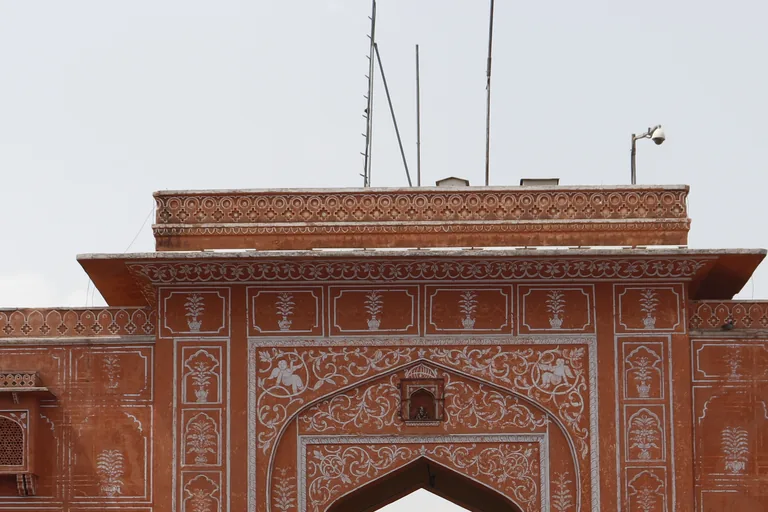
Photo: Yayawar monk · Wikimedia Commons source · CC BY-SA 4.0 · Cropped to the recorded 3:2 source rectangle and resized from the exact hash-bound source input. New Gate is an arched gateway in the south wall of Jaipur's old city, its pink face drawn over with white vines and flowers, at the corner where Bapu Bazaar and Nehru Bazaar meet, both following the wall on its inner side.
The route starts here for the walled city UNESCO inscribed in 2019, a city its listing describes as designed to be a commercial capital: the nomination records a masonry wall with battlements around it whose gates were once closed at night by rule, and India's tourism ministry names Bapu Bazaar for Rajasthani textiles and shoes of camel skin.
Cars, motorbikes, auto rickshaws and cattle share the bazaars and signals are few, so cross steadily alongside other walkers; most shops close on Sundays, and nothing on the walk needs a ticket.
Sanganeri Gate
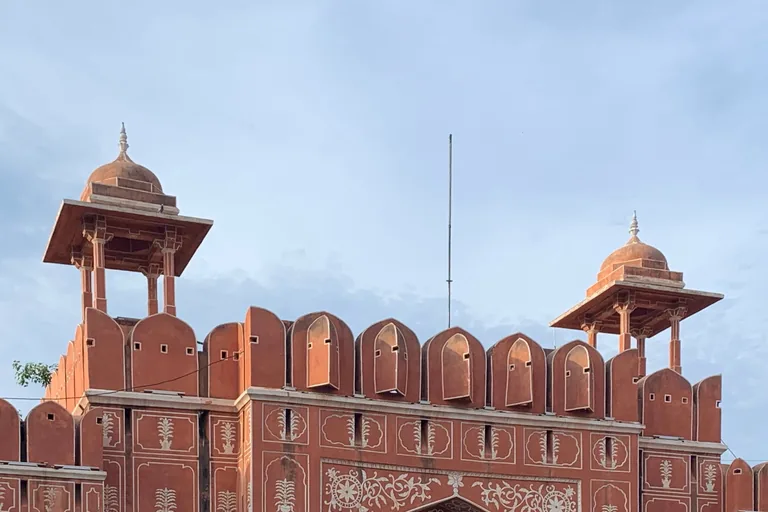
Photo: Chainwit. · Wikimedia Commons source · CC BY-SA 4.0 · Cropped to the recorded 3:2 source rectangle and resized from the exact hash-bound source input. Sanganeri Gate is the gate in the south wall at the foot of Johari Bazaar, where the road leaves the old city; the walk stops a few steps inside it, on the west side of the bazaar.
The route stops here for the founding and the plan: UNESCO's listing says Sawai Jai Singh II founded the city in 1727 on the plain south of the Amber hills, on a grid of broad streets that cross at large public squares, and ICOMOS, which evaluated the nomination, writes that the main palaces, roads and square were completed in about four years.
The gate is seen from the inside only and the walk never passes through it; the next leg crosses Johari Bazaar where its central divide has a gap, with no signal.
Johari Bazaar
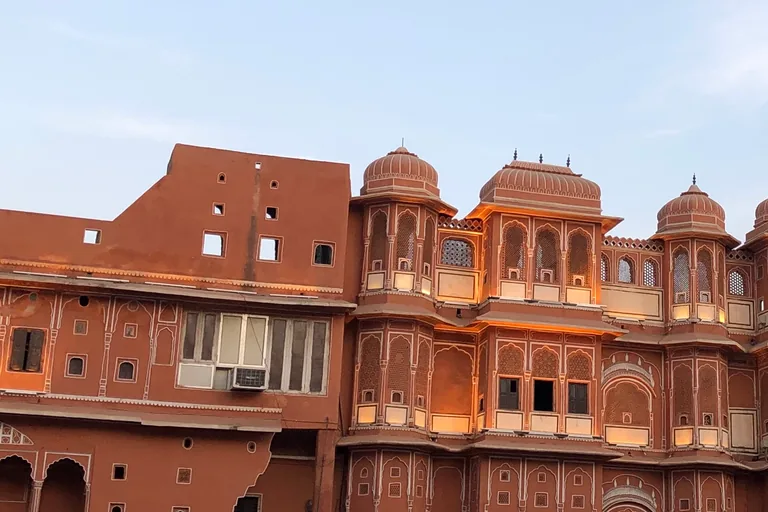
Photo: Yamen · Wikimedia Commons source · CC BY-SA 4.0 · Cropped to the recorded 3:2 source rectangle and resized from the exact hash-bound source input. Johari Bazaar is a wide, straight street running north from Sanganeri Gate, lined on both sides by arcades of shops, with pink upper storeys of latticed balcony windows and small domed pavilions above them.
The route stops here for the merchants' city: the nomination records that the founder wrote personally to bankers and merchants, offering tax concessions and land if they settled in the new city, UNESCO's listing says the main markets and shops were the state's own work, which kept the street fronts uniform, and an article from the Gemological Institute of America says the bazaar marked the start of Jaipur's gem and jewellery trade.
The walk goes into no shop and any purchase is yours to weigh; stalls and goods often fill the arcades, so at times you walk at the edge of the road, and the mouths of side lanes are crossed on foot.
The Hawa Mahal
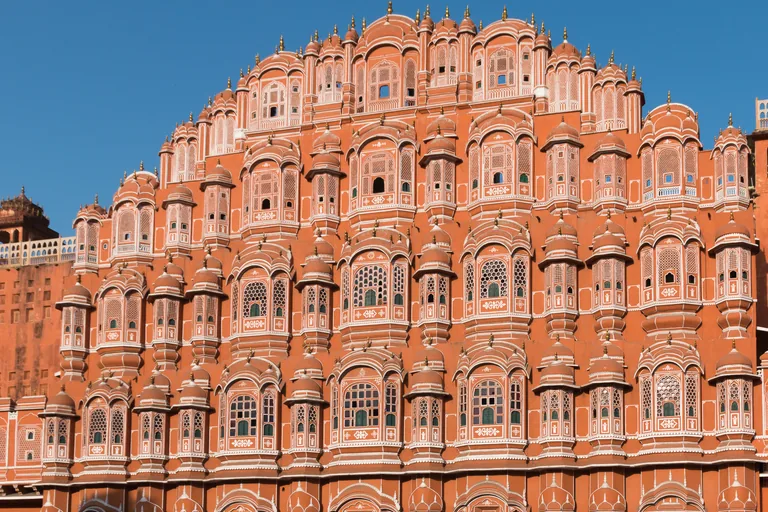
Photo: Daniel VILLAFRUELA · Wikimedia Commons source · CC BY-SA 3.0 · Cropped to the recorded 3:2 source rectangle and resized from the exact hash-bound source input. The Hawa Mahal stands on the west side of the road running north from Badi Chaupar, a tall pink and white front of small projecting latticed windows rising in tiers to a row of small domes.
The route stops here for the palace front and the city's colour: the nomination says the poet king Sawai Pratap Singh built it so the royal ladies could watch processions and daily life, India's tourism ministry gives 1799 as its date, Rajasthan's tourism department tells the tale of a city painted pink in 1876 for a visit by the Prince of Wales, and the nomination records byelaws from 1970 that set dark pink walls in the main bazaars.
Going inside is ticketed and optional, so the walk stays on the street; the road in front of the building has no marked crossing, so cross steadily with others on foot.
The Tripolia Gate
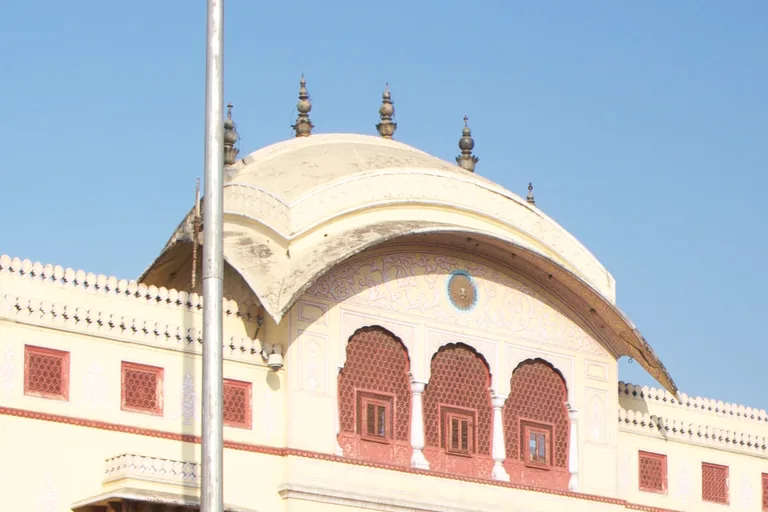
Photo: Aleksandr Zykov · Wikimedia Commons source · CC BY-SA 2.0 · Cropped to the recorded 3:2 source rectangle and resized from the exact hash-bound source input. The Tripolia Gate stands on the north side of Tripolia Bazaar, a tall cream gateway under a curved roof with finials and three latticed windows over its arch, at the edge of the City Palace.
The route stops here for the palace behind it: the nomination says the gate is private property, reserved for processions and other occasions, the Imperial Gazetteer of 1908 reckoned the palace with its grounds at about one seventh of the city's area, and UNESCO inscribed the Jantar Mantar, the founder's observatory near the palace, in 2010.
Visitors cannot enter by the gate and the walk keeps to the bazaar; the palace museum is ticketed and the observatory is a separate visit, and the temple of Govind Dev Ji beyond the palace is a working place of worship that the walk does not reach.
Isarlat
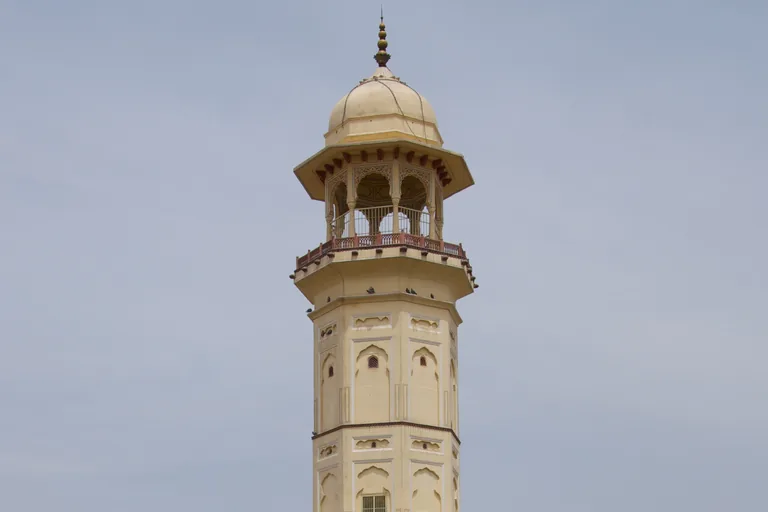
Photo: Jon Connell · Wikimedia Commons source · CC BY 2.0 · Cropped to the recorded 3:2 source rectangle and resized from the exact hash-bound source input. Isarlat is a slim, cream coloured tower rising behind the shops on the north side of Tripolia Bazaar, ringed by balconies with red railings and topped by a small domed pavilion.
The walk ends here for the tower and the later city: Rajasthan's tourism department says Ishwari Singh raised it in 1749 to mark a victory, ICOMOS records that the city grew and prospered in the nineteenth century, when gas lamps lit its paved boulevards, and the nomination notes that Jaipur later became the capital of the state of Rajasthan.
Going up the tower is a separate, ticketed choice; the walk ends on the south side of the bazaar, about 240 metres east of Choti Chaupar and its metro station.


Before you go
The walk is a line of about 2.1 km on level ground inside the walls: east along the inner side of the south wall from New Gate to Sanganeri Gate, north up Johari Bazaar to Badi Chaupar and round the square's east side to face the Hawa Mahal, then back to the square and west along Tripolia Bazaar, crossing at the Chaura Rasta signals, to face the Tripolia Gate, and on about 160 m to face Isarlat.
The audio gives each turn as you reach it.
Access and surfaces
Allow about 95 minutes with the audio, over about 2.1 km between the stops.
The walk is flat with no steps and keeps to the arcades in front of the shops where stalls and goods leave them clear.
Cars, buses, auto rickshaws, motorbikes and cattle share the bazaars, and the walk crosses four roads, only one of them at signals: cross steadily alongside other walkers and hold your bag close where it is crowded.
Midday is very hot from April to June and the monsoon brings rain from about July to September, so walk in daylight, in the morning or late afternoon, and carry water.
Most shops in the bazaars close on Sundays.
The walk enters nothing: the Hawa Mahal, the City Palace museum, the Jantar Mantar and the tower keep their own tickets, and the temples near the route are places of worship.
Plan the walk
- How long is the Jaipur audio walking tour?
- Allow about 95 minutes. The route runs one way for 2.1 km (1.3 mi) with 6 stops, including walking and listening time, on level streets.
- Where does the Jaipur walk start and end?
- It starts just inside New Gate in the south wall of the old city, where Bapu Bazaar and Nehru Bazaar meet, and ends on Tripolia Bazaar facing the Isarlat tower, about 240 m east of Choti Chaupar and its metro station.
- Does the walk go inside the Hawa Mahal or the City Palace?
- No. The walk stays on the street. The Hawa Mahal, the City Palace museum, the Jantar Mantar and the Isarlat tower keep their own tickets, and visiting them is up to you; the Tripolia Gate is a private gate, not a way in.
- Is the Jaipur route step free?
- The route is flat and there are no steps on it, but no step free route was checked, stalls and goods often fill the arcades, and only one of the four road crossings has signals.
- When should I walk the Jaipur route?
- In daylight, in the morning or late afternoon. Midday is very hot from April to June, the monsoon brings rain from about July to September, and most shops in the bazaars close on Sundays.
Same region
More tours in India
$4.99Stop 1 is free