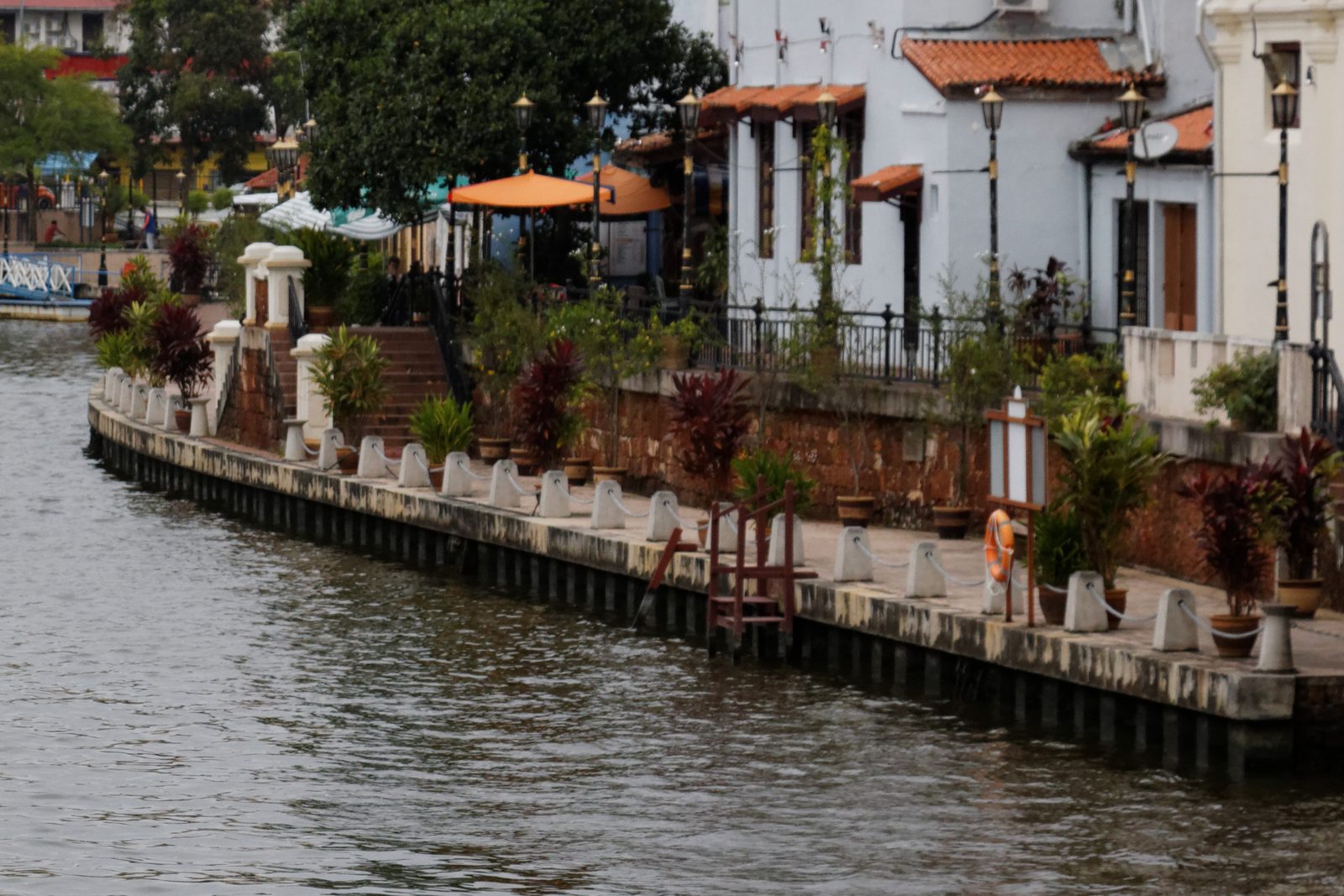
Malacca · Melaka, Malaysia
Malacca — The Port Where the Ships Waited
KimonBerlin, Wikimedia Commons; cropped and resized by ChapterWalks · CC BY-SA 2.0
An audio walk through Malacca, the old trading port in Melaka, Malaysia, from the one gate left of its fort, over St Paul's Hill and across the river.
Narration in English · Stop 1 is free
- 10 stops
- 1.9 km (1.2 mi)
- About 90 minutes
- Moderate walking route
Stop 1 · Porta de Santiago
Stop 1 is free. Listen before you buy.
Read Stop 1Hide Stop 1 text
Transcript · Stop 1
Malacca, in the Malay spelling Melaka, grew up around a wait: ships lay in this harbour until the wind changed. Whoever held the town after that kept the same hill and the same river. What follows is mostly the story of people who came to trade, and stayed.
In front of you is the Porta de Santiago, one stone gateway with a carved panel above its arch, standing on its own at the foot of the hill: the one gate left of the fort. UNESCO lists Malacca as an old trading port linking East and West. The city and its kingdom were founded around 1400. Legend has it that the founder, resting under a tree, watched a mouse deer get the better of his hunting dog, and named the settlement after the tree. A Ming account of the Chinese fleets says that on the voyage home their ships put in at Malacca and waited for a south wind. UNESCO's advisers report that some eighty languages were spoken in the town.
In 1511 the Portuguese captured the city and began a stone fort around the hill. The Portuguese chronicle says they called the fortress A Famosa, the Famous. The Dutch renovated the fort's main gate in 1670. An old footnote to a Dutch history says the gateway bears Portuguese arms, but a Dutch date. Look up at the carved panel above the arch.
Malacca is hot and wet all year, so carry water, and shelter when the rain comes. The way up the hill is by steps, and there is no step free way. If you would rather not climb, stay at street level on Jalan Kota, with the hill on your right, and at the end cross the road with care to rejoin the walk at the Middelburg Bastion.
Walk round the right side of the gate to the path behind it, and take the long flight of steps up to the old church on the hill.
An audio walking tour of Malacca, from the Porta de Santiago over St Paul's Hill and across the river to the old trading streets and the Kampung Hulu Mosque, at your own pace
Malacca, spelled Melaka in Malay, stands on the Malaysian coast of the strait named after it, and traders from across Asia and Europe came and went here for centuries. The Portuguese captured it in 1511, the Dutch in 1641, and the British came after them. The walk begins at the Porta de Santiago, the single gateway remaining from the fort, climbs the stepped path to the roofless St Paul's Church, and comes down past the Middelburg Bastion to the red buildings of the Dutch Square.
From there it crosses the Malacca River at the Tan Kim Seng Bridge into the streets its traders settled: Jalan Tun Tan Cheng Lock, once Heeren Street, among the townhouses of the Baba Nyonya; Jalan Hang Jebat, widely called Jonker Street and named after a figure of the old Malay tales; Jalan Tukang Emas, the goldsmiths' street, with a Hindu temple and a mosque built under Dutch rule; and Cheng Hoon Teng, a Chinese temple founded in the mid 1600s. It ends beside the Kampung Hulu Mosque, which dates from the 1720s, near a lane going down to the river.
Route notes
Route and itinerary
About each stop · narration stays in the app
Porta de Santiago
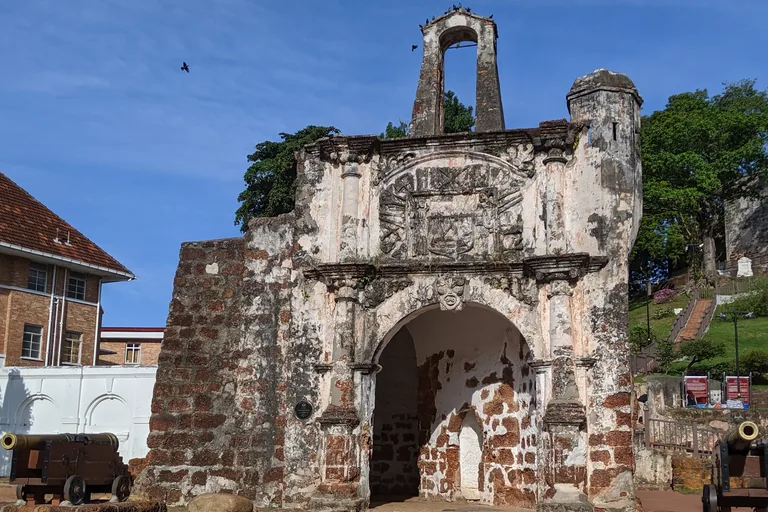
Photo: Kushared (Mohammed Sardar) · Wikimedia Commons source · CC BY-SA 4.0 · Cropped to the recorded 3:2 source rectangle and resized from the exact hash-bound source input. The Porta de Santiago is a single stone gateway at the foot of St Paul's Hill in Malacca, in the Malaysian state of Melaka, standing alone on a plaza beside Jalan Kota.
The route starts here for the fort this gate belonged to: a catalogue note of the National Museum of Singapore says the fort first had four main towers and was built of stone, and the report of a Dutch governor written in 1678 lists the bastions the Dutch gave new names to.
The way up the hill beyond the gate is by steps with no step free alternative; anyone not climbing can keep to Jalan Kota along the foot of the hill and rejoin the walk at the third stop.
St Paul's Church
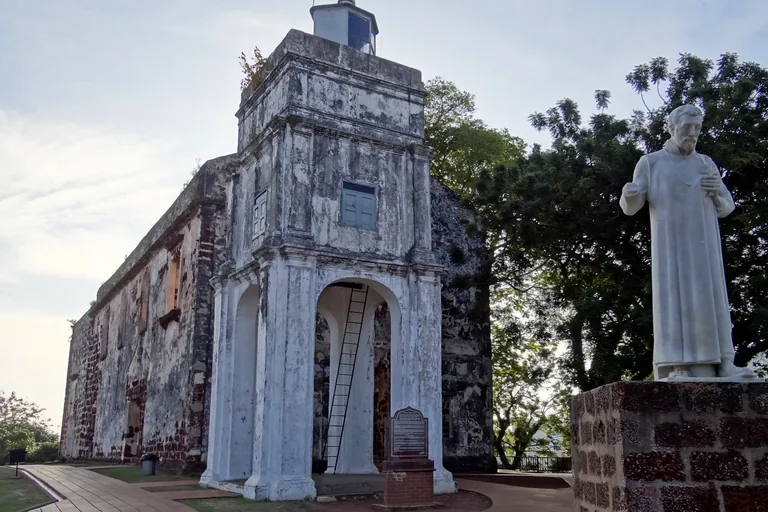
Photo: Bjørn Christian Tørrissen · Wikimedia Commons source · CC BY-SA 3.0 · Cropped to the recorded 3:2 source rectangle and resized from the exact hash-bound source input. St Paul's Church is the roofless shell of a church on the top of St Paul's Hill in Malacca, Malaysia, above the plaza and the old gate.
The route stops here for the church's early years and its stones: its encyclopedia entry says the chapel was dedicated to Our Lady of Grace and deeded to the Jesuits in 1548, and an old survey of the inscriptions gives dates from 1568 into the eighteenth century, helped by a list a sexton made in 1713.
The ruin stands on open ground and is reached only by steps; keep to the paths on the summit and take care on the flight down the west side.
Middelburg Bastion
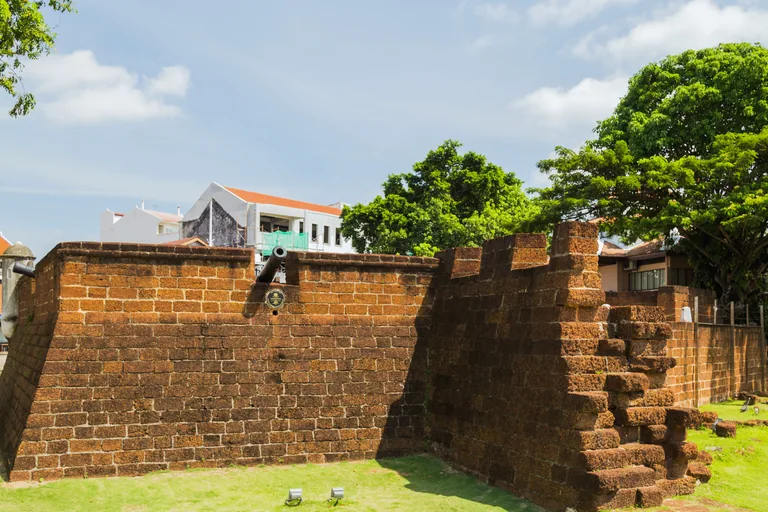
Photo: Marcin Konsek · Wikimedia Commons source · CC BY-SA 4.0 · Cropped to the recorded 3:2 source rectangle and resized from the exact hash-bound source input. The Middelburg Bastion is a long wall of red laterite blocks at the northern foot of St Paul's Hill in Malacca, near the river and beside Jalan Kota.
The route stops here for the plan of the Dutch defences: the governor's report of 1678 calls Ernestus, the neighbouring work, another half bastion, and describes a strong stone gate with great double doors on the river side between the two.
The wall is seen from the street and the walk says nothing about how much of it is original; the next stretch goes over Jalan Tun Khalil Yaakob by the marked crossing and may have no pavement on the hill side, with cars coming towards walkers.
The Dutch Square
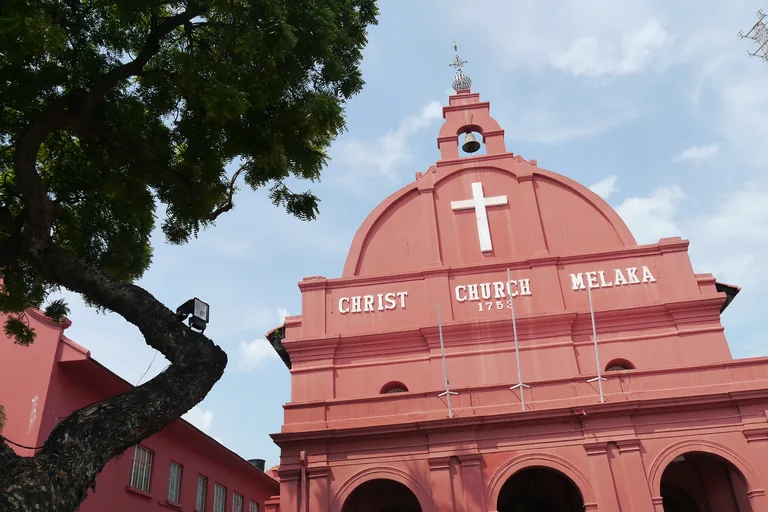
Photo: Quahla · Wikimedia Commons source · CC BY-SA 4.0 · Cropped to the recorded 3:2 source rectangle and resized from the exact hash-bound source input. The Dutch Square is the red painted group of buildings at the foot of St Paul's Hill in Malacca, Malaysia, with the Stadthuys along one side and Christ Church at its head.
The route stops here for the town's public centre: a handbook of 1908 called the Stadthuys the chief public building of Malacca, and the national heritage register records both the Stadthuys and Christ Church as declared on 14 February 2009.
The walk stays outside the Stadthuys, and Christ Church is in use, with no promise that it is open; the way on crosses the road that leaves the roundabout, so take care there.
The River at the Tan Kim Seng Bridge
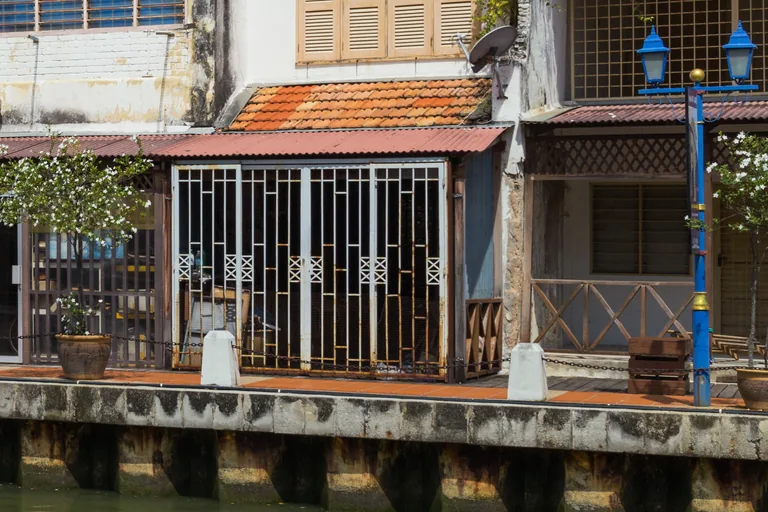
Photo: Marcin Konsek · Wikimedia Commons source · CC BY-SA 4.0 · Cropped to the recorded 3:2 source rectangle and resized from the exact hash-bound source input. The Tan Kim Seng Bridge crosses the Malacca River in Malacca, Malaysia, between the side of the hill and the old streets of the town.
The route stops here for the river as a port: a Ming account dated 1416 describes this country as having the ocean to its west and high mountains to its east and north, with sandy and brackish soil along the mountains, and the UNESCO advisers' evaluation describes the town's former role as a trading port between East and West.
The stand is at the railing of the seaward footway, where nobody should lean over the water, and the walk reaches it by crossing the road that leaves the roundabout, so take care on the way.
Jalan Tun Tan Cheng Lock
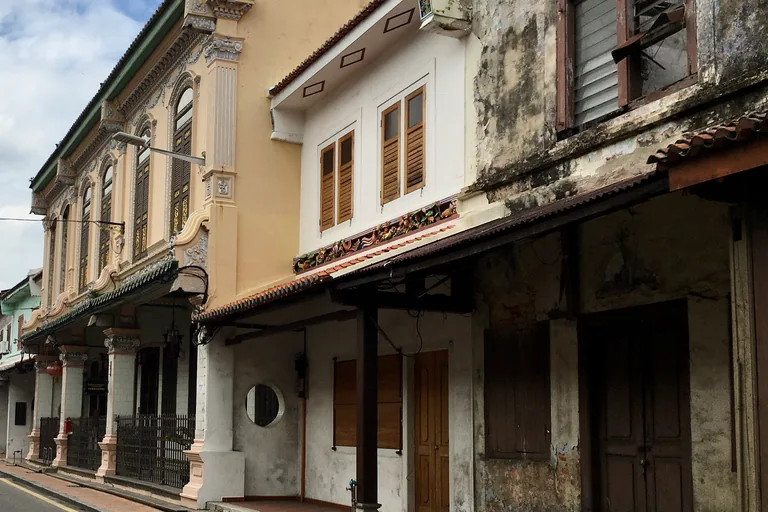
Photo: Slleong · Wikimedia Commons source · CC0 1.0 · Cropped to the recorded 3:2 source rectangle and resized from the exact hash-bound source input. Jalan Tun Tan Cheng Lock is a street of long, narrow townhouses across the river from the hill in Malacca, known in older records as Heeren Street.
The route stops here for the street's plots and families: a deed of 1815 measures two pieces of ground joined into one at five rods and six feet along the street, and an encyclopedia entry defines the Peranakan Chinese by their descent from Southern Chinese settlers who intermarried with people of the region.
People live and work behind these fronts, so keep voices low and leave doorways and windows alone; the walk goes inside none of the houses, and cars come towards walkers.
Jalan Hang Jebat
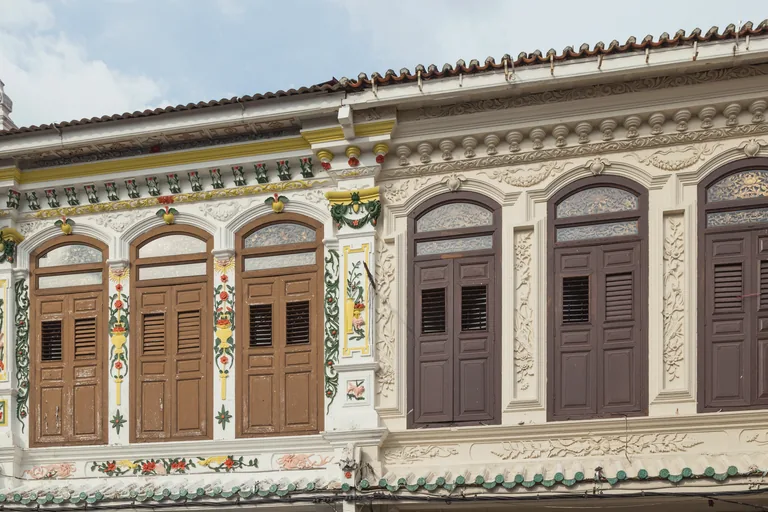
Photo: Marcin Konsek · Wikimedia Commons source · CC BY-SA 4.0 · Cropped to the recorded 3:2 source rectangle and resized from the exact hash-bound source input. Jalan Hang Jebat is a narrow street of old shophouses in the centre of Malacca, Malaysia, better known as Jonker Street.
The route stops here for a name out of literature: the street recalls a companion of Hang Tuah from the old Malay tales, and the encyclopedia entry on Hang Tuah sets out how those texts disagree and records a long debate among historians over his existence, so the walk treats the story as legend.
This is a working street with people living upstairs, and the walk makes no promise about a market on any given day; keep to the edge and keep voices down.
Jalan Tukang Emas
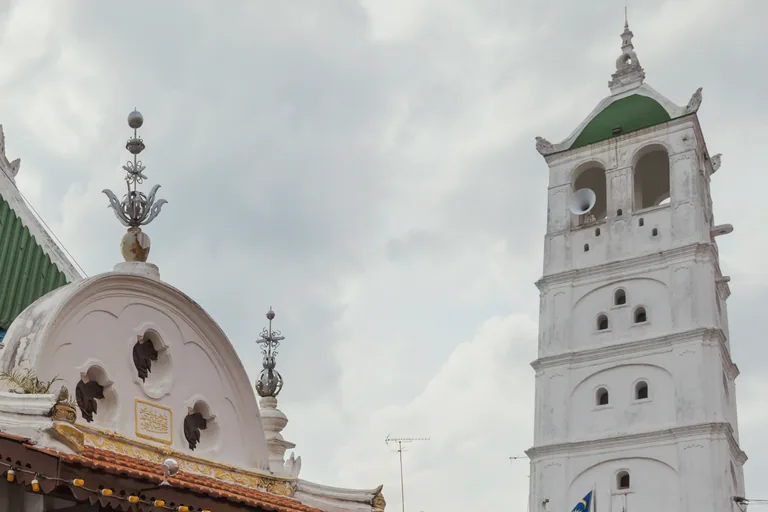
Photo: Marcin Konsek · Wikimedia Commons source · CC BY-SA 4.0 · Cropped to the recorded 3:2 source rectangle and resized from the exact hash-bound source input. Jalan Tukang Emas is a narrow street in the old centre of Malacca, Malaysia, where the Sri Poyyatha Vinayagar Moorthi Temple and the Kampung Kling Mosque stand a short way apart.
The route stops here for two listed buildings: a Southeast Asian art record likens the mosque's minaret to a Chinese pagoda and also to a tower type at Nagapattinam in South India, and the national heritage register records both buildings as declared on 14 February 2009.
Both are working places of worship with no promise of entry, so dress with care and keep out during prayers and services; the street is narrow and cars come towards walkers.
Cheng Hoon Teng
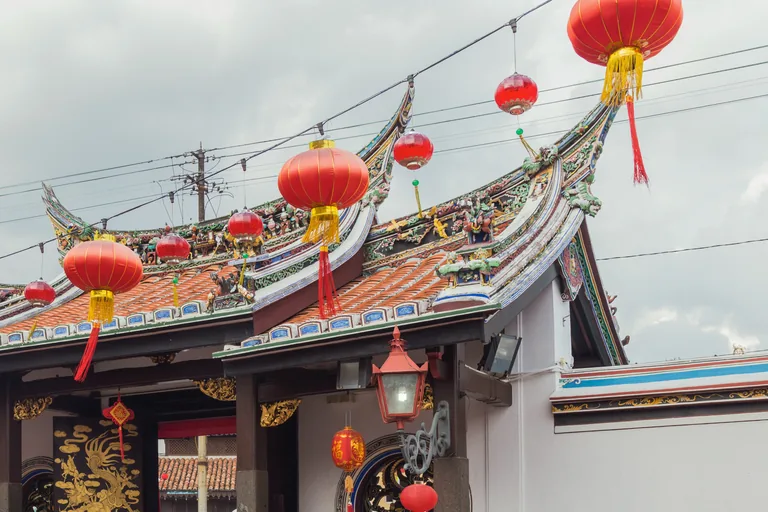
Photo: Marcin Konsek · Wikimedia Commons source · CC BY-SA 4.0 · Cropped to the recorded 3:2 source rectangle and resized from the exact hash-bound source input. Cheng Hoon Teng is a Chinese temple on Jalan Tokong in the old centre of Malacca, Malaysia, with a sweeping tiled roof over its street gate.
The route stops here for the temple and its care: a press report of 2003 dates the first phase of its restoration from late 1999 to early 2001, and says a second phase was then under way on the ancillary buildings and the main entrance, and the 2002 UNESCO heritage awards it reports on drew 46 entries from 15 countries and areas.
It is a working temple with no promise of entry, so dress with care and do not cross a service in progress; this stop looks at the gate from across a street where cars come towards walkers.
Kampung Hulu by the River
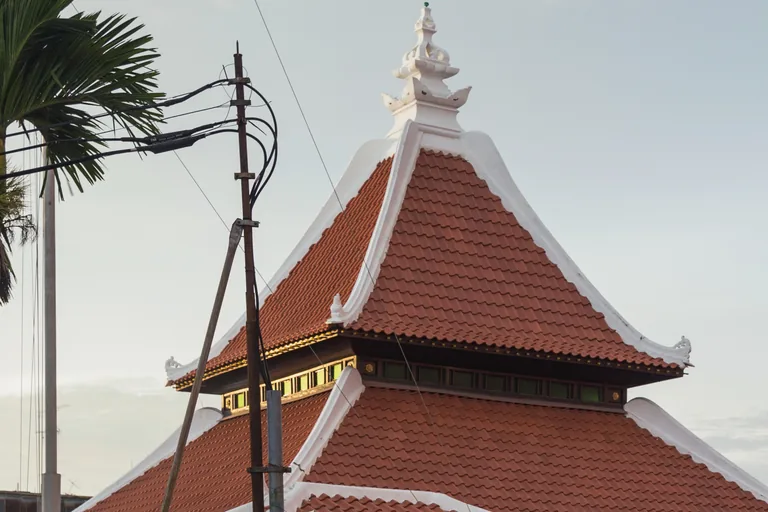
Photo: Marcin Konsek · Wikimedia Commons source · CC BY-SA 4.0 · Cropped to the recorded 3:2 source rectangle and resized from the exact hash-bound source input. The Kampung Hulu Mosque stands on Jalan Kampung Hulu in Malacca, Malaysia, at the end of the walk, near a short lane that runs down to the river.
The route ends here for the mosque and the town's standing: the national heritage register gives its declaration as 14 February 2009, and the World Heritage Committee's decision speaks of the town's living multicultural heritage.
It is a working mosque with no promise of entry, so dress with care and keep out at prayer times; cars pass in both directions, the lane reaches a footbridge by steps, and these streets are people's homes.


Before you go
The walk runs one way for about 1.9 km on foot: from the Porta de Santiago at the foot of the hill up to St Paul's Church, down to the Middelburg Bastion and the Dutch Square, over the Tan Kim Seng Bridge, along Jalan Tun Tan Cheng Lock and Jalan Hang Jebat, down Jalan Tukang Emas, along Jalan Tokong to Cheng Hoon Teng, and north on Jalan Kampung Hulu to the corner of the lane to the river.
Access and surfaces
A one way walk of about 1.9 km on foot; allow about 90 minutes with the audio.
St Paul's Church is reached and left only by steps, with no step free route up the hill; to skip it, keep to Jalan Kota along the foot of the hill from the gate to the Middelburg Bastion, about 470 metres, which leaves out the second stop.
Across the river several streets are narrow and one way, cars may come towards you and the pavements are uneven or missing; take care at the roundabout before the bridge and at the river's edge.
It is hot and humid all year and heavy rain is common, so carry water and a hat.
The streets across the river are lived in, so keep your voice down and leave doorways to the people who live there.
The walk goes inside nothing: the Stadthuys and other museums are not part of it, and the church, temples and mosques on the way are working places of worship with no promise that they are open.
Plan the walk
- How long is the audio walking tour of Malacca?
- Allow about 90 minutes. The route runs one way for 1.9 km (1.2 mi) with 10 stops, including walking and listening time, with steps on the hill near the start.
- Where does the Malacca walk start and end?
- It starts at the Porta de Santiago on Jalan Kota, at the foot of St Paul's Hill, and ends on Jalan Kampung Hulu beside the Kampung Hulu Mosque, across the river in the old town.
- Does the walk go inside the museums, temples or mosques?
- No. The walk is told from the streets, the hill and the bridge and goes inside nothing. The Stadthuys and other museums are not part of the walk, and the church, temples and mosques on the way are working places of worship, so any visit is on their own terms and there is no promise that they are open.
- Is the route step free?
- No. St Paul's Hill is climbed and descended by steps, with no step free route. To skip the church, keep to Jalan Kota along the foot of the hill from the gate to the Middelburg Bastion, which leaves out the second stop; across the river the pavements are uneven or missing in places.
Same region
More tours in Malaysia
$4.99Stop 1 is free