George Town · Penang, Malaysia
George Town — A Free Port on the Strait
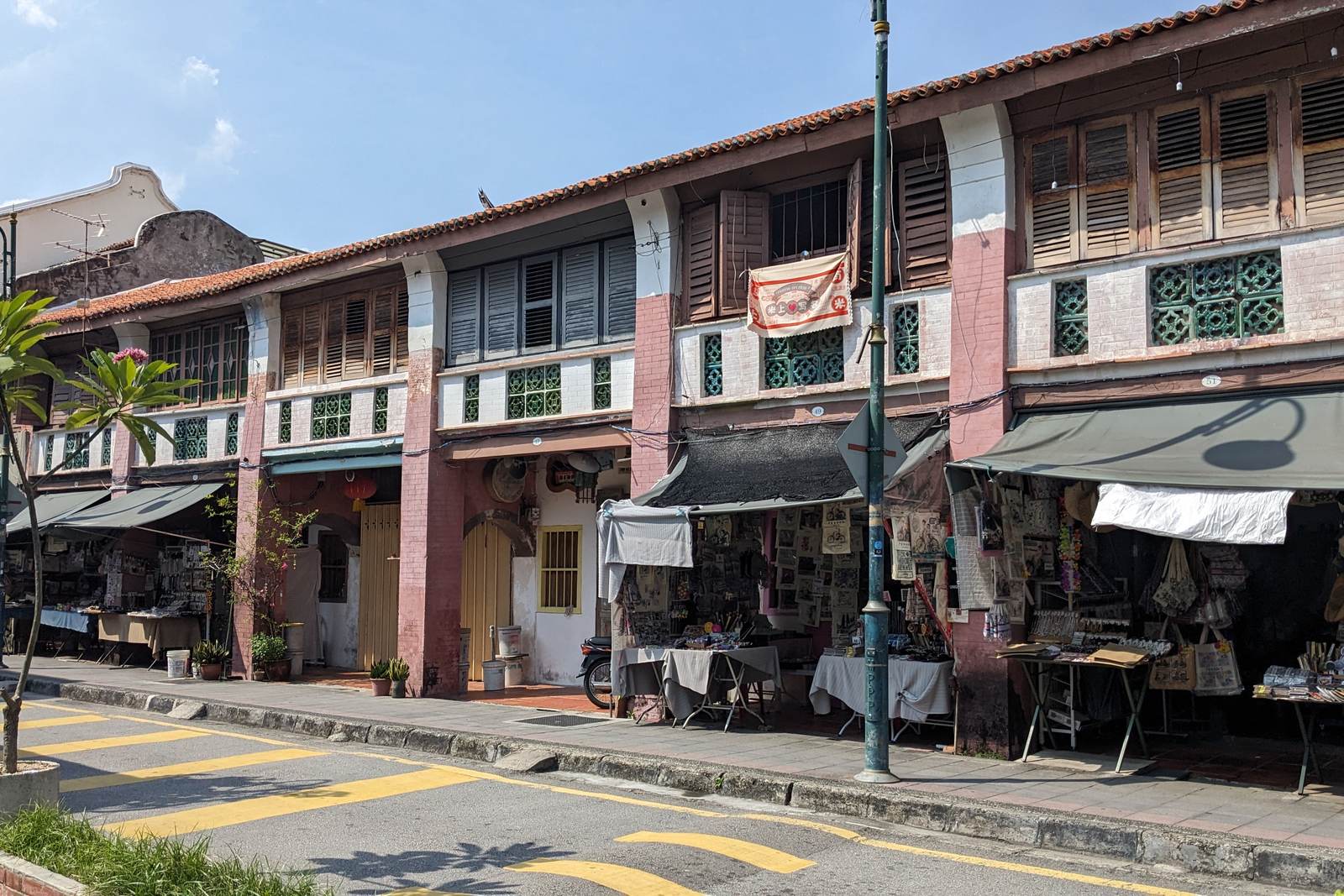
philip.mallis, Wikimedia Commons; cropped and resized by ChapterWalks · CC BY-SA 2.0
An audio walk across George Town's old free port, from Fort Cornwallis past a church, temples and a mosque to the clan houses and a jetty village on the sea.
Narration in English · Stop 1 is free
- 8 stops
- 1.9 km (1.2 mi)
- About 80 minutes
- Easy city route
Stop 1 · Fort Cornwallis and the Esplanade
Stop 1 is free. Listen before you buy.
Read Stop 1Hide Stop 1 text
Transcript · Stop 1
A free port grew up behind this sandy point, and it is still a working town, its shophouses lived in and its temples, mosques and churches in use. Several places ahead are working places of worship that ask visitors to dress modestly; any visit is on their own terms, and this walk goes inside nothing.
In front of you, across the moat park, runs the long, low south west wall of Fort Cornwallis. To your left opens Padang Kota Lama, the Esplanade.
In 1786 Francis Light, a trader working for the East India Company, set up a settlement here by arrangement with the Sultan of Kedah. His marines came ashore on this sandy point on 17 July and began clearing the forest. A few weeks later, on 11 August, the flag went up. The island was named Prince of Wales Island, after the Prince of Wales, on the eve of his birthday, and the town George Town, after King George the Third.
There is a story, told since at least the 1860s, that Light hurried the clearing by firing a cannon loaded with silver dollars into the forest.
The Company ran the town as a free port: traders paid no duties, and people from all over were encouraged to settle. Three months after the flag went up Light wrote that the inhabitants were increasing very fast, "every one building as fast as they can". Since 2008 the old town has been a World Heritage site, together with Melaka.
The first fort, laid out on this spot within weeks of the landing, was a timber stockade. It was rebuilt in brick in the early 1800s. The moat was filled in about a century ago; it has been dug out and flooded again, and the fort reopened after its restoration in 2026. The fort charges for entry; this walk stays outside.
Lebuh Light is busy. Ahead, the five foot ways, the covered walkways in front of the shops, are often blocked, so you will step into the road: watch the traffic. Carry water and a hat, and shelter under the five foot ways in a downpour.
Turn left along Lebuh Light, with the Esplanade on your right, to the corner where Jalan Masjid Kapitan Keling begins. Cross Lebuh Light there with care, follow that street to the next corner, and turn right.
An audio walking tour of George Town from Fort Cornwallis past St George's Church, the Goddess of Mercy Temple, the Sri Mahamariamman Temple and the Kapitan Keling Mosque, through the clan houses and shophouses to the Chew Jetty, at your own pace
George Town grew up from 1786 as a free port of the East India Company on the island of Penang, and since 2008 its old core has been a UNESCO World Heritage Site, inscribed together with Melaka. The walk begins outside Fort Cornwallis, on the point where the Company's marines landed, and goes on to St George's Church, which the Company paid for, and to the Goddess of Mercy Temple, a Chinese temple of about 1800 whose site the Company gave to the temple's founders. A few streets further on stand the Sri Mahamariamman Temple, which grew from a shrine of 1801 into a temple in 1833, and the Kapitan Keling Mosque, founded by the Company's Muslim sepoys and enlarged in 1916.
The walk then turns into the streets of the Chinese clans. On Lebuh Cannon a passage leads to the square of the Khoo clan, whose association was founded in 1835 and whose clan house was built again after a fire in 1901; on Lebuh Armenian the gateway of the Cheah clan faces rows of shophouses with their covered five foot ways, the shop below and the home above. It ends on Pengkalan Weld, Weld Quay, laid out on ground reclaimed from the sea during the 1880s, at the mouth of the Chew Jetty, one of the clan jetties where families still live in timber houses on stilts over the water.
Route notes
Route and itinerary
About each stop · narration stays in the app
Fort Cornwallis and the Esplanade
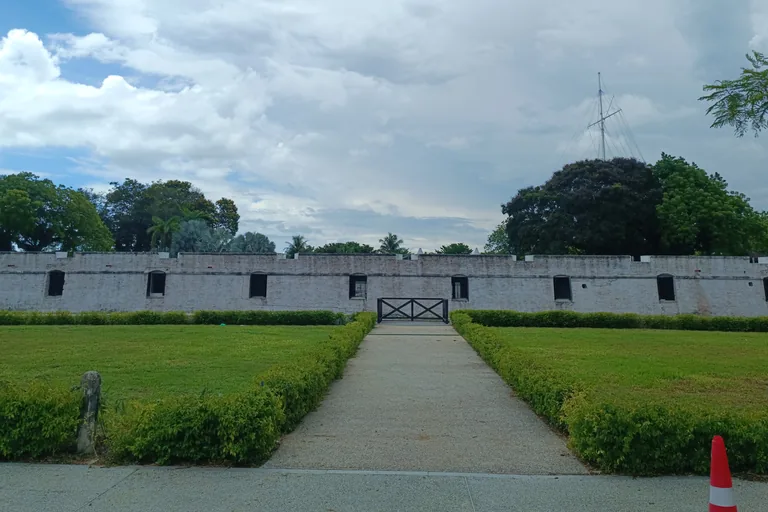
Photo: LEE 003 · Wikimedia Commons source · CC BY 4.0 · Cropped to the recorded 3:2 source rectangle and resized from the exact hash-bound source input. Fort Cornwallis stands on the point where George Town meets the sea, beside the open green of Padang Kota Lama, the Esplanade, and this stop faces its long south west wall from the pavement of Lebuh Light.
The route begins here for the fort's working life: the heritage agency's guide records that its heaviest guns stood on outworks beyond the moat on the sides facing the sea, with smaller ones on the ramparts, that none was ever fired in defence though they were fired regularly for salutes, and that the fort was declared a National Monument in 1976.
The fort charges for entry and the walk stays outside it; Lebuh Light carries heavy traffic, and no pedestrian crossing is mapped where the route crosses it at Jalan Masjid Kapitan Keling, so take care.
St George's Church
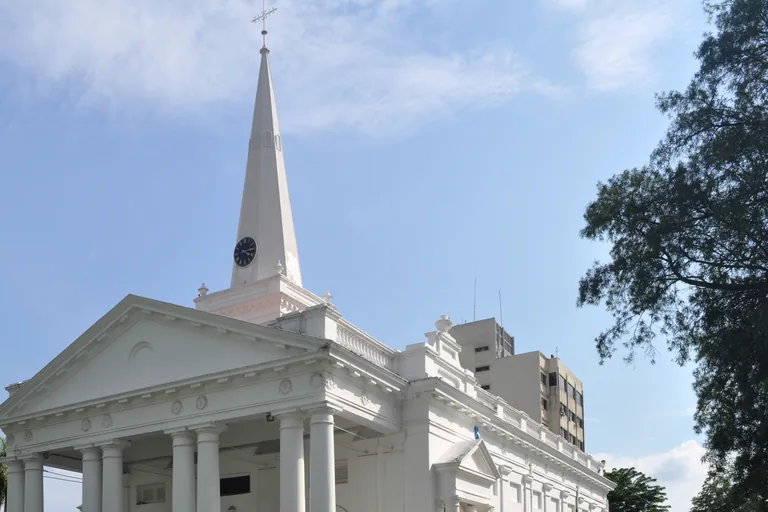
Photo: Paweł 'pbm' Szubert · Wikimedia Commons source · CC BY-SA 4.0 · Cropped to the recorded 3:2 source rectangle and resized from the exact hash-bound source input. St George's Church is the Anglican church on Lebuh Farquhar in George Town, set back behind a railing and a lawn, with a memorial to Francis Light in front of it.
The route stops here for the building's design: the heritage agency's guide records that it was modelled on St George's Church in Madras by Lieutenant Colonel James Lilliman Caldwell of the Madras Engineers and built by Lieutenant Robert Smith of the Bengal Engineers.
The church is a place of worship in regular use, and the walk tells it from the street outside the railing; any visit is at the church's discretion.
The Goddess of Mercy Temple
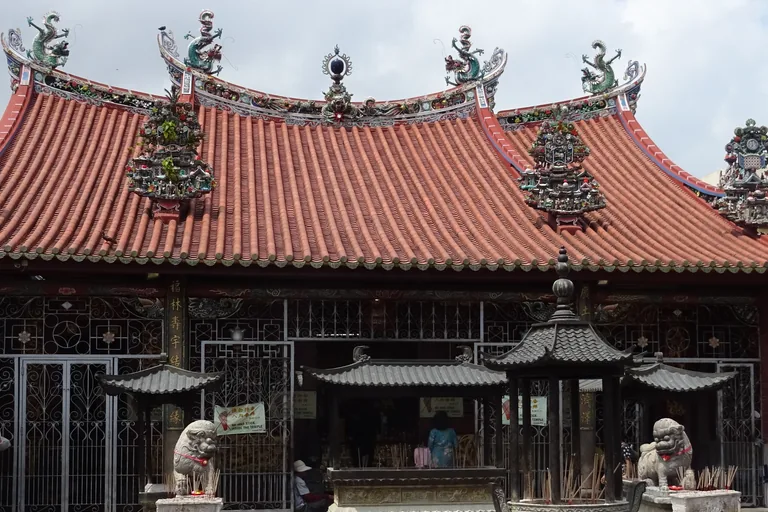
Photo: Christophe95 · Wikimedia Commons source · CC BY-SA 4.0 · Cropped to the recorded 3:2 source rectangle and resized from the exact hash-bound source input. The Goddess of Mercy Temple, known locally as Kuan Yin Teng, is a Chinese temple on Jalan Masjid Kapitan Keling in George Town, standing back behind a wide paved forecourt.
The route stops here for the temple's setting: the Site and Space history of the temple says the site was chosen for its higher ground, a gentle knoll recognised as a dragon in the principles of feng shui, and that the Chinese Town Hall built beside it in the 1880s later took over the economic and social work the temple had done for the community.
The temple is in daily use by worshippers, so the walk stays at the street edge of the forecourt and goes no further; when moving on, cross the street with care.
The Sri Mahamariamman Temple
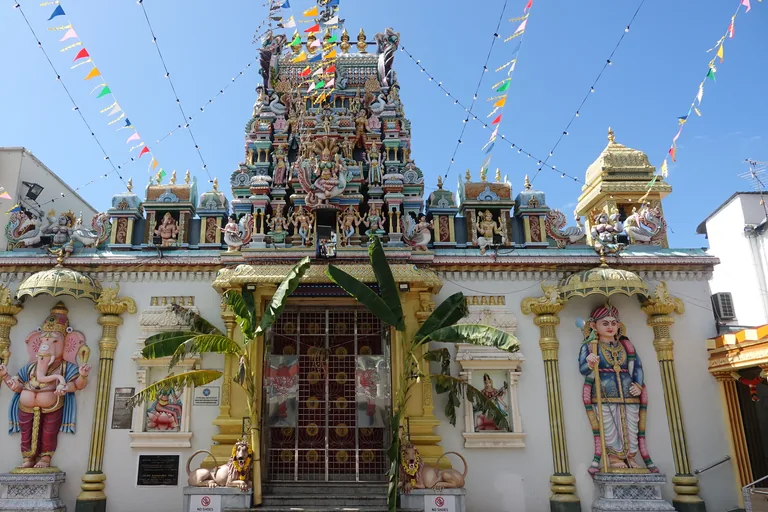
Photo: Sin-siōng · Wikimedia Commons source · CC BY-SA 4.0 · Cropped to the recorded 3:2 source rectangle and resized from the exact hash-bound source input. The Sri Mahamariamman Temple is the Hindu temple of the goddess Mariamman on Lebuh Queen in George Town, with a second, back entrance on Jalan Masjid Kapitan Keling.
The route stops here for the tower over its entrance, built in the south Indian Dravidian style: the Hindu Endowments Board's page says the tower carries soldiers and floral decoration among its figures, that the temple is consecrated anew about once every twelve years in keeping with Hindu tradition, and that for its restoration of 1978 to 1980 a sculptor and two assistants were brought from an academy of sculptors near Chennai.
The temple is a place of worship in daily use, and the walk tells it from the far side of Lebuh Queen, a narrow street of shopfronts, without going in.
The Kapitan Keling Mosque
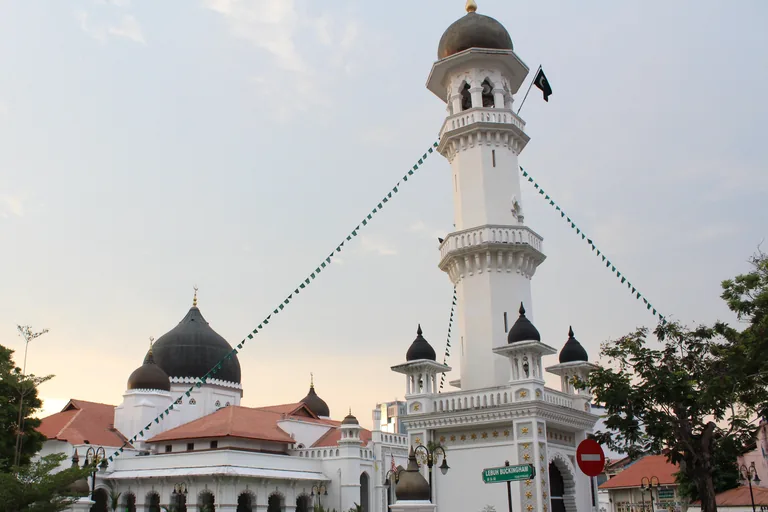
Photo: Syafiqcool88 · Wikimedia Commons source · CC BY-SA 4.0 · Cropped to the recorded 3:2 source rectangle and resized from the exact hash-bound source input. The Kapitan Keling Mosque stands in walled grounds on Jalan Masjid Kapitan Keling in George Town, the street that carries its name, and this stop looks across its railing at the domes and the minaret.
The route stops here for the mosque that came before the present building: the Site and Space history says the earlier building was a single storey mosque with minarets at each corner, an outer colonnade and a low scalloped wall, set among shophouses and reached through narrow gateways.
The mosque is a place of worship in daily use and the walk stays outside its railing; modest dress is expected, and any visit is at the mosque's discretion.
The Clan Houses of Lebuh Cannon
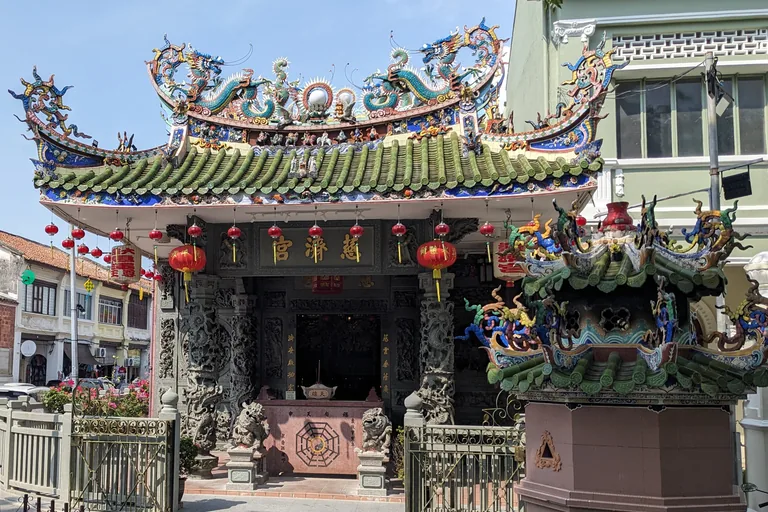
Photo: philip.mallis · Wikimedia Commons source · CC BY-SA 2.0 · Cropped to the recorded 3:2 source rectangle and resized from the exact hash-bound source input. Lebuh Cannon is a short street in George Town where a passage between the houses leads to the square of the Khoo clan's temple, with the temples of the Yap clan at the corner of Lebuh Armenian.
The route stops here for the clan as an institution: the heritage agency's guide to the clan houses records that in 1907 the Khoo clan set up a two grade elementary school in its clan house, which moved in 1914 to houses on Lebuh Victoria and took the name Sin Kang Primary School, and that the clan still gives educational aid and scholarships to its younger members.
The Khoo clan temple charges for entry beyond the passage and the walk stays in the street outside; Lebuh Cannon is narrow, so stand clear of passing cars and motorcycles.
The Shophouses of Lebuh Armenian
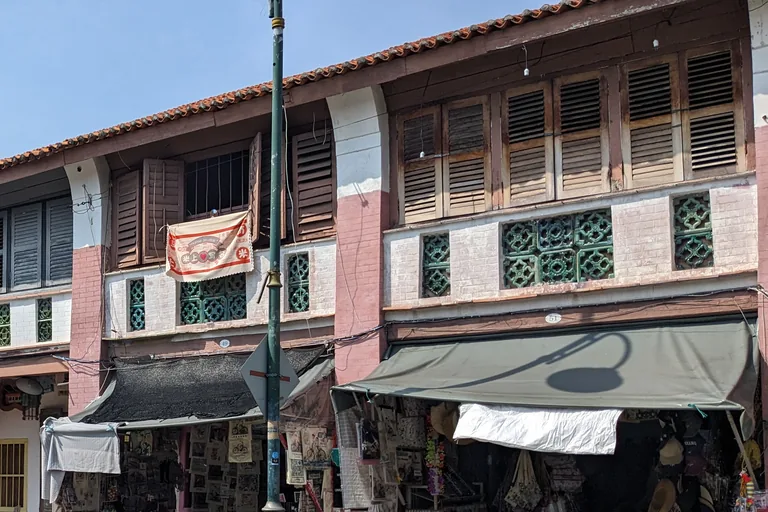
Photo: philip.mallis · Wikimedia Commons source · CC BY-SA 2.0 · Cropped to the recorded 3:2 source rectangle and resized from the exact hash-bound source input. Lebuh Armenian is a street of two and three storey shophouses in George Town, and this stop stands on its pavement across from the gateway of the Cheah clan's compound.
The route stops here for how the shophouses were built: the heritage agency's page says most used soft burnt clay bricks, with lime plastered walls and terracotta floors that helped keep the rooms cool, that the earlier houses were short, with a kitchen and an open airwell at the back, and grew longer over time with an airwell between each pitched roof, and that the town's shophouses fall into six main styles, from the Early Penang Style of the 1790s onwards.
The covered walkways along the shophouse fronts are often blocked, so watch the traffic whenever stepping out into the street, and keep to the pavement opposite the gateway.
The Chew Jetty
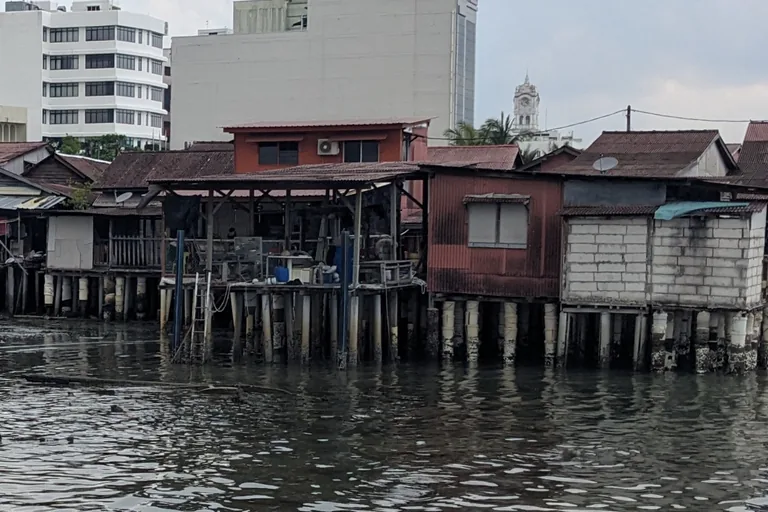
Photo: philip.mallis · Wikimedia Commons source · CC BY-SA 2.0 · Cropped to the recorded 3:2 source rectangle and resized from the exact hash-bound source input. The Chew Jetty is one of the clan jetties on Pengkalan Weld, Weld Quay, in George Town, a settlement of timber houses on stilts along a walkway over the sea, and the walk ends on the quay at its mouth.
The route ends here for the clan's village on the water: the Clan Jetties article says the Chew clan came from Xinglinshe in Tong'an, Xiamen, that the jetty is the focal point of the yearly celebrations of the Jade Emperor's birthday on the ninth day of the Chinese New Year and has its own places of worship for Chinese deities, and the heritage agency lists the Chew Jetty in its Category II, of special interest and warranting every effort to preserve it.
The jetty is made up of people's homes, and the walk ends on the forecourt at its mouth without going onto it; Pengkalan Weld carries heavy traffic in both directions, with no marked pedestrian crossing at the jetty, so cross with great care.


Before you go
The walk runs one way for about 1.9 km on foot across the old core of George Town: from Fort Cornwallis on Lebuh Light along the edge of the Esplanade to St George's Church on Lebuh Farquhar, south along Jalan Masjid Kapitan Keling to the Goddess of Mercy Temple, through Lebuh China and Lebuh Queen to the Sri Mahamariamman Temple, by Lebuh Chulia to the Kapitan Keling Mosque, down Lebuh Cannon and along Lebuh Armenian, then across Lebuh Pantai and down to Pengkalan Weld, where it ends at the Chew Jetty.
Access and surfaces
A level, one way walk of about 1.9 km on foot; allow about an hour and twenty minutes with the audio.
The streets are flat, but the covered walkways along the shophouse fronts are often blocked by goods, barriers and parked motorcycles, and their levels change from one shop to the next, so walkers often step out into the road; no step free route was checked.
Traffic is heavy on Lebuh Light at the start and on Pengkalan Weld before the last stop; no pedestrian crossing is mapped where the route crosses either street, so cross with care.
The town is hot and humid all year and heavy rain can come suddenly: walk early or late in the day, take water and a hat, and wait out a downpour under the covered walkways.
Public toilets are at the Esplanade, near the start.
The walk goes inside nothing: Fort Cornwallis and the Khoo clan temple charge for entry; the church, the temples and the mosque are places of worship in daily use, where modest dress is expected and visits are at their discretion.
The clan jetties are people's homes, and the walk ends at the mouth of the Chew Jetty, on the quay.
Plan the walk
- How long is the George Town audio walking tour?
- Allow about 80 minutes. The route runs one way for 1.9 km (1.2 mi) with 8 stops, including walking and listening time, on level streets.
- Where does the George Town tour start and end?
- It starts on Lebuh Light, facing the south west wall of Fort Cornwallis beside the Esplanade, and ends on Pengkalan Weld, Weld Quay, at the mouth of the Chew Jetty, one of the clan jetties on the waterfront.
- Does the walk go inside the fort, the temples or the jetty?
- No. The walk is told from the streets and the quay and goes inside nothing. Fort Cornwallis and the Khoo clan temple charge for entry; the church, the temples and the mosque are places of worship in daily use, where modest dress is expected and visits are at their discretion. The clan jetties are people's homes, and the walk ends at the mouth of the Chew Jetty.
- Is the route step free?
- No step free route was checked. The streets are level, but the covered walkways along the shophouse fronts are often blocked and change level from one shop to the next, so you will often walk in the road. Lebuh Light and Pengkalan Weld carry heavy traffic, and no pedestrian crossing is mapped where the route crosses them.
Same region
More tours in Malaysia
$4.99Stop 1 is free