Hanoi · Hanoi, Vietnam
Hanoi — The Guild Streets of the Old Quarter
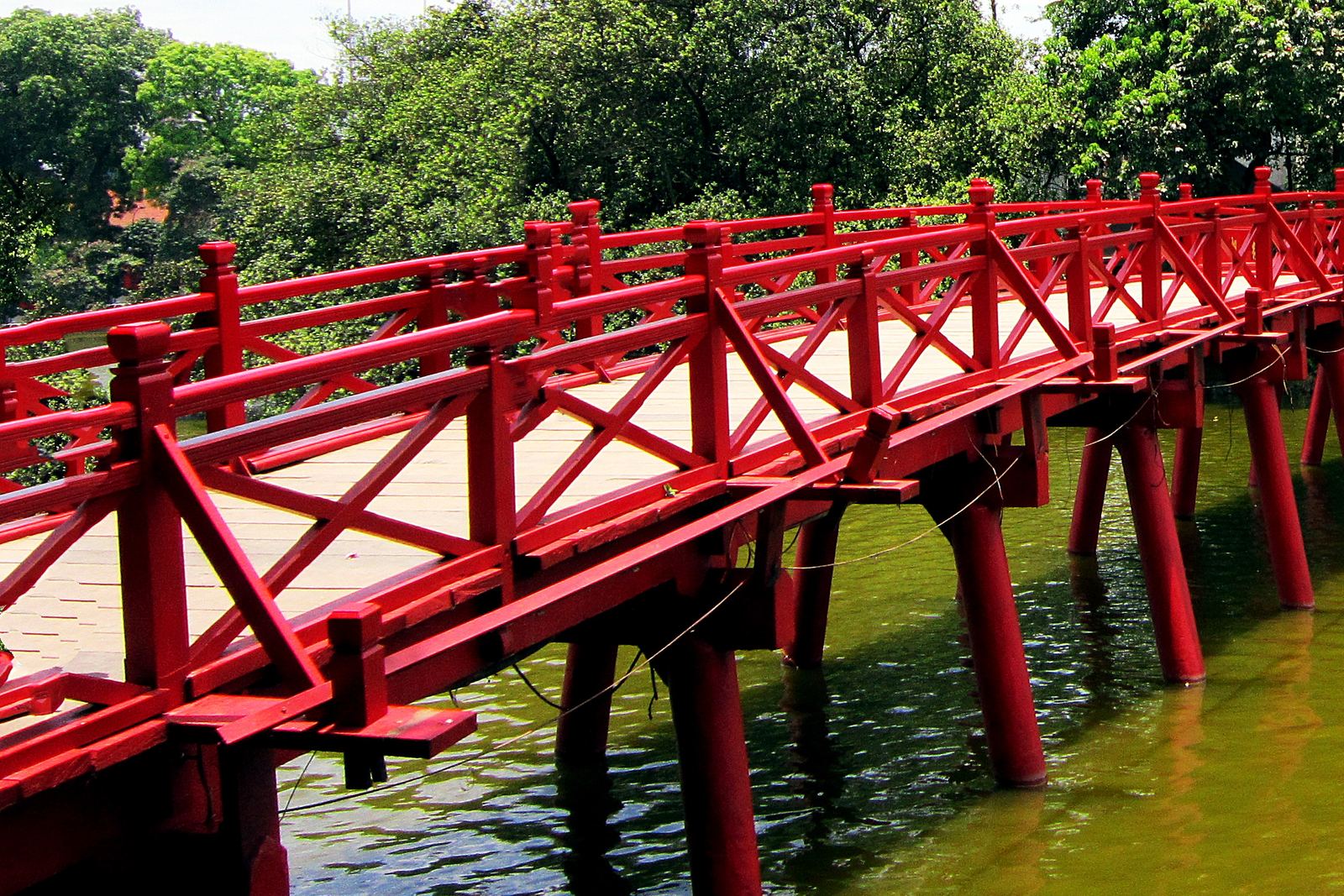
Bùi Thụy Đào Nguyên, Wikimedia Commons; cropped and resized by ChapterWalks · CC BY-SA 3.0
An audio walk through the guild streets of Hanoi's Old Quarter, from Hoan Kiem Lake past a goldsmiths' communal house and an old city gate to Dong Xuan market.
Narration in English · Stop 1 is free
- 7 stops
- 2 km (1.2 mi)
- About 100 minutes
- Easy city route
Stop 1 · The Lake Shore at the Ngoc Son Gate
Stop 1 is free. Listen before you buy.
Read Stop 1Hide Stop 1 text
Transcript · Stop 1
Hanoi grew up as two towns side by side: the walled seat of its rulers, and beside it a town of merchants and craftsmen, where each street was known by what it made or sold. Those streets are still here, narrow and crowded. This walk follows them north from the lake, one trade at a time.
Beside the gate stands a stone tower with a writing brush at its tip. A short paved way runs past it to a red wooden bridge, and the bridge crosses the water to a small island and its temple among the trees.
This is Hoan Kiem, the lake of the returned sword. The lake's name comes from a legend. In the telling a French scholar recorded in the nineteenth century, a king out in a boat on the lake met a great turtle, which seized his sword and vanished into the water. The island is Ngoc Son, the jade mountain. Since 2013 the lake and the Ngoc Son temple have been a special national monument, as the culture ministry's newspaper reports. The tower's inscriptions, as that scholar translated them, name it the obelisk of the brush and give it a task: to write on the blue sky.
North of the lake, between the old citadel of the rulers and the Red River, lies the quarter of merchants and craftsmen. As the geographer Michael Waibel writes, it has been there since the city was founded, in 1010. A French guide of the early twentieth century described it as the former merchant suburb of the official city in the citadel. The name Hanoi itself was given in 1831.
Walk this route by day. The traffic here is mostly motorbikes: cross at a steady walking pace, without stopping or running, so riders can see where you will be. Parked motorbikes and goods often fill the pavements, so at times you will walk at the edge of the road. Keep bags and phones on the side away from the traffic. From June to September expect heavy showers and humid heat, and carry water. On weekend evenings parts of the quarter and the lake shore are closed to traffic and fill with people. Please do not photograph police or military posts. The temples on the way are places of worship, so keep your voice low. The island temple keeps its own tickets; going in is up to you, and this walk tells it from the shore.
Now turn right and follow the shore road north, with the lake on your left. As you go, look back across the water for the small Turtle Tower on its own island. The road bends west along the north end of the lake. At the lake's far corner, where the road turns south again along the water, cross it to the far pavement: this is the walk's busiest crossing, so take your time and cross at a steady pace. Then walk a short way north on that pavement to a junction of old streets, and turn left into Hang Gai. Stop a few steps into it.
An audio walking tour of Hanoi's Old Quarter, north from the shore of Hoan Kiem Lake through Hang Gai and Hang Bac past the Bach Ma temple and O Quan Chuong to Hang Ma and Dong Xuan market, at your own pace
Hanoi's Old Quarter grew up beside the citadel of its rulers as a town of merchants and craftsmen, and the geographer Michael Waibel dates it to the founding of the city in 1010. Its streets took the names of what was made or sold in them, and to this day many of those names open with hang, the word for goods. This walk of about 2 km heads north from the shore of Hoan Kiem Lake, where a stone tower topped by a writing brush stands at the gate to the island temple of Ngoc Son, into Hang Gai, which the Hanoi writer Bang Son remembered as a street of hemp nets and lines.
It goes on along Hang Bac, the silver street, to the old street door of the Kim Ngan communal house of the goldsmiths, and to the Bach Ma temple of the white horse legend, counted among four temples that guard the old capital. It comes out at O Quan Chuong, which Nhan Dan reports is the last of the city wall's gates still standing, follows Hang Chieu to Hang Ma, which began as a street of votive paper and later took in the makers of Mid Autumn lanterns, and ends at the gabled front of Dong Xuan market, a market of iron halls from 1889 that was rebuilt after a fire in 1994.
Route notes
Route and itinerary
About each stop · narration stays in the app
The Lake Shore at the Ngoc Son Gate
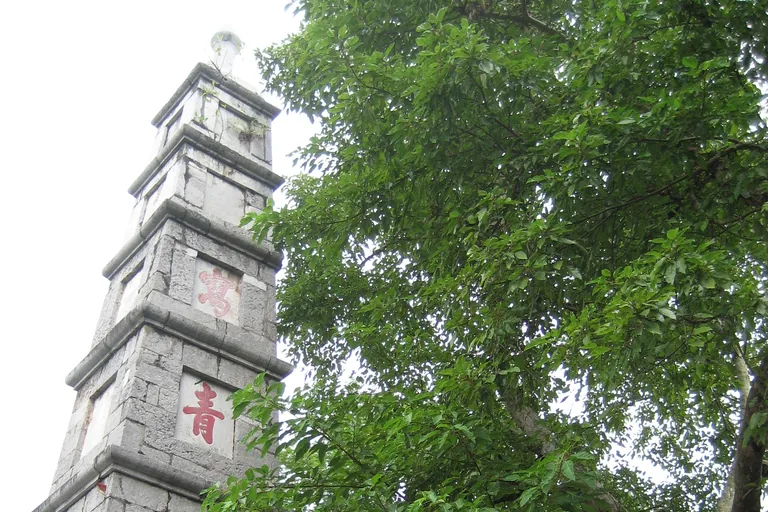
Photo: Minh Phượng (Neweco) · Wikimedia Commons source · CC BY-SA 3.0 · Cropped to the recorded 3:2 source rectangle and resized from the exact hash-bound source input. The walk begins on the shore plaza of Hoan Kiem Lake at the gate of the approach to the Ngoc Son temple, where a stone tower crowned by a writing brush stands beside a paved path that leads to a red bridge and the temple's small wooded island.
The route starts here for the lake's name and the quarter's age: in the version a French scholar wrote down in the nineteenth century, a great turtle in the lake took a king's sword back into the water, which is why the name Hoan Kiem speaks of a returned sword; the culture ministry's newspaper reports that the lake and the temple were made a special national monument in 2013; and the geographer Michael Waibel dates the merchants' and craftsmen's quarter north of the lake to the founding of the city in 1010.
The stand is on a level, open plaza a few metres from a busy road; come by day, cross the motorbike traffic at an even pace without stopping or running, and treat the island temple, which keeps its own tickets, as an option the walk does not need.
Hang Gai
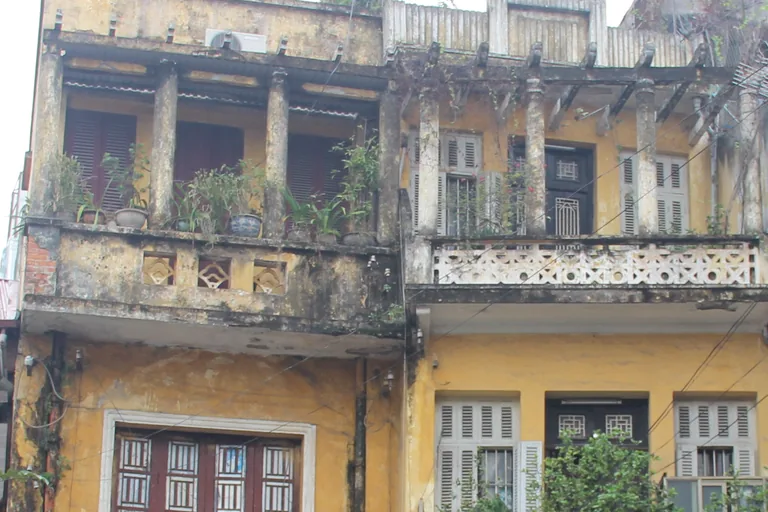
Photo: Gary Todd · Wikimedia Commons source · CC0 1.0 · Cropped to the recorded 3:2 source rectangle and resized from the exact hash-bound source input. Hang Gai is a narrow trade street that runs west from a busy junction just north of the lake, with tall, narrow old house fronts, shutters and balconies above its awnings.
The route stops here for the old trade streets: the Hanoi writer Bang Son tied the street's name, hemp goods, to the hemp fishing lines and nets once sold there, an essay on Vietnam's government portal explains the quarter's old name, thirty six streets, as a count of the guilds of the old capital, and the city's regulation of 2013 lists 79 streets in the quarter.
Parked motorbikes and goods often take the narrow pavements, so you may stand at the edge of the road; nothing is entered here, and the way on crosses the junction to the east.
Hang Bac and the Kim Ngan Communal House
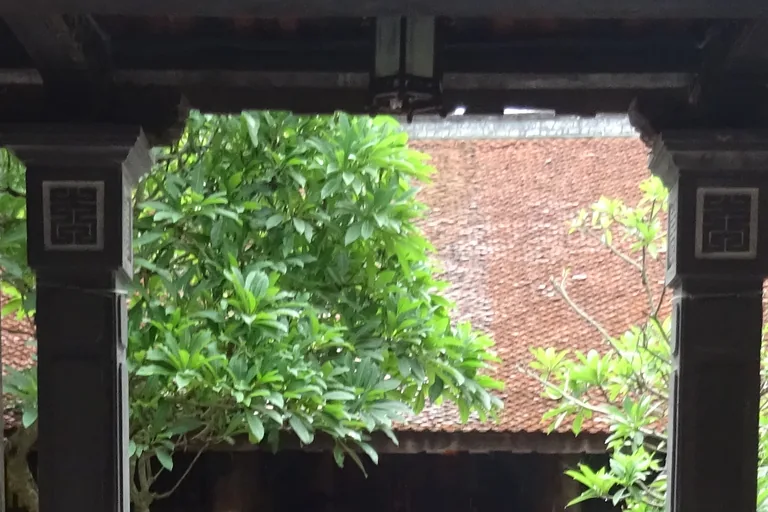
Photo: Christophe95 · Wikimedia Commons source · CC BY-SA 4.0 · Cropped to the recorded 3:2 source rectangle and resized from the exact hash-bound source input. Kim Ngan is a communal house on Hang Bac, the silver street, reached through an old street door between the shopfronts at numbers 42 and 44.
The route stops here for the silver workers: Vietnamese press accounts say that settlers from Chau Khe village made Hang Bac a street of silver casting and money changing and founded the communal house, which became a meeting place for the capital's goldsmiths, and the geographer Michael Waibel explains the quarter's narrow, deep houses by plots split again and again over the centuries.
The communal house is a working place of worship, seen only from the street with no promise that its door stands open; the restored old house at 87 Ma May, close by, keeps its own tickets and is a detour the walk leaves to you.
The Bach Ma Temple
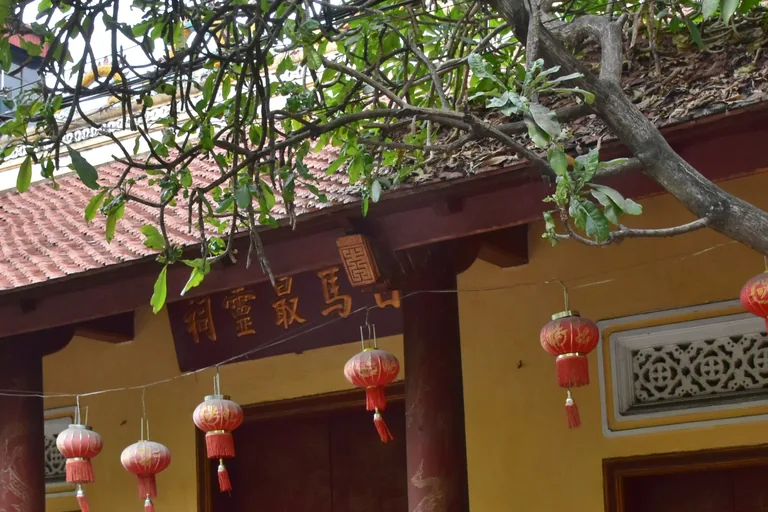
Photo: Richard Mortel · Wikimedia Commons source · CC BY 2.0 · Cropped to the recorded 3:2 source rectangle and resized from the exact hash-bound source input. The Bach Ma temple stands on a corner of Hang Buom, a low yellow front with red columns, hanging lanterns and a gilded name board above the doors.
The route stops here for the white horse of the temple's legend: as the state portal on the capital's history tells the story, a white horse from the temple showed the king Ly Thai To where to raise the walls of his new capital; Bach Ma is counted as the guardian temple of the east of the old capital, and in 2022 it and the other three guardian temples became a special national monument together.
It is a working temple seen from the street, so speak quietly there; the walk does not go in, its doors may or may not be open, and motorbikes pass and turn at this crossroads.
O Quan Chuong
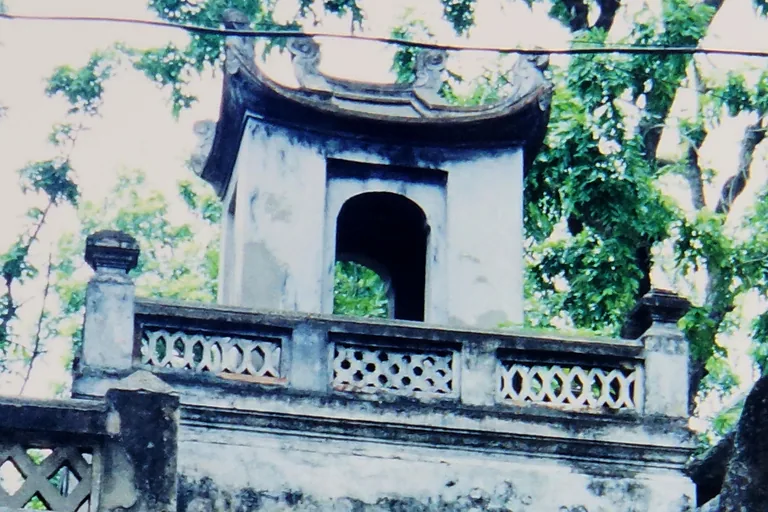
Photo: lienyuan lee · Wikimedia Commons source · CC BY 3.0 · Cropped to the recorded 3:2 source rectangle and resized from the exact hash-bound source input. O Quan Chuong is an old gate tower of brick and weathered plaster at the eastern end of Hang Chieu, with arched openings below, topped by a small roofed lookout.
The route stops here for the city wall: VnExpress reports that in 1749 the lord Trinh Doanh rebuilt the earth rampart that ringed the city, the national daily Nhan Dan dates the gate to that year and names it the last survivor of the twenty one gates counted by the old geographies, and VTC News says it took its present size when it was rebuilt in the early 1800s.
The walk stays on the inner side of the gate, on Hang Chieu, where motorbikes ride through the arches, and it never crosses the busy main road beyond.
Hang Ma
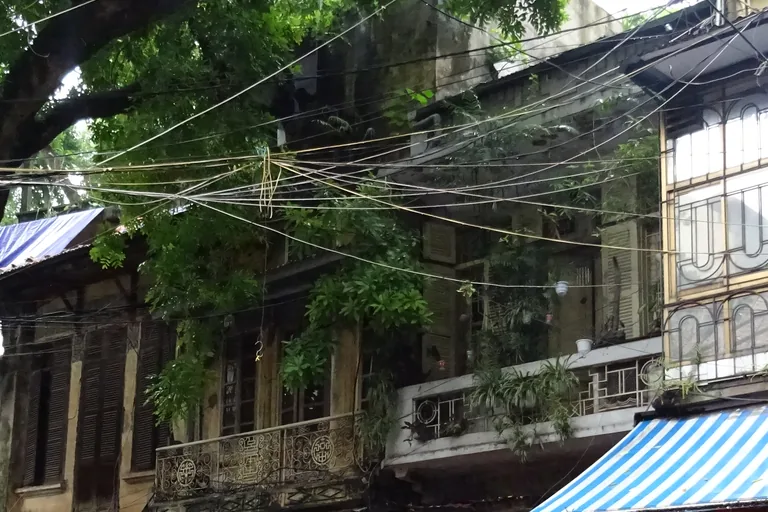
Photo: Christophe95 · Wikimedia Commons source · CC BY-SA 4.0 · Cropped to the recorded 3:2 source rectangle and resized from the exact hash-bound source input. Hang Ma is a two way street of shopfronts full of paper goods, toys and decorations, below old house fronts with wooden shutters and iron balconies.
The route stops here for the paper crafts: VTC News describes Hang Ma as a craft street of votive paper, offerings of paper used in worship, joined late in the nineteenth century by makers of papier mache and lanterns from Quach Giai village, and Hanoi's regulation for the Old Quarter names it among the traditional craft streets.
Goods and parked motorbikes often fill the pavement, so keep to the side of the road with care and hold bags away from the traffic; nothing is entered or needs to be bought, and the street is crowded in the weeks before the Mid Autumn festival and Tet.
Dong Xuan Market
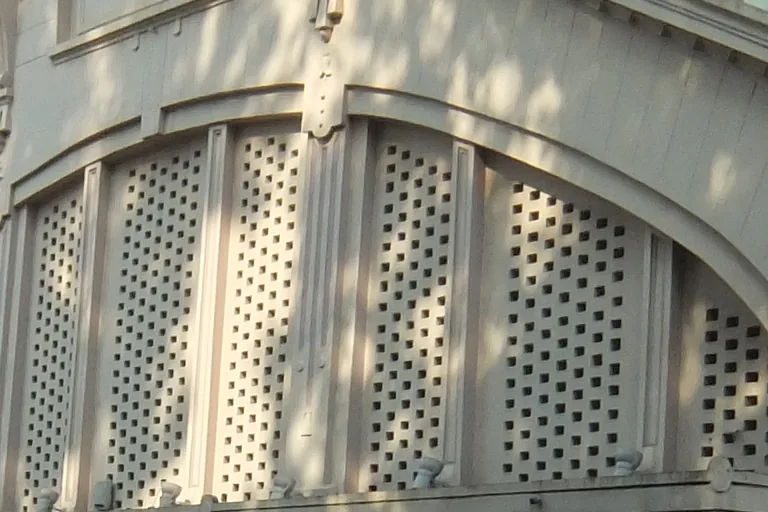
Photo: shankar s. · Wikimedia Commons source · CC BY 2.0 · Cropped to the recorded 3:2 source rectangle and resized from the exact hash-bound source input. Dong Xuan market is the end of the walk, a long cream coloured front of high gables whose arches are filled with pierced screens, with a newer market building rising behind it.
The walk ends here for the market of the French period: a French travellers' guide of the early twentieth century describes the iron halls of 1889, VietNamNet reports that after a great fire in 1994 the market was rebuilt behind its old front, and Hanoi's regulation for the Old Quarter calls the whole quarter a national historic monument.
In daytime traders, goods and motorbikes fill the market and the streets around it; going inside is your choice, and the lake shore lies about 700 metres back to the south on level streets.


Before you go
The walk is a line of about 2 km through the Old Quarter on level streets, heading north from the lake.
From the shore by the Ngoc Son gate it follows the lake road to the lake's north west corner and crosses into Hang Gai, then runs east a block in from the shore and north to Hang Bac, north again by Ta Hien to Hang Buom and the Bach Ma temple, up to the old gate at the end of Hang Chieu, west along Hang Chieu to Hang Ma, and back to Dong Xuan street for the market.
The audio gives each turn as you reach it.
Access and surfaces
Allow about 100 minutes with the audio, over about 2 km between the stops.
The streets are flat with no steps on the route, but no step free route was checked, and parked motorbikes and goods often take the pavements, so at times you keep to the edge of the road.
Motorbike traffic is heavy: cross at an even pace without stopping or running, and hold bags and phones away from the road side; the first crossing, at the lake's north west corner, is the busiest.
Between June and September heavy showers and humid heat are likely, so carry water, and walk by day.
Some streets of the quarter and the shore of the lake close to traffic on weekend evenings and fill with walkers.
The walk goes into nothing: the temples on the way are working places of worship, and the island temple and a restored old house on Ma May keep their own tickets.
The market at the end is crowded and busy with goods being moved.
Plan the walk
- How long is the Hanoi audio walking tour?
- Allow about 100 minutes. The route runs one way for 2 km (1.2 mi) with 7 stops, including walking and listening time, on level streets.
- Where does the Hanoi walk start and end?
- It starts on the shore of Hoan Kiem Lake at the gate of the approach to the Ngoc Son temple, on Dinh Tien Hoang, and ends outside Dong Xuan market, about 700 m north of the lake by level streets.
- Does the walk go into the temples?
- No. The temples and the communal house on the way are working places of worship, seen from the street, and the walk promises no opening times. The island temple of Ngoc Son and the restored house at 87 Ma May keep their own tickets; visiting them is up to you.
- Is the Hanoi route step free?
- The streets are flat and there are no steps on the route, but no step free route was checked, and parked motorbikes and goods often block the pavements.
- When should I walk the Hanoi route?
- By day. Between June and September heavy showers and humid heat are likely, and on weekend evenings some streets of the quarter and the shore of the lake close to traffic and fill with walkers.
Same region
More tours in Vietnam and Laos
$4.99Stop 1 is free