Dubai · Emirate of Dubai, United Arab Emirates
Dubai — Old Dubai Across the Creek
An audio walk through old Dubai, from the wind tower lanes of Al Fahidi past the fort and through the souq, then by abra across the creek to the spice souq.
Narration in English · Stop 1 is free
 Tour no. 46
- Stops
- 8
- Distance
- 1.9 km (1.2 mi)
- Time
- About 80 minutes
- Route
- Easy city route
Listen before you buy
Stop 1 · Al Fahidi, the merchants' quarter
Stop 1 is free. Listen before you buy.
The walk
An audio walking tour of Dubai from the wind tower lanes of Al Fahidi past the fort and through the souq, then by abra across the creek to Deira, at your own pace
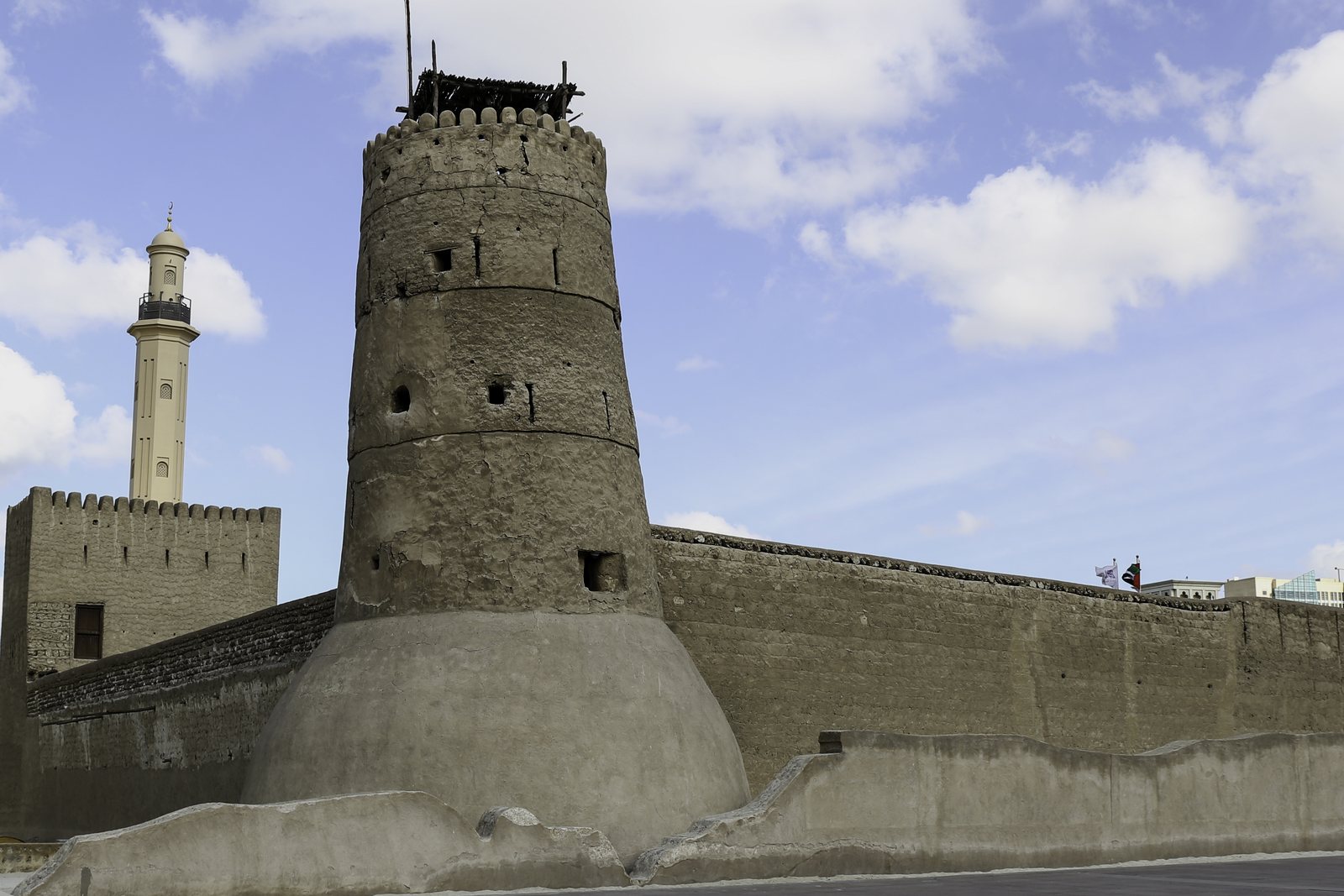
Old Dubai grew up on the two banks of its creek, and this walk crosses it. It begins in Al Fahidi Historical Neighbourhood, the quarter long called Al Bastakiya after Bastak, a district behind the Persian coast; merchant families from there and, by some accounts, from Lingeh and nearby towns built their houses in these lanes from about the start of the twentieth century, in the years when British records describe Lingeh's transit trade passing to Dubai. In the narrow lanes the square wind towers catch the breeze above the roofs and send it down into the rooms. Out on the street stands Al Fahidi Fort, square, with a tower at three of its four corners and parts of it commonly placed in the late eighteenth century; it has been a stronghold, a prison and the ruler's seat of government; it opened as a museum in 1971 and has been shut for restoration since 2021.
From the fort the route goes past the mosque and along a narrow lane of small shops into the Bur Dubai souq, a long arcade under a wooden roof where cloth from India and across Asia hangs in the doorways, and where the British survey of 1908 found the town's Indian merchants living. At the far end of the souq an abra, one of the small wooden ferry boats that have long joined the two banks, takes you across to Deira. There the walk pauses on the quay of a creek deepened by dredging in the years around 1960 for larger vessels, goes into the spice souq among sacks of dried roses, herbs and resins, and ends in the quiet lanes of Al Ras at Al Ahmadiya School, which a pearl merchant founded in 1912, beside Heritage House, a merchant's house with wind towers around a courtyard.
Route notes
Route and itinerary
About each stop · narration stays in the app
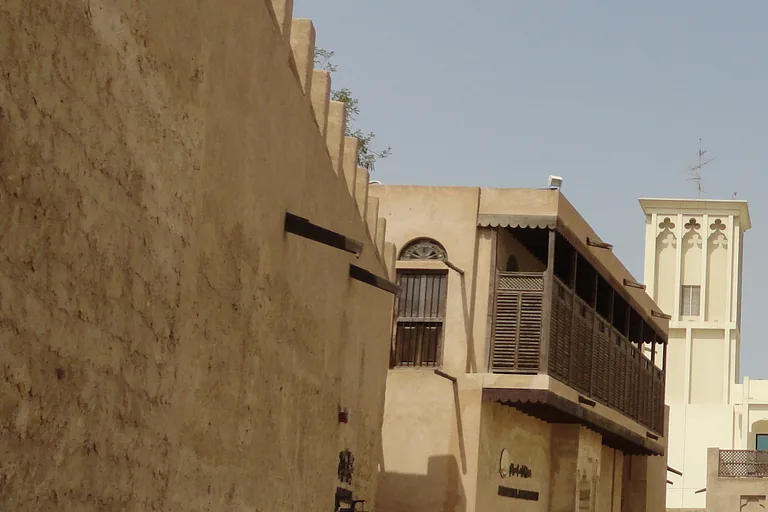
Photo: Fabio Achilli · Wikimedia Commons source · CC BY 2.0 · Cropped to the recorded 3:2 source rectangle and resized from the exact hash-bound source input. Al Fahidi, the merchants' quarter
This stop is at the southern edge of Al Fahidi Historical Neighbourhood, the quarter of wind tower houses on the Bur Dubai side of the creek that took its present name from the nearby fort in 2012 and was long known as Al Bastakiya. The route starts here for the merchants of the Persian coast: the British survey of 1908 counted Bastak and Lar within the inland country whose trade depended on the port of Lingeh, and the British records add that after the customs crisis of 1902 the confidence of Lingeh's merchants did not recover, and that the port was still declining in 1907. The forecourt borders a busy road and a roundabout, and many houses in the lanes are offices or private homes, while the galleries, cafés and small museums among them keep their own hours, so stay on the public lanes and check opening times locally.
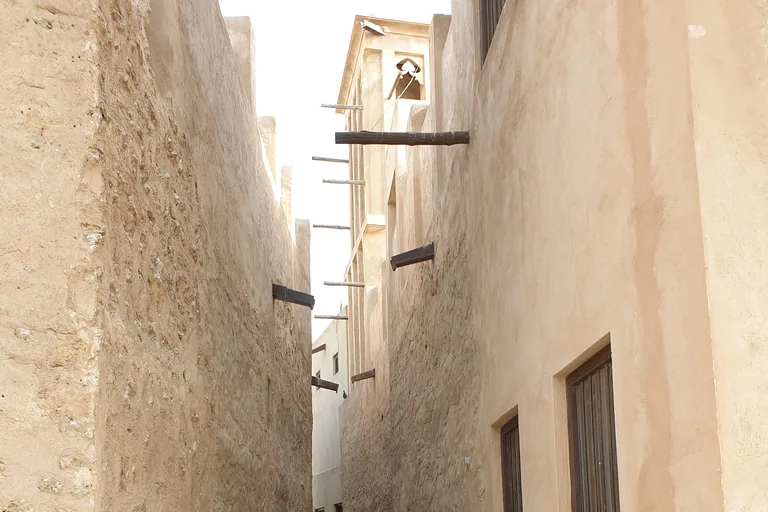
Photo: Aleksei Grin · Wikimedia Commons source · CC BY-SA 4.0 · Cropped to the recorded 3:2 source rectangle and resized from the exact hash-bound source input. A wind tower lane
This stop is a narrow paved lane inside Al Fahidi Historical Neighbourhood that bends a little between high walls of stone and plaster, under the square wind towers of the houses on either side. The route stops here for the study and the protection of these houses: the architect Peter Jackson's survey of one house, published as a short monograph in 1975, became a book on the merchant houses of Dubai in 2007, written with the social geographer Anne Coles, which extended the work to six other remaining houses and the Bastaki families who had lived in them. The quarter was also part of the stretch of the creek, from Shindagha to the end of Al Fahidi and taking in close to 700 traditional houses, that Dubai proposed for World Heritage listing as a traditional merchants' harbour, a nomination the UAE withdrew in 2018. The lane is narrow and the houses along it are private homes or offices, so keep to the lane, let others pass and do not look or photograph into doorways.
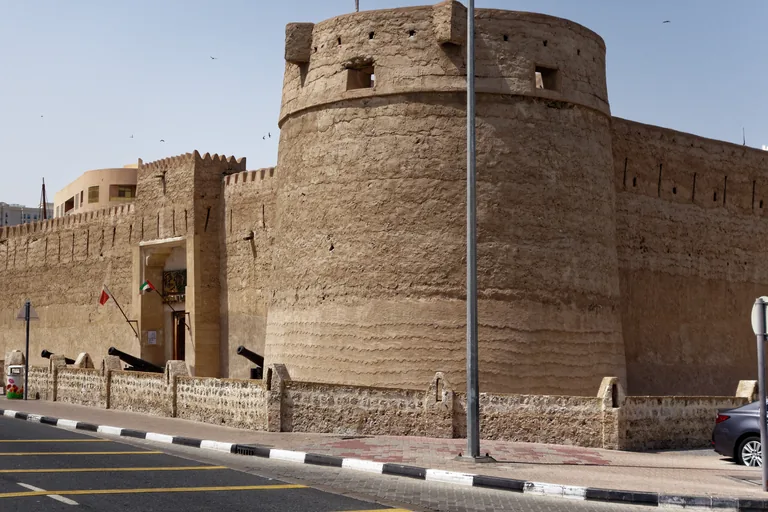
Photo: Kimon Berlin · Wikimedia Commons source · CC BY-SA 2.0 · Cropped to the recorded 3:2 source rectangle and resized from the exact hash-bound source input. Outside Al Fahidi Fort
Al Fahidi Fort is the walled fort on the Bur Dubai side of the creek, and the stop is on the pavement outside its east wall, near the main gate. The route stops here for the town the fort defended: the British survey of 1908 found that Dubai had once been walled, its wall by then in ruins, with a number of towers of defence still standing on the landward side, and the British records note that the General Treaty of Peace of 1820 was signed separately on behalf of Dubai's chief, then a minor, and that a Perpetual Treaty of Peace followed in 1853. The fort has been shut for restoration since 2021 and had no announced reopening date in September 2026, so the stop works from the street; the pavement here may be narrowed by building works, and the busy street should be crossed only at marked crossings.
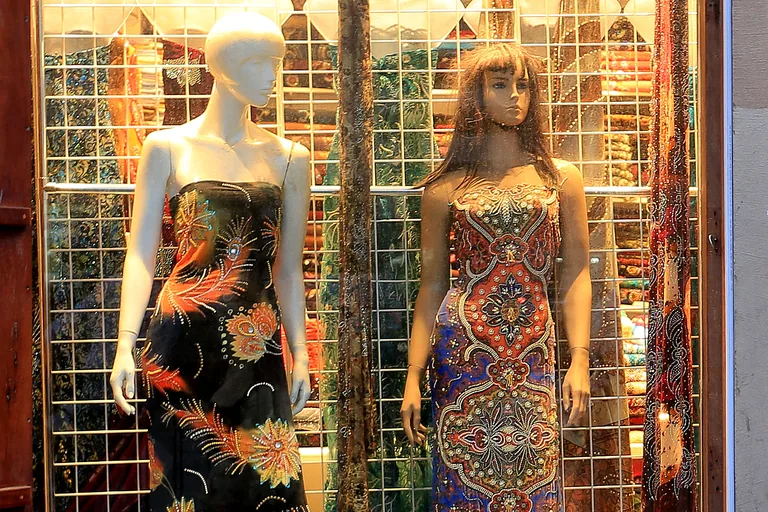
Photo: Iwona Rege · Wikimedia Commons source · CC BY-SA 4.0 · Cropped to the recorded 3:2 source rectangle and resized from the exact hash-bound source input. Bur Dubai Souq
Bur Dubai Souq is the long roofed arcade of cloth shops with wooden shutters that runs beside the creek on the Bur Dubai side. The route stops here for the cloth trade: in 2010 a reporter wrote that before the renovation business in the souq was done in the open on the streets, that its cloth had once come only from Japan and later also from Korea and Indonesia, with China the main supplier by then, and that tailors in the souq could copy a garment or a pattern, while in 2018 early traders told a newspaper that the nearby lane called Meena Bazaar took its name from the signboard of a textile shop opened at its entrance in 1973. The arcade is roofed and level but crowded in the evenings, GPS may drift under the roof, and many shops close for a break in the early afternoon and open late on Fridays, so check hours locally; the lane the walk takes behind the mosque is a narrow public lane of small shops where a temple stands, so keep voices low, dress modestly and do not go into any temple.
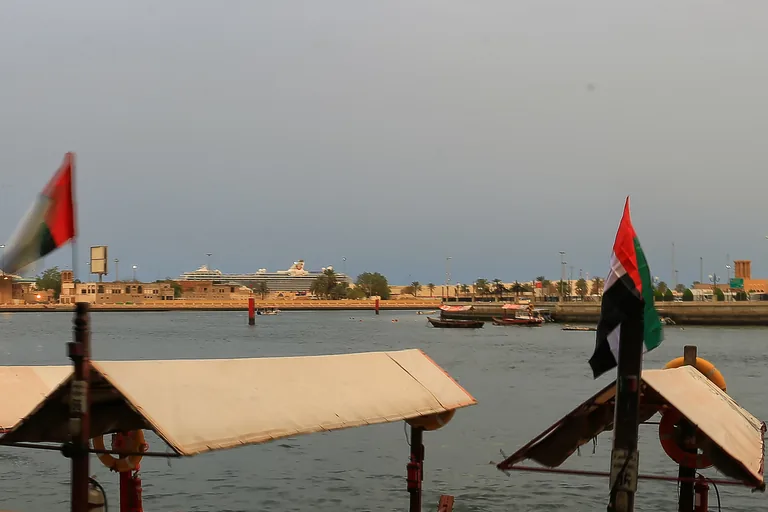
Photo: Iwona Rege · Wikimedia Commons source · CC BY-SA 4.0 · Cropped to the recorded 3:2 source rectangle and resized from the exact hash-bound source input. Bur Dubai Abra Station
The Bur Dubai abra station is the quay at the west end of the souq where the small wooden ferry boats called abras wait to cross the creek to the Deira Old Souq station. The route stops here for the crossing itself: a newspaper in 2021 gave the boat's name as coming from an Arabic word meaning to cross, and in 2025 a boatman who had worked the creek since 1970 remembered old names of landing stages that have gone from today's maps: the Gold Souk station was once Bandar Talib, and the Baniyas station Bandar Garage. Board only a boat bound for the Deira Old Souq station, since the abras at the dock halfway along the souq go to other stations; boats leave when they are full, the quay has little shade, and stepping down into a moving boat needs care, so have small coins ready for the boatman.
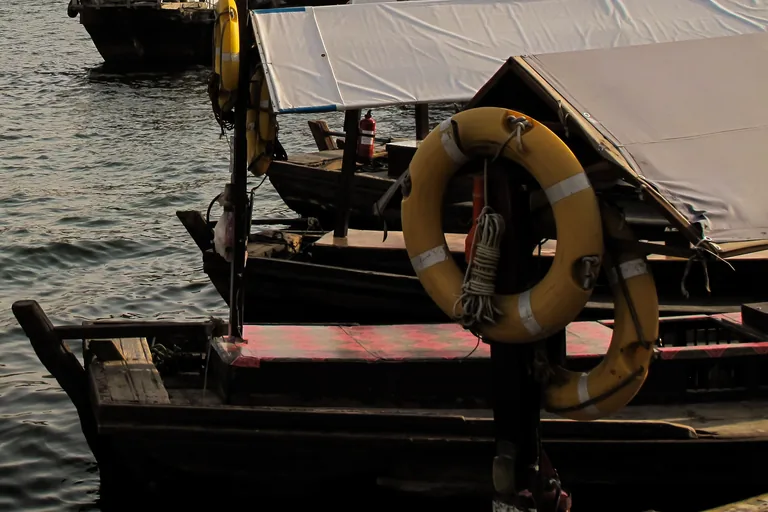
Photo: Francisco Anzola · Wikimedia Commons source · CC BY 2.0 · Cropped to the recorded 3:2 source rectangle and resized from the exact hash-bound source input. Deira Old Souq Abra Station
The Deira Old Souq abra station is the landing stage on the Deira bank of the creek where the abras from Bur Dubai put in, across Baniyas Road from the old souq of Deira. The route stops here for the working waterfront: the wharfage on this bank was rebuilt with proper berths and jetties in 1993, and in 2014 the cargo dhows were told to move to a new, deeper wharfage on the Deira seafront, where a sailor who had come to Dubai on dhows for twenty years told a newspaper that he would miss this place. Step off the abra with care and cross Baniyas Road only at the marked crossing toward the souq; the quay has little shade, and wooden dhows may or may not be moored along this bank.
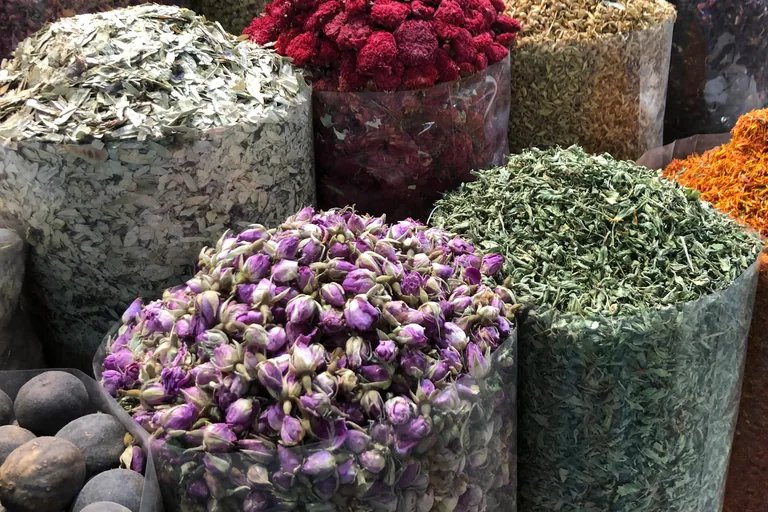
Photo: Frodlekis · Wikimedia Commons source · CC BY-SA 4.0 · Cropped to the recorded 3:2 source rectangle and resized from the exact hash-bound source input. Deira Spice Souk
Deira Spice Souk is a few narrow roofed lanes of the old souq of Deira, close to the creek, lined with small shops that open straight onto the lane. The route stops here for the goods of the lanes: in 2008 a newspaper found the shops also selling rock salt, indigo for dyeing cloth, pumice for rough skin and strong Arabic perfume sold by volume, with many of the traders Iranian and dried goods arriving from Iran every day or every week, and in 2011 a shopkeeper showed a reporter a red incense that people buy in the belief that it keeps away jinn and the evil eye. The lanes are narrow and roofed, GPS can drift under the roofs so the stop may start a few steps early or late, goods are sold by weight and bargaining is usual, and many shops close for a break in the early afternoon, so check locally.
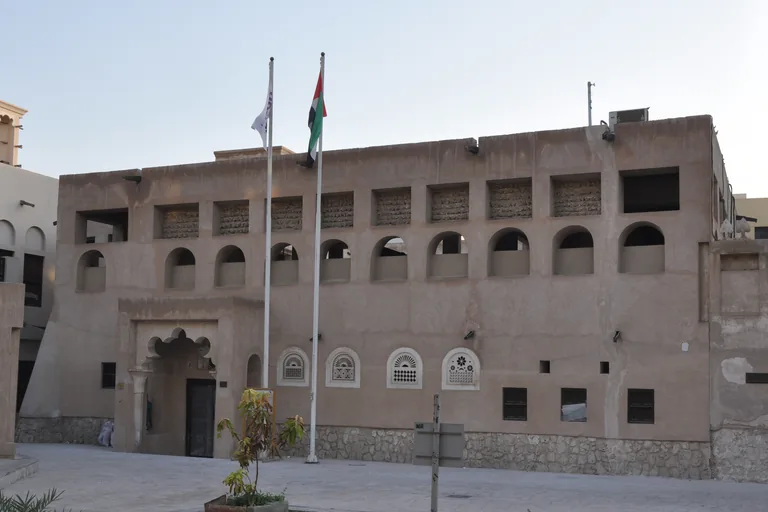
Photo: أمين علوان · Wikimedia Commons source · CC BY-SA 4.0 · Cropped to the recorded 3:2 source rectangle and resized from the exact hash-bound source input. Al Ahmadiya School
Al Ahmadiya School is the two storey school of 1912 in the quiet lanes of Al Ras in Deira, now a museum of education, with Heritage House, a house first built in 1890 and enlarged in later years, standing close beside it. The route ends here for what the school taught: a former pupil recalled that the youngest boys learned calligraphy and the Quran while older pupils studied Arabic and mathematics in the morning and jurisprudence at noon, and many of its graduates went on to work in the courts. The government of Dubai began to support the school in 1937, benches and desks later took the place of the palm leaf mats, and after its restoration in the mid 1990s the building opened as a museum in 2000, while from the upper veranda of Heritage House people once watched the sea, which came closer to the house then. Both buildings are museums that keep their own hours, so check locally before planning a visit; the walk ends here, a short walk from Al Ras station on the metro's Green Line, with taxis on the creek road.


Local context
Before you go
The walk covers about 1.3 km on foot on the level, south to north, plus the abra crossing of the creek, about 1.9 km in all, from the forecourt of Al Fahidi Historical Neighbourhood in Bur Dubai to Al Ahmadiya School in Al Ras, Deira. The lanes of Al Fahidi and the roofed souq give shade; the quays on both banks have little. The walk ends a short way from Al Ras station on the metro's Green Line, and taxis pass on the creek road.
On the ground
Access and surfaces
About 1.3 km on foot on the level, plus the crossing of the creek by abra, the small wooden ferry boat, from the Bur Dubai station at the west end of the souq to the Deira Old Souq station; the abras at the dock halfway along the souq go to other stations. Dubai is very hot from about May to September: in those months walk early in the morning or after sunset, and carry water in any season. Boarding the abra means stepping down from the quay into a moving boat across a gap: take a hand if one is offered and sit down at once. The fare is small and paid in cash to the boatman, so carry small coins and check locally. Many souq shops close for a break in the early afternoon and open late on Fridays, and hours change in Ramadan, so check locally. Dress modestly, with shoulders and knees covered, in the souqs and near the mosque and the temple; the walk passes the mosque from outside and goes along the public temple lane behind it, among small shops, so do not go into the mosque or any temple, keep voices low in the lane and do not photograph people at prayer or at worship. Al Fahidi Fort has been shut for restoration since 2021, and the stop works from the street. Most houses in Al Fahidi that are not museums, galleries or cafés are offices or private homes. Take care on Al Fahidi Street and Ali bin Abi Talib Street in Bur Dubai and on Baniyas Road in Deira, and cross only at marked crossings.
Frequently asked
Plan the walk
- How long is the Dubai audio walking tour?
- Allow about 80 minutes. The route covers 1.9 km (1.2 mi) in 8 stops, including walking, listening and the wait for an abra across the creek.
- Where does the Dubai tour start and end?
- It starts on the southern forecourt of Al Fahidi Historical Neighbourhood in Bur Dubai, about ten minutes on foot from Sharaf DG metro station, and ends at Al Ahmadiya School in Al Ras, Deira, a short walk from Al Ras station on the metro's Green Line.
- How do I cross the creek?
- By abra, the small wooden ferry boat. Take one from the Bur Dubai station at the west end of the souq to the Deira Old Souq station; boats leave when they are full. The fare is small and paid in cash to the boatman on board, so carry small coins.
- Can I go inside the fort?
- Not at the time of writing. Al Fahidi Fort has been shut for restoration since 2021, and no date for reopening had been announced, so the stop works from the street. Al Ahmadiya School and Heritage House at the end of the walk are museums that keep their own hours; check locally.
Same region