Volubilis · Fès-Meknès, Morocco
Volubilis
A self-guided audio tour of Volubilis, from Roman houses and mosaics to olive presses, civic monuments, and later archaeological layers.
Narration in English · Stop 1 is free
 Tour no. 03
- Stops
- 11
- Distance
- 1.3 km (0.8 mi)
- Time
- About 85 minutes
- Route
- Moderate archaeological route
Listen before you buy
Stop 1 · Southern entry and city walls
Stop 1 is free. Listen before you buy.
The walk
A self-guided audio tour of Volubilis
Volubilis grew at the western edge of Roman rule in North Africa. Its mosaics survive inside former houses, while presses, temples, the forum, basilica, and arch show how the town worked beyond its decorated floors.
The route climbs from the southern entrance to the Tangier Gate along the city's main axis. It also follows what happened after Rome, from Idrisid occupation and French-colonial excavation to modern Moroccan conservation.
Route notes
The stops
About each stop · narration stays in the app
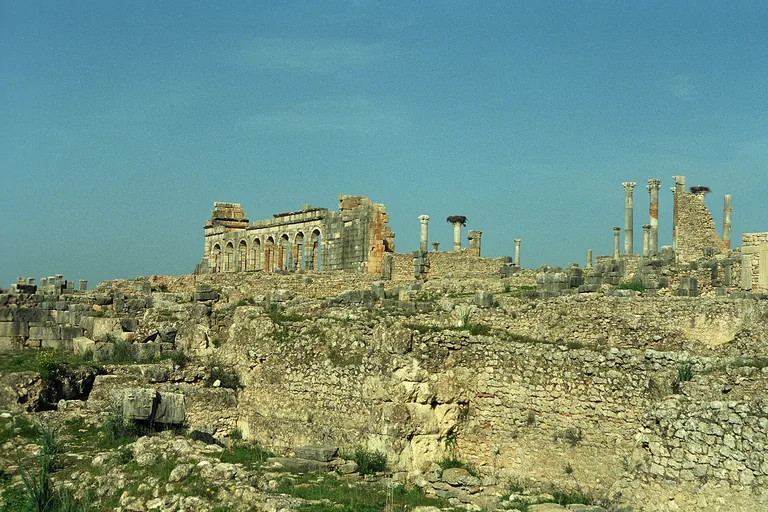
Photo: Jerzy Strzelecki · Wikimedia Commons source · CC BY 3.0 · Cropped to the recorded 3:2 source rectangle and resized from the exact hash-bound source input. Southern entry and city walls
The southern entry is the modern visitor threshold across Volubilis's Roman rampart, whose main circuit was built in 168–169 CE. The route starts at the city edge so the size and changing boundaries of the settlement are legible before its houses and monuments. The site is open, exposed and uneven from the first stop, so carry water and allow time for rough stone and gravel paths.
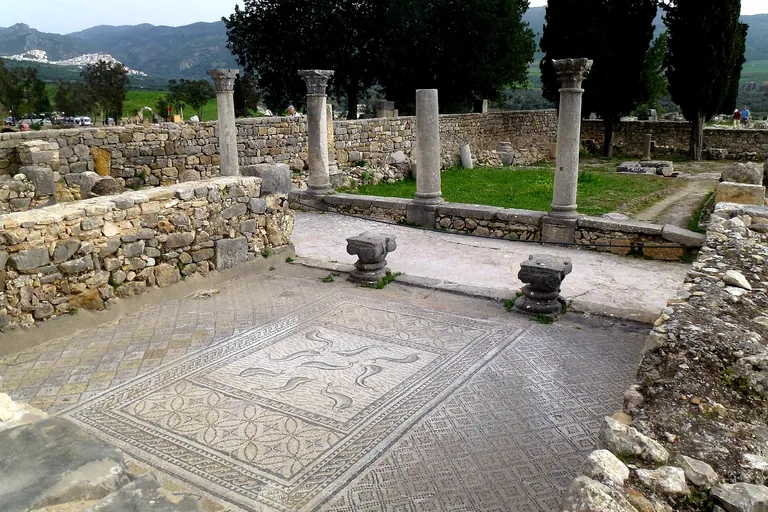
Photo: Hiroki Ogawa · Wikimedia Commons source · CC BY 3.0 · Cropped to the recorded 3:2 source rectangle and resized from the exact hash-bound source input. House of Orpheus
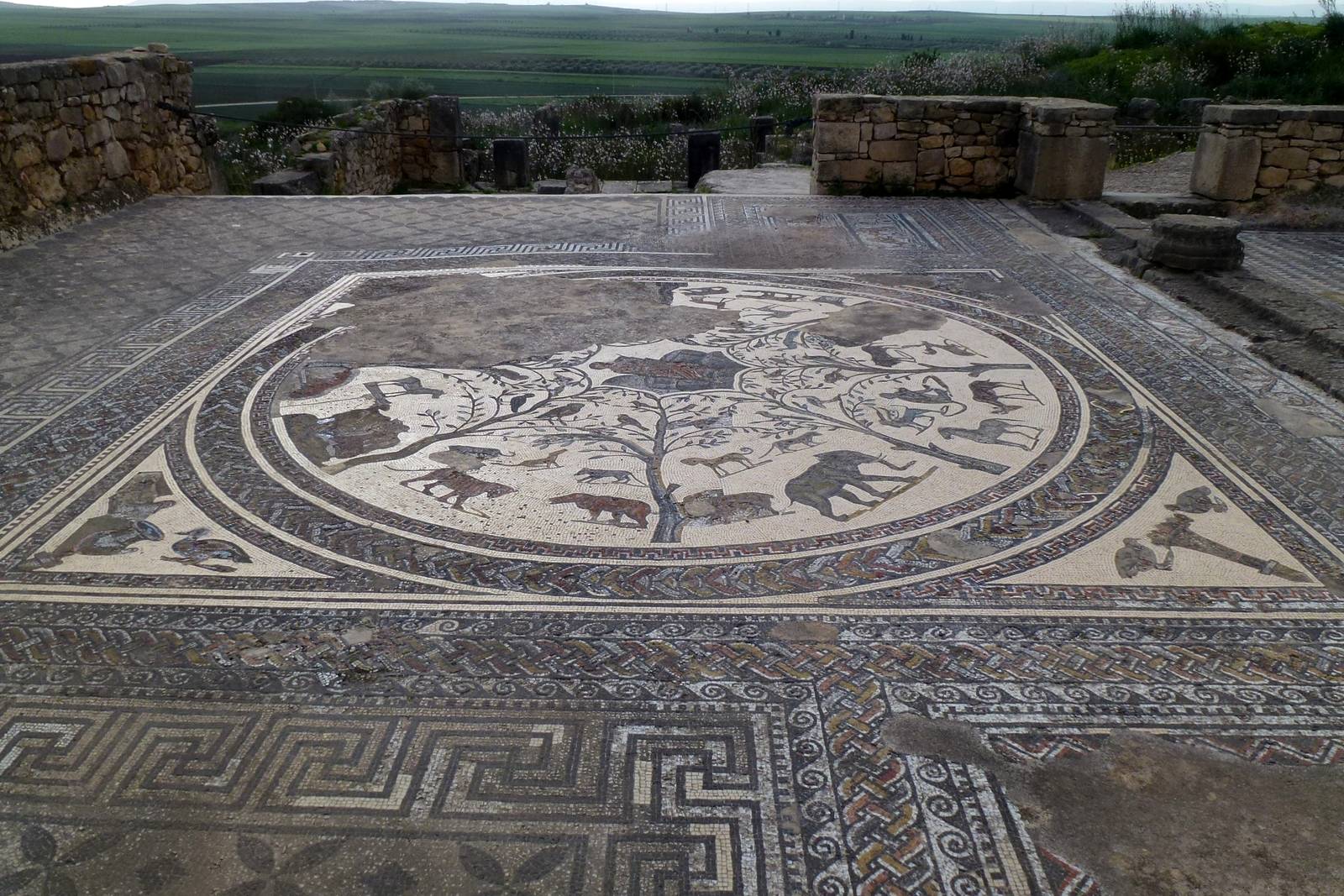
The House of Orpheus is a Roman residence centred on a circular mosaic showing Orpheus with his lyre among panels of animals and birds. It gives the route its first close view of domestic wealth and of the excavation choices that determine which layers visitors see today. View the mosaic from the raised visitor edge and do not step onto the ancient floor or surrounding walls.
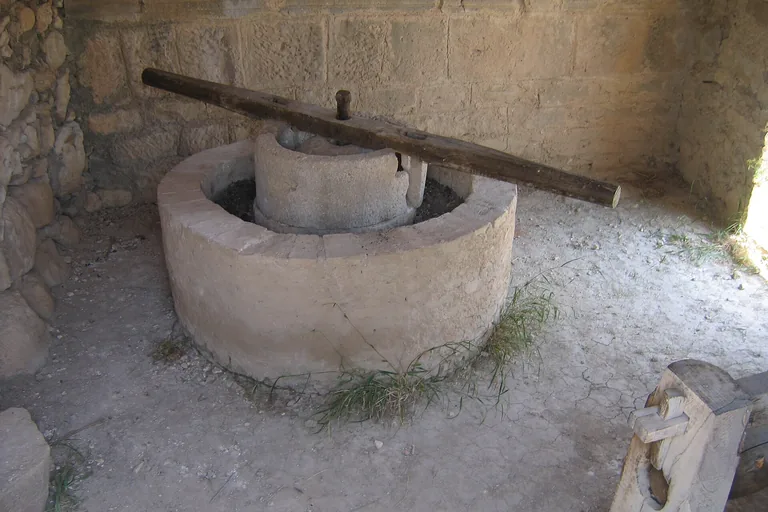
Photo: Leitmotiv · Wikimedia Commons source · CC BY-SA 2.0 · Cropped to the recorded 3:2 source rectangle and resized from the exact hash-bound source input. Olive presses
Volubilis preserves more than fifty identified olive-oil installations, with crushing and counterweight-press elements still readable among the ruins. This stop follows the mosaic house to show the productive economy beneath the city's expensive floors and public buildings. The remains are low and the ground is irregular, so stay on the visitor route and look across the installation rather than walking through it.
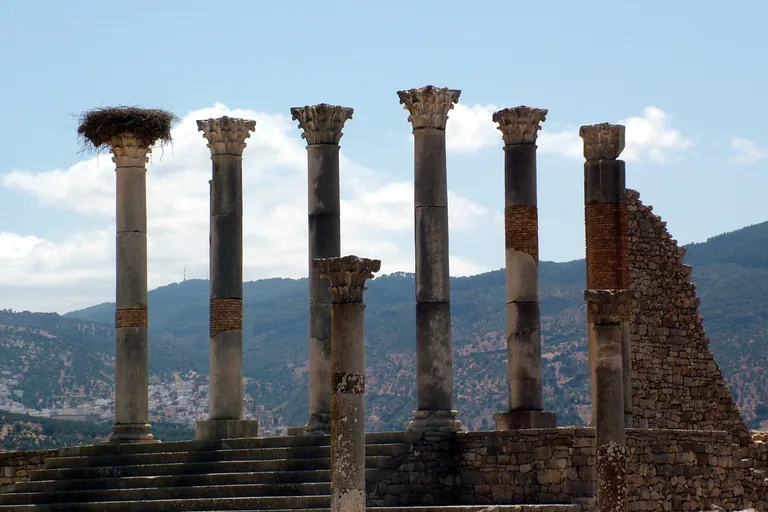
Photo: Marcin Sochacki (Wanted) · Wikimedia Commons source · CC BY-SA 4.0 · Cropped to the recorded 3:2 source rectangle and resized from the exact hash-bound source input. Capitol
The Capitol was the city's temple to Jupiter, Juno and Minerva, approached by a high stair and restored in antiquity under Macrinus in 218 CE. Its position above the forum marks state religion as part of the same compact civic centre as law, trade and administration. The temple is best read from the path below; the ancient steps and platform are steep, worn and exposed.
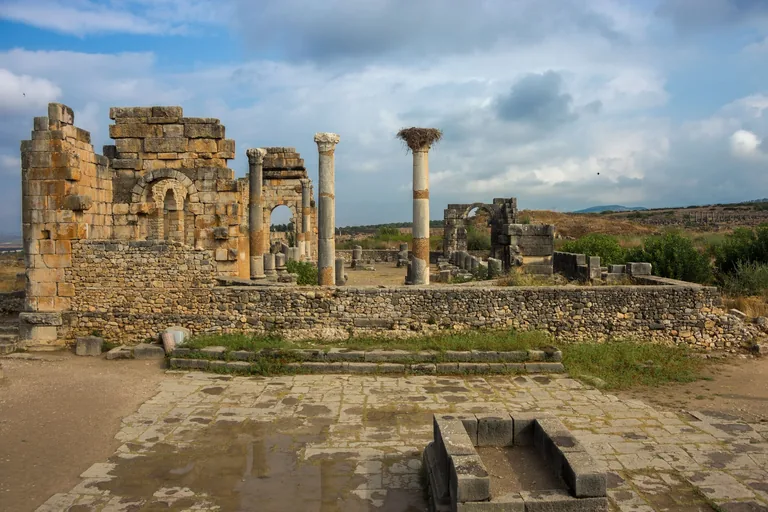
Photo: Rigelus · Wikimedia Commons source · CC BY-SA 4.0 · Cropped to the recorded 3:2 source rectangle and resized from the exact hash-bound source input. Forum
Volubilis's paved forum occupied roughly 1,300 square metres between the Capitol, basilica, shops and smaller sacred buildings. The route pauses here to make the monumental quarter's plan visible before examining its principal civic building. There is little shade and the surviving paving is uneven, so use the open centre for orientation without crossing fragile remains.
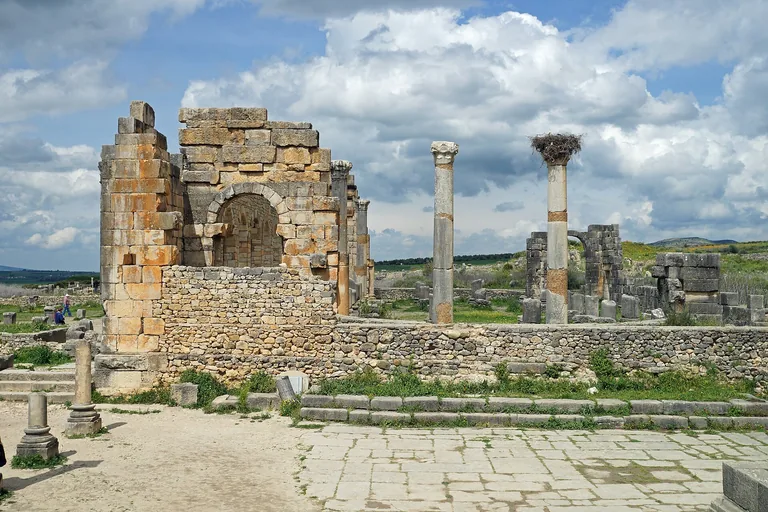
Photo: Mhobl · Wikimedia Commons source · CC BY-SA 4.0 · Cropped to the recorded 3:2 source rectangle and resized from the exact hash-bound source input. Basilica
The basilica was the city's great civic hall, with an eight-arch eastern façade facing the forum and a design related to Roman buildings elsewhere in North Africa. It widens the route from one provincial city to a shared architectural language along the Roman African coast. Keep to the marked exterior route around the standing arches; loose stone, steps and exposed edges make shortcuts unsuitable.
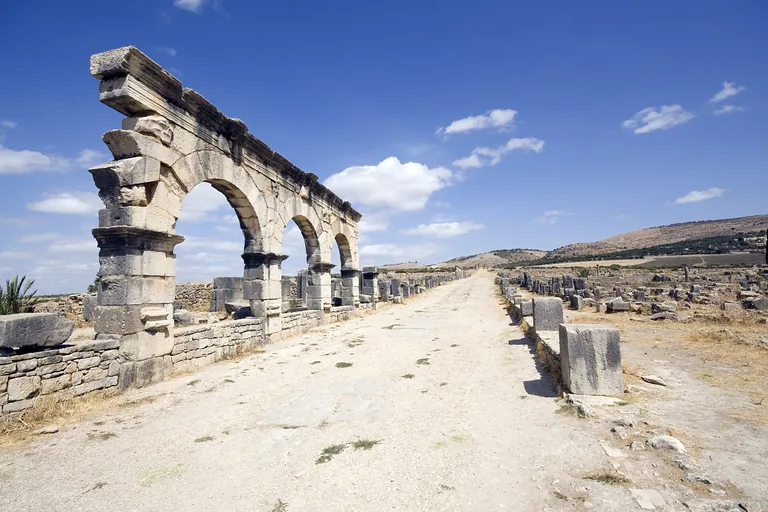
Photo: Prioryman · Wikimedia Commons source · CC BY-SA 4.0 · Cropped to the recorded 3:2 source rectangle and resized from the exact hash-bound source input. Decumanus Maximus
The Decumanus Maximus was Volubilis's principal east–west street, linking the monumental centre with the arch and the northern gate. Walking its line turns scattered monuments into a city plan and shows how public and residential quarters connected. Original paving is rough and can be slippery when wet, so watch footing and leave extra time for the long exposed avenue.
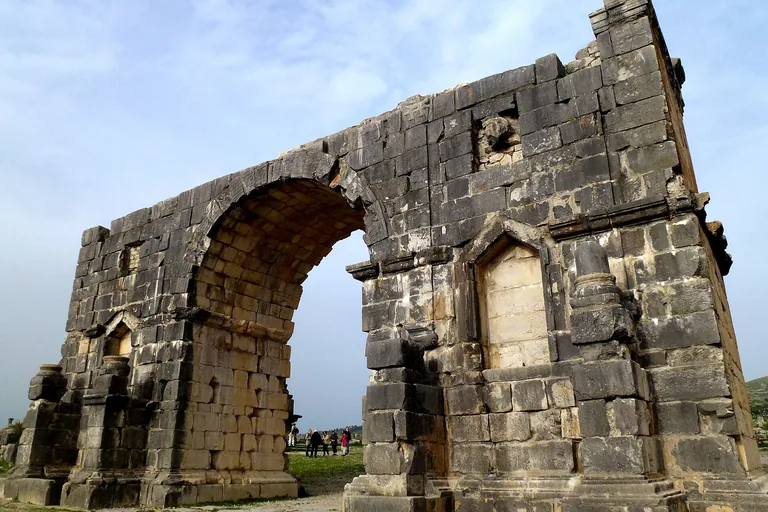
Photo: Hiroki Ogawa · Wikimedia Commons source · CC BY 3.0 · Cropped to the recorded 3:2 source rectangle and resized from the exact hash-bound source input. Triumphal Arch of Caracalla
The arch was dedicated in 217 CE to Caracalla and Julia Domna and was substantially reconstructed by French archaeologists in the twentieth century. It is included both as the city's most prominent surviving monument and as evidence that modern restoration shapes the view of antiquity. The junction around the arch is open and busy with visitors; step back on the marked path for the clearest full view.
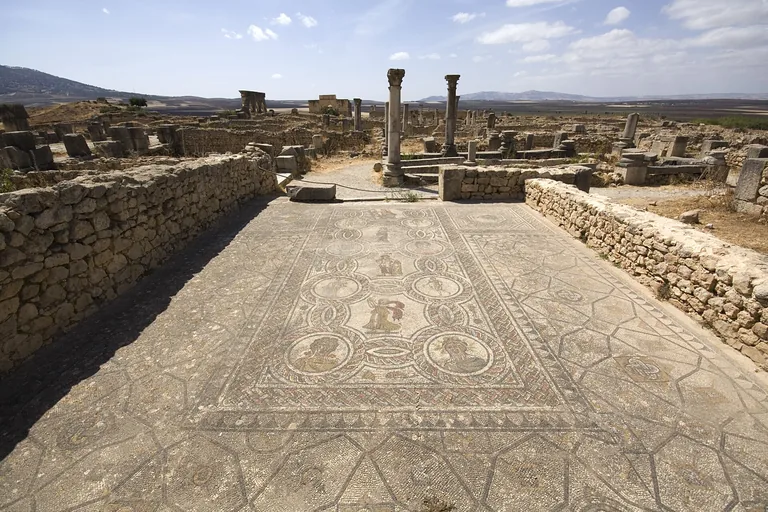
Photo: Prioryman · Wikimedia Commons source · CC BY-SA 3.0 · Cropped to the recorded 3:2 source rectangle and resized from the exact hash-bound source input. House of the Labours of Hercules
This Roman house is named for a dining-room mosaic whose surviving medallions depict the labours of Hercules around a central mythological scene. It provides a second domestic floor after Orpheus, making differences in subject, room and preservation easier to compare. The mosaic is seen from its perimeter; keep off the floor and allow for uneven approaches between low walls.
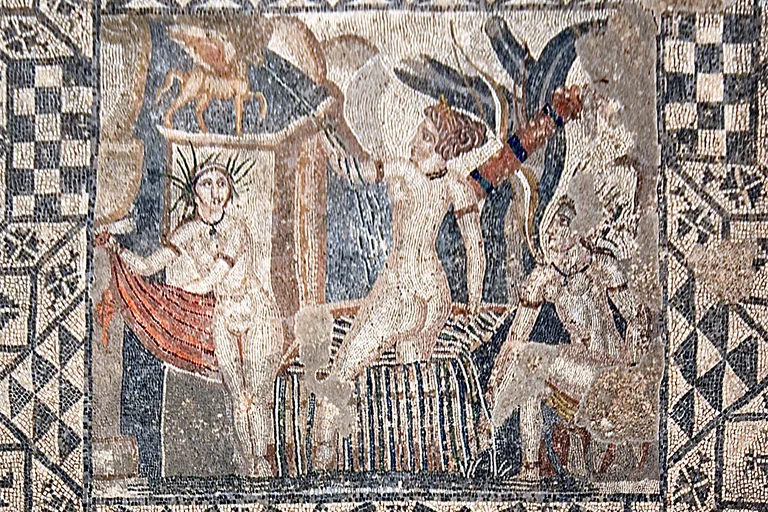
Photo: Prioryman · Wikimedia Commons source · CC BY-SA 3.0 · Cropped to the recorded 3:2 source rectangle and resized from the exact hash-bound source input. House of Venus
The House of Venus preserves several mythological mosaics, including scenes of Diana and Actaeon and of Hylas with the nymphs. The route uses this richly decorated residence to close its sequence of houses before returning to the city's street and wall system. Follow the viewing edges and barriers, since the mosaics and adjacent archaeological surfaces are not walking areas.
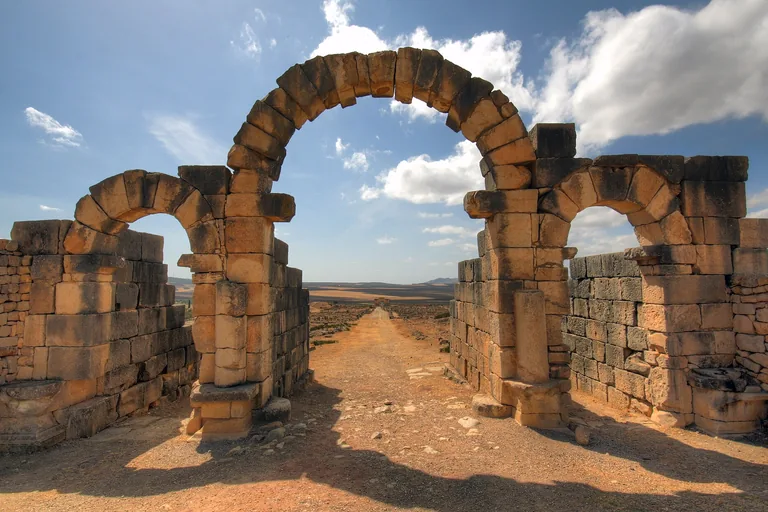
Photo: Prioryman · Wikimedia Commons source · CC BY-SA 4.0 · Cropped to the recorded 3:2 source rectangle and resized from the exact hash-bound source input. Tangier Gate
Tangier Gate stands at the northern end of the Decumanus Maximus on the road once directed toward Tingis, the provincial capital. It closes the walk at the opposite rampart line from the modern southern entry and restores Volubilis to its regional road network. The gate area is exposed and the stone threshold is uneven; the visitor exit and facilities remain back toward the southern entrance.


Local context
Before you go
The archaeological site covers roughly 42 hectares. Shade is scarce, surfaces are uneven, and services are limited once inside. Bring water and sun protection in warm months, and allow time to return from the Tangier Gate to the entrance.
On the ground
Access and surfaces
Ancient flagstones, exposed Roman paving, and gravel make the 1.3 km (0.8 mi) route uneven throughout. It gains about 30 meters from south to north. Some peripheral paths are smoother, but the original Roman surfaces are not wheelchair-accessible.
Frequently asked
Plan the walk
- How long is the Volubilis audio tour?
- Allow about 85 minutes. The self-guided route covers 1.3 km (0.8 mi) in 11 stops, including walking and listening time.
- Does the Volubilis audio guide include entry or transport?
- No. Site admission and transport are separate; Volubilis is about 30 km from Meknes and under two hours by road from Fes.
- What should I bring to Volubilis?
- Bring water and sun protection in warm months. Shade is scarce, and ancient paving and gravel make the route uneven.
- Will the Volubilis audio guide work offline?
- Yes, after download. Audio, stop text, images, and GPS triggering work without data; the live map background still needs a connection.