Taormina · Sicily, Italy
Taormina — The Corso and the Theatre
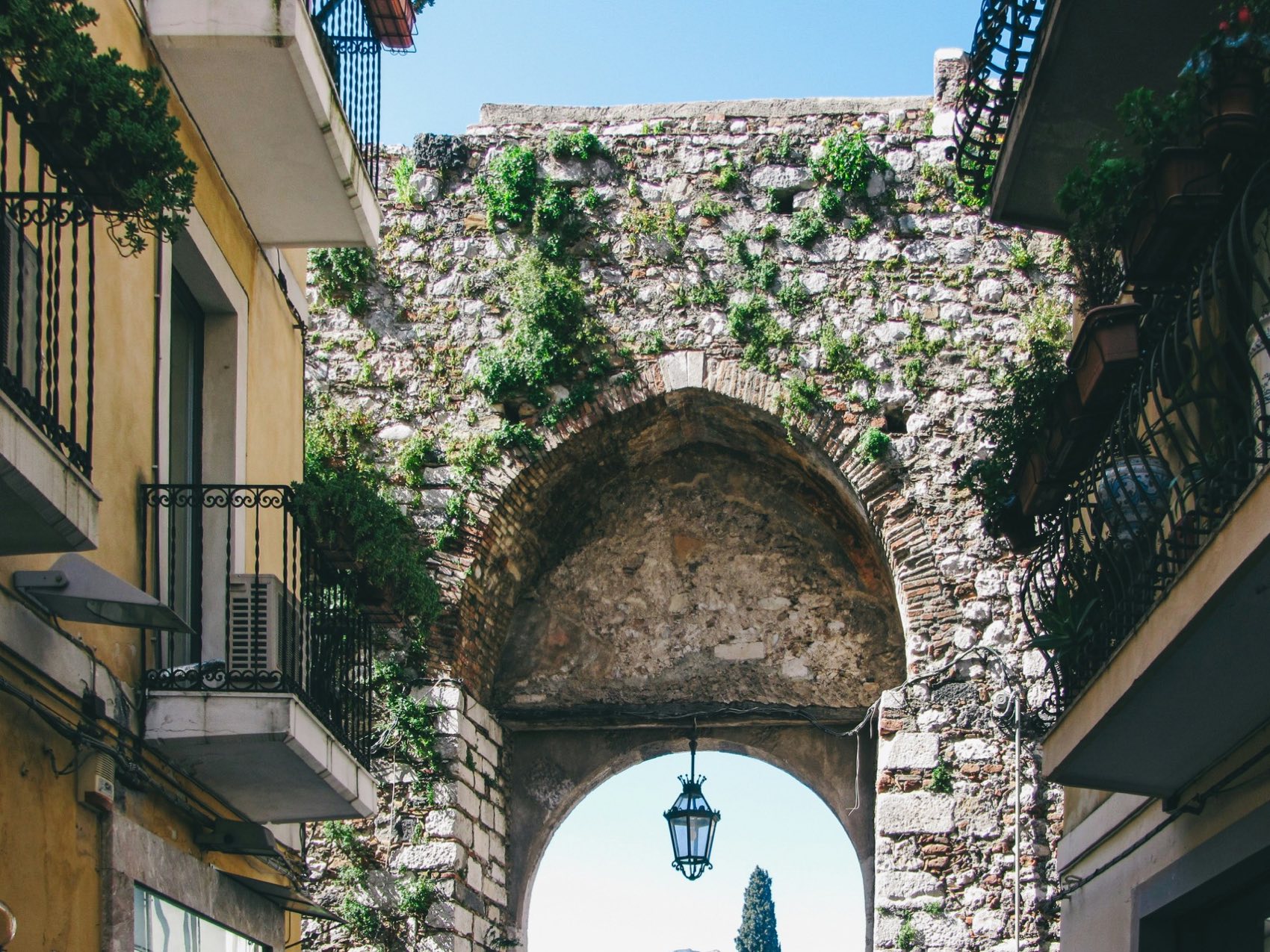
Taormina has one street, running between two gates along a shelf of Monte Tauro, and everything the town has ever been is arranged along it: a cathedral built like a fort, a fountain whose crowned half-horse woman is the town's emblem, a wall of Roman brick holding back a buried reservoir, and a palace where the Sicilian parliament sat in 1411.
Narration in English · Stop 1 is free
 Tour no. 19
- Stops
- 8
- Distance
- 1.9 km (1.2 mi)
- Time
- About 130 minutes
- Route
- Moderate walking route
Listen before you buy
Stop 1 · Porta Catania and the Palazzo dei Duchi di Santo Stefano
Stop 1 is free. Listen before you buy.
The walk
A self-guided audio tour of Taormina
Taormina has one street, running between two gates along a shelf of Monte Tauro, and everything the town has ever been is arranged along it: a cathedral built like a fort, a fountain whose crowned half-horse woman is the town's emblem, a wall of Roman brick holding back a buried reservoir, and a palace where the Sicilian parliament sat in 1411. The walk ends in the Greek theatre, with Etna framed in the gap in the stage wall — and that gap is the point of it. The stage building covered that view when the theatre was whole; it exists because the middle of the wall fell down. One after another, the things this town is famous for turn out to have been made rather than found, including a square named after a day the news was wrong.
Route notes
The stops
About each stop · narration stays in the app
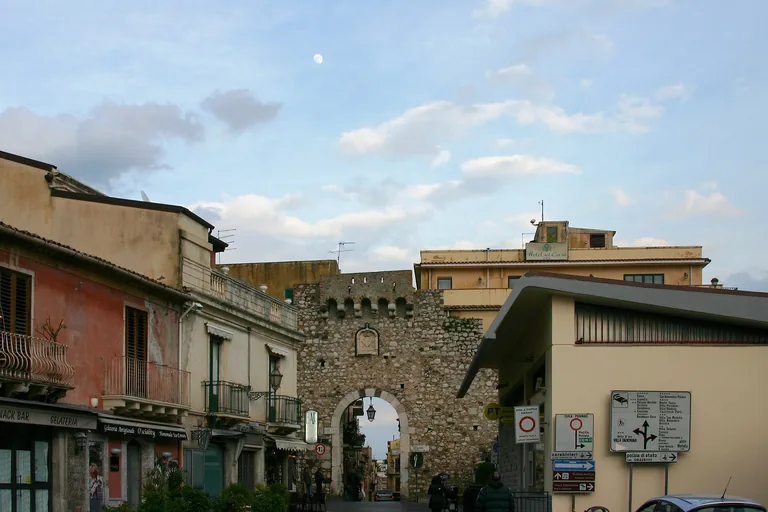
Photo: José Luiz · Wikimedia Commons source · CC BY-SA 4.0 · Cropped to the recorded 3:2 source rectangle and resized from the exact hash-bound source input. Porta Catania and the Palazzo dei Duchi di Santo Stefano
Porta Catania, dated 1440 above its arch, shares a small square with the lava-and-limestone façade of Palazzo dei Duchi di Santo Stefano. The paired buildings introduce both the old town's threshold and the black-and-white volcanic building palette repeated along the route. The square and exteriors are free and level; the palace gallery keeps separate opening hours.
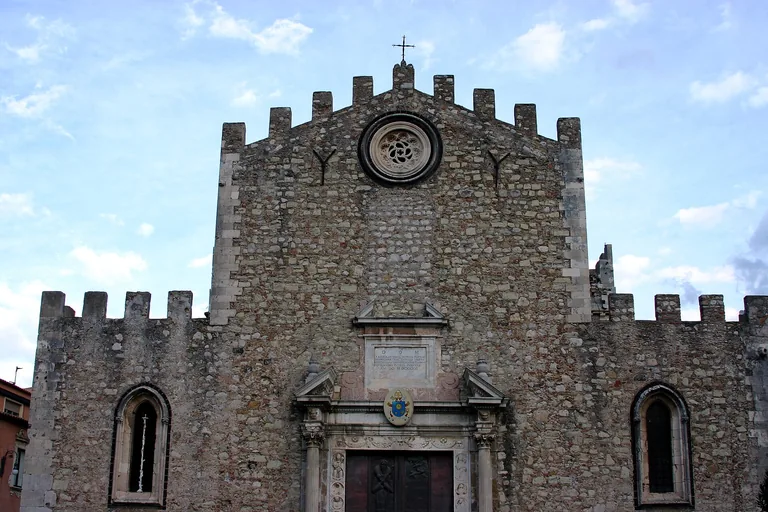
Photo: José Luiz · Wikimedia Commons source · CC BY-SA 4.0 · Cropped to the recorded 3:2 source rectangle and resized from the exact hash-bound source input. The Duomo and the fountain on Piazza del Duomo
Taormina's fortified-looking cathedral faces a seventeenth-century fountain crowned by the town's emblematic female centaur. The stop pairs a church shaped like a stronghold with the civic symbol at the centre of its public square. The square is free and level, while church entry involves steps and depends on worship hours.
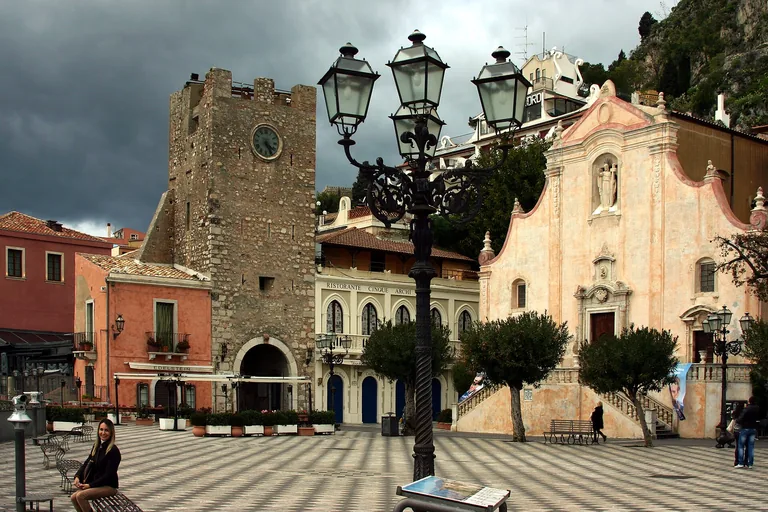
Photo: José Luiz · Wikimedia Commons source · CC BY-SA 4.0 · Cropped to the recorded 3:2 source rectangle and resized from the exact hash-bound source input. Piazza IX Aprile
Piazza IX Aprile is Taormina's panoramic terrace, named for the mistaken report on 9 April 1860 that Garibaldi had landed in Sicily. The route includes it as an example of a celebrated public place built around a remembered date whose original news was wrong. The square is free, level and often crowded at midday; surrounding churches and the library keep their own hours.
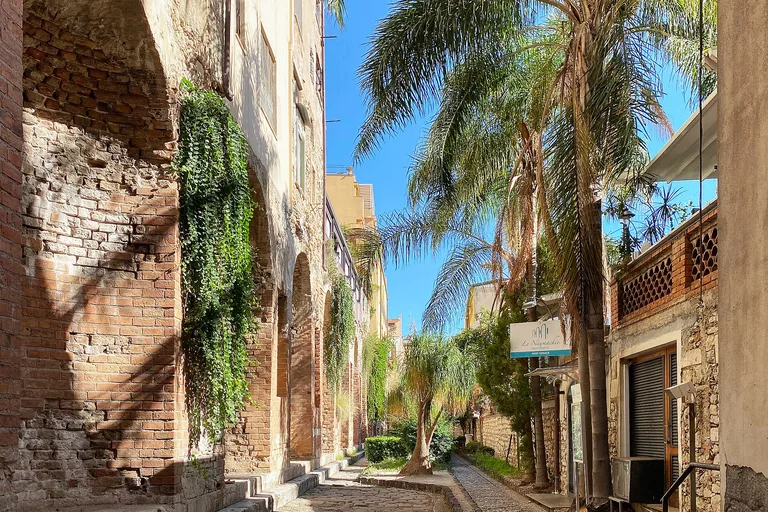
Photo: Bernard Gagnon · Wikimedia Commons source · CC BY 4.0 · Cropped to the recorded 3:2 source rectangle and resized from the exact hash-bound source input. Le Naumachie
Le Naumachie is a long Roman brick retaining wall with niches and a water reservoir behind it, not an arena for staged naval battles. This stop shows both the infrastructure beneath Taormina and the persistence of a confident but misleading historical name. The alley is reached by steps from Corso Umberto, though part of the wall can be seen from the top if the descent is unsuitable.
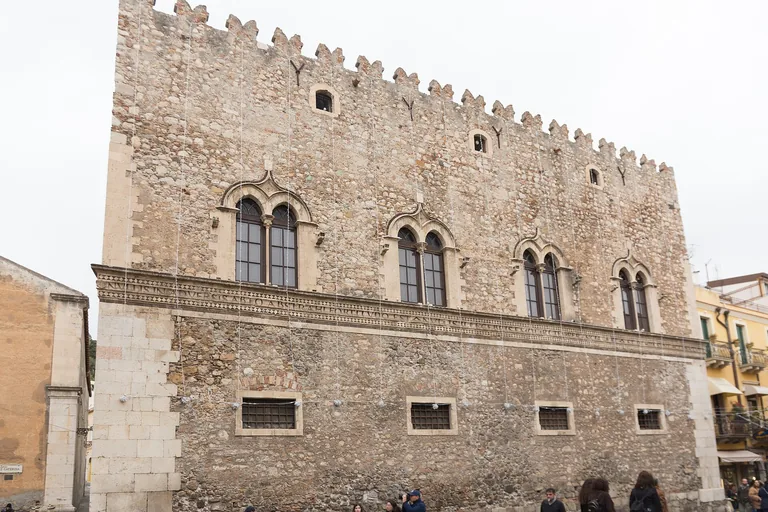
Photo: Pymouss · Wikimedia Commons source · CC BY-SA 4.0 · Cropped to the recorded 3:2 source rectangle and resized from the exact hash-bound source input. Palazzo Corvaja, Santa Caterina and the Odeon
This square layers a Greek sacred site, a Roman odeon, the church of Santa Caterina and Palazzo Corvaja within a few metres. It is the route's deepest architectural stack, showing how successive civic and religious uses occupied the same ground. The square and fenced odeon view are free; museum and church interiors have steps, tickets or opening-hour limits.
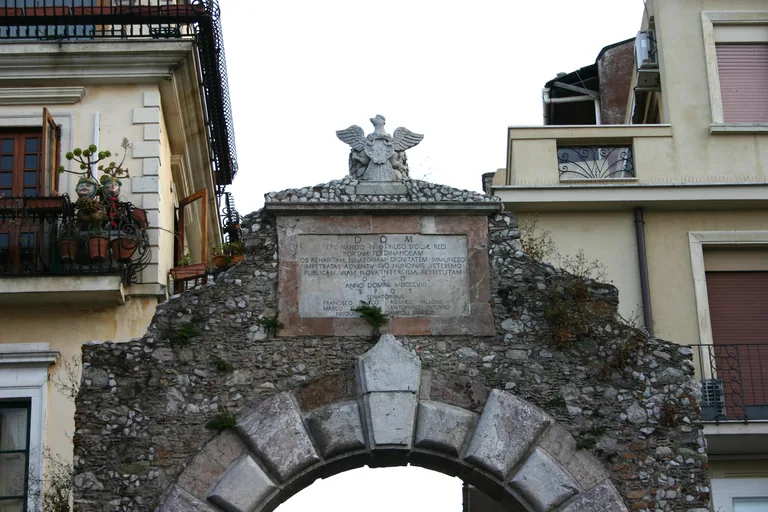
Photo: Giovanni Dall'Orto · Wikimedia Commons source · Attribution · Cropped to the recorded 3:2 source rectangle and resized from the exact hash-bound source input. Porta Messina
Porta Messina is the northern gate of the old town's main street, inaugurated in 1808 rather than inherited unchanged from the Middle Ages. Its relatively recent date marks the route's shift from the historic town core toward the gardens and theatre shaped for later visitors. The gate is free and level but handles heavy pedestrian flows, bus arrivals and taxi traffic through much of the day.
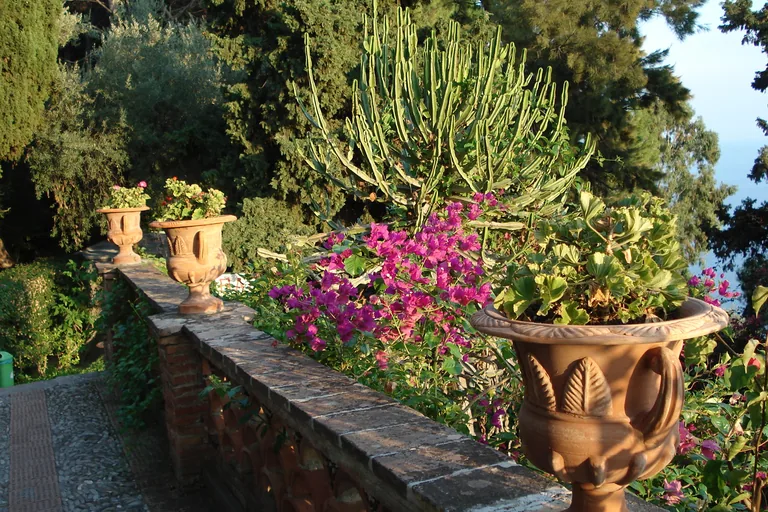
Photo: Giovanni Dall'Orto. · Wikimedia Commons source · Attribution · Cropped to the recorded 3:2 source rectangle and resized from the exact hash-bound source input. The Villa Comunale — Florence Trevelyan's garden
The Villa Comunale began as Florence Trevelyan's private garden, filled with fanciful brick-and-stone pavilions before becoming public in the twentieth century. It is included to examine how foreign residents helped manufacture Taormina's picturesque image on ground close to genuine ancient remains. The garden is free but keeps daily hours; paths are terraced and the return from Via Bagnoli Croci involves a climb.
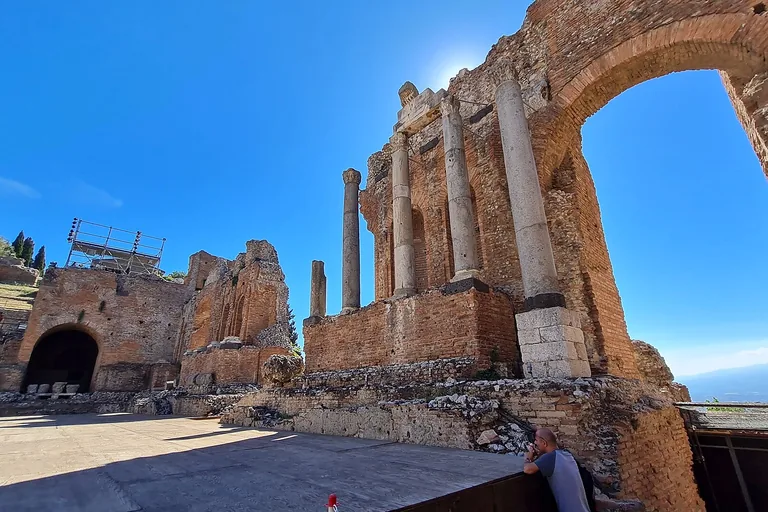
Photo: Derbrauni · Wikimedia Commons source · CC BY 4.0 · Cropped to the recorded 3:2 source rectangle and resized from the exact hash-bound source input. The Ancient Theatre
Taormina's Ancient Theatre is the visible Roman rebuilding of an earlier theatre, with re-erected columns and a broken stage wall that now frames Etna. The route ends here because its famous view depends on loss and restoration as much as on the ancient building itself. The site is ticketed, steep and uneven with many steps; allow time for the climb and check seasonal closing hours before setting out.


.JPG)


_05.jpg)
Local context
Before you go
The published route starts at Corso Umberto I, 98039 Taormina ME, Italia. It begins at Porta Catania and the Palazzo dei Duchi di Santo Stefano and ends at The Ancient Theatre.
On the ground
Access and surfaces
A line, not a loop: it starts at the southern gate, runs the length of Corso Umberto, and finishes at the theatre above the northern end. The Corso itself is pedestrianised, level enough to be comfortable, and paved in worn stone. Two stretches are harder than the rest, and both are optional in the sense that the audio works from the top of them. The Naumachie sit below the Corso down a short stepped alley. The public gardens are reached by walking down Via Bagnoli Croci, about 400 m of steady descent from the Corso, and the same climb back up toward the theatre. The theatre is ticketed and keeps seasonal hours; its own approach from Via Teatro Greco is a climb, and the seating is ancient stone with no handrails. Every other stop on the walk is free and outdoors. The cathedral, Palazzo Corvaja and the church of Santa Caterina are free but keep church and museum hours; the Palazzo dei Duchi di Santo Stefano opens as a foundation gallery rather than a monument. Summer afternoons on the Corso are genuinely crowded, and the walk is much better early or in the evening.
Frequently asked
Plan the walk
- How long is the Taormina audio walking tour?
- Allow about 130 minutes. The self-guided route covers 1.9 km (1.2 mi) in 8 stops, including walking and listening time.
- Where does the Taormina tour start and end?
- It starts at Corso Umberto I, 98039 Taormina ME, Italia. The published route begins at Porta Catania and the Palazzo dei Duchi di Santo Stefano and ends at The Ancient Theatre.
- Will the Taormina audio tour work offline?
- Yes, after download. Audio, stop text, images, and GPS triggering work without data; the live map background still needs a connection.