Sintra · Lisbon, Portugal
Sintra — The Town Below the Palaces
An audio walk through Sintra, from the railway station past the palace of the two chimneys and the bakers' lane to the field at Seteais the town kept open.
Narration in English · Stop 1 is free
 Tour no. 32
- Stops
- 9
- Distance
- 2 km (1.2 mi)
- Time
- About 100 minutes
- Route
- Moderate walking route
Listen before you buy
Stop 1 · Sintra Station
Stop 1 is free. Listen before you buy.
The walk
An audio tour through the town below Sintra's palaces, at your own pace
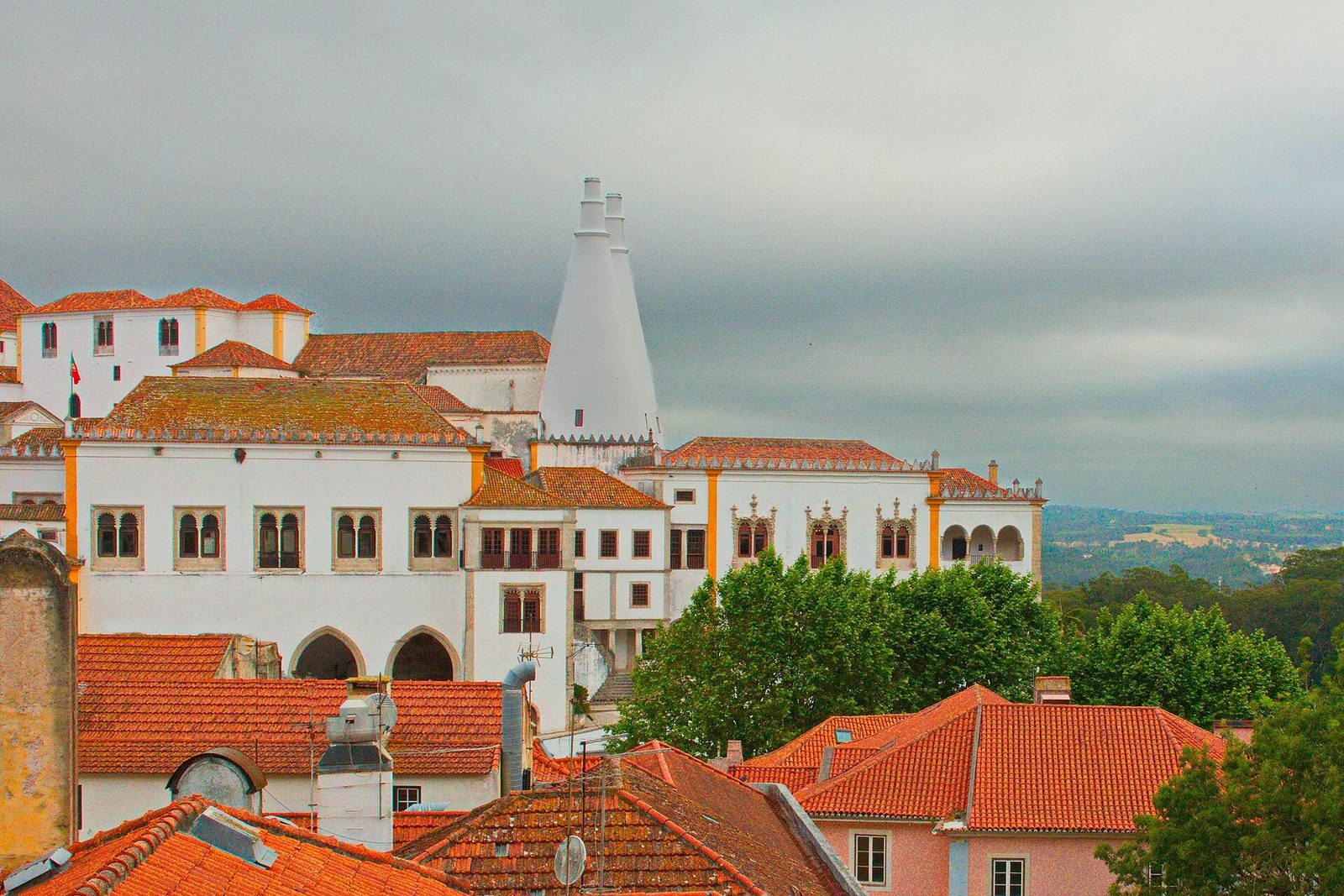
For six hundred years people have come up this hill to get out of Lisbon: kings for the air and the hunting, foreign poets later, and after the railway arrived in 1887, everyone else. The palaces on the ridge are what most of them came for; this walk stays in the town below, the one that housed, fed and baked for their visitors. It starts at the station, passes the town hall under its tiled spire, and follows the Volta do Duche, a road that kept the name of a modest bathhouse, to the National Palace, whose two white kitchen chimneys stand 33 metres high.
Up the narrow lane beside the palace square are the bakeries that moved into town with the railway, selling the queijada, a small cheese tart known here since at least 1227 and once used to pay rents. Beyond them come the museum of Ferreira de Castro, the novelist who worked four years on a rubber estate on the Madeira river as a boy, and Lawrence's Hotel, where Byron stayed in the summer of 1809. The road then leaves town between high walls, past the carved towers of the Quinta da Regaleira, built for the man locals called Monteiro of the Millions, and ends on the lawn at Seteais. When a marquis tried to enclose that field, the townspeople rose against it, and in 1801 the council ordered two gates kept open for the public at all times. They still are.
Route notes
The stops
About each stop · narration stays in the app
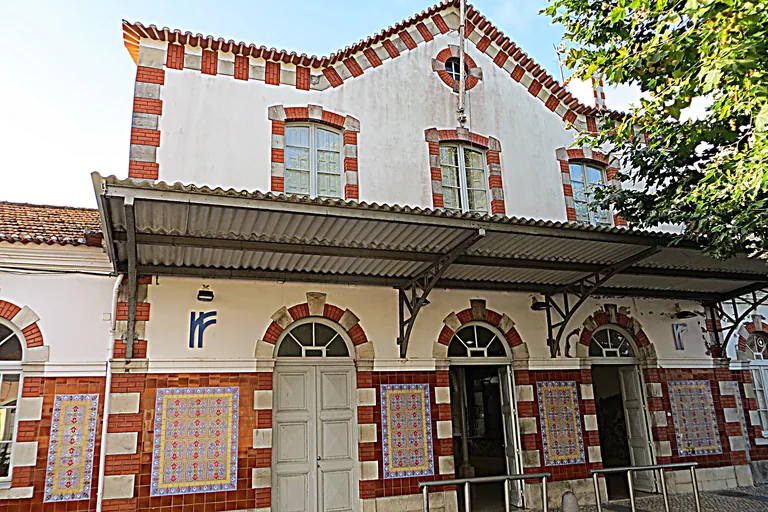
Photo: Mister No · Wikimedia Commons source · CC BY 3.0 · Cropped to the recorded 3:2 source rectangle and resized from the exact hash-bound source input. Sintra Station
Sintra Station is the terminus of the Sintra line, which opened on 2 April 1887 and today carries suburban CP trains to Lisbon, including Rossio station in the city centre. The route begins here, at the rail link that brought the summer visitors of the early twentieth century, and heads west into the old town before following the road out to Seteais. The stop is made on the pavement in front of the station building, as buses, taxis and tuk tuks share the street at train times; the whole walk is a line of about two kilometres, not a loop.
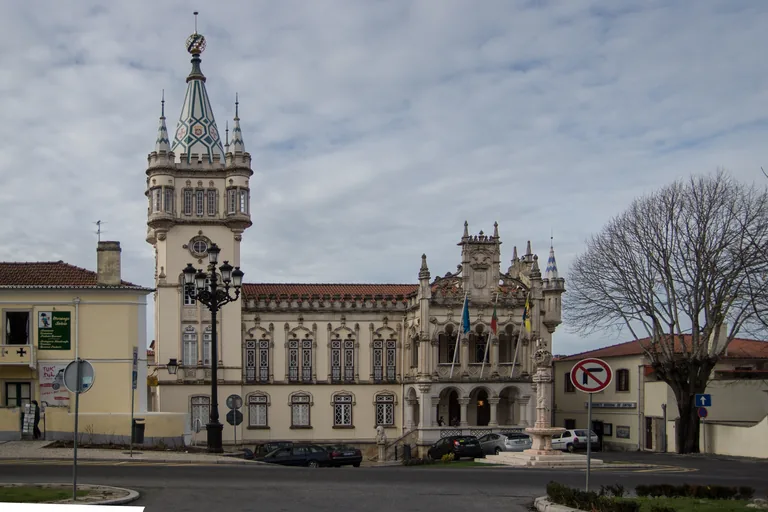
Photo: Pedro J Pacheco · Wikimedia Commons source · CC BY-SA 4.0 · Cropped to the recorded 3:2 source rectangle and resized from the exact hash-bound source input. Sintra Town Hall
Sintra Town Hall was designed by the architect Adães Bermudes and built from 1906 on the site of the Manueline chapel of São Sebastião, then inaugurated at the town's Spring Festival of 1909. The route stops here because the council placed its new seat between the old town and the newer Estefânia quarter, and its carved Manueline revival front and tall tower roofed in coloured tiles show the revival styles of Sintra at that time. It is seen from outside, from the pavement of Largo Virgílio Horta by the marble fountain of 1914; traffic circulates around a roundabout in the square.
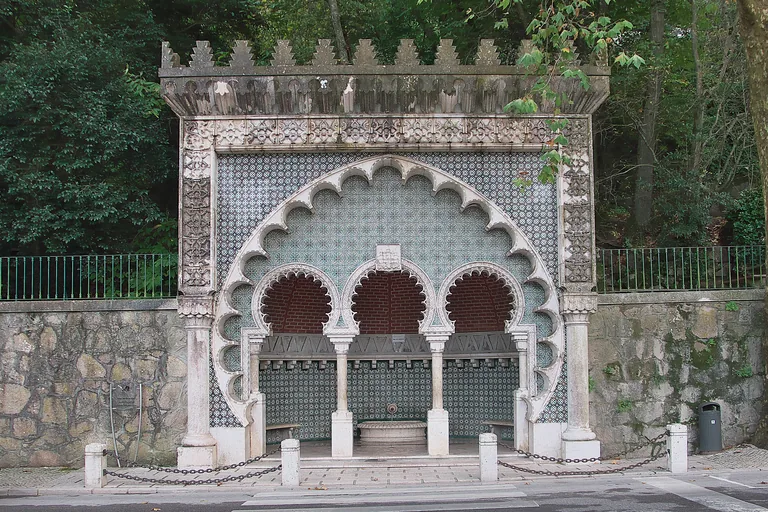
Photo: José Luis Filpo Cabana · Wikimedia Commons source · CC BY 3.0 · Cropped to the recorded 3:2 source rectangle and resized from the exact hash-bound source input. Fonte Mourisca
The Fonte Mourisca is a public fountain built in 1922 to a design by José da Fonseca in a Moorish revival style: a great scalloped horseshoe arch holds three smaller ones, framed in coloured tiles around the town's arms. It stands on the Volta do Duche, the road laid out after the railway arrived to link the old town with the station and the Estefânia quarter, and the route follows that road from the town hall to the palace. The fountain is set into a retaining wall under trees beside a road with traffic, so it is seen from the narrow pavement in front of its arches.
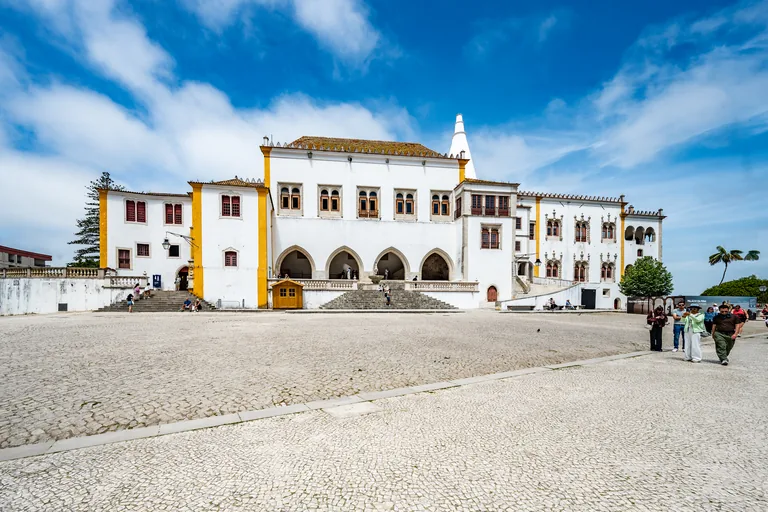
Photo: Michael Gaylard from Horsham, UK · Wikimedia Commons source · CC BY 4.0 · Cropped to the recorded 3:2 source rectangle and resized from the exact hash-bound source input. Sintra National Palace
Sintra National Palace is the royal palace in the centre of the town, shaped mainly by building campaigns under Dinis, João I, Manuel I and João III; its two conical kitchen chimneys, 33 metres high, are a landmark of Sintra. The route includes it as the royal core of the old town: the court came here for the hunting and for the nearness of Lisbon, and the palace was one of its main summer residences for centuries. The stop is made from the large, level square in front, which is crowded with visitors and tuk tuks by day; the palace interior has its own tickets and opening hours.
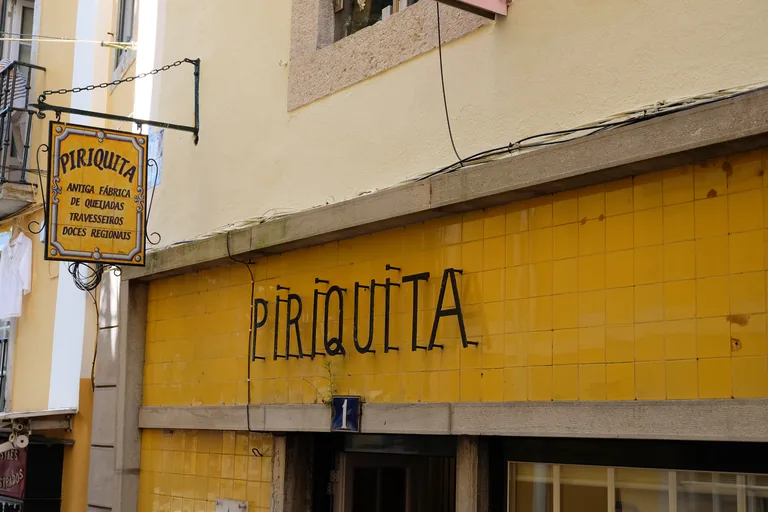
Photo: Julien Chatelain from Paris, France · Wikimedia Commons source · CC BY-SA 2.0 · Cropped to the recorded 3:2 source rectangle and resized from the exact hash-bound source input. Rua das Padarias
Rua das Padarias is a lane climbing from the centre of the old town past the Piriquita, a pastry house founded in 1862 and run today by the sixth generation of the founding family. The route includes it for Sintra's pastry trade: the queijada, a small tart of fresh cheese, eggs, sugar and cinnamon sold in rolls of six, is the town's best known sweet, and the Piriquita calls its travesseiro, a puff pastry, its signature. The lane is narrow, sloping and pedestrian, its cobbles are slippery when wet, and it gets crowded outside the pastry shops during the day.
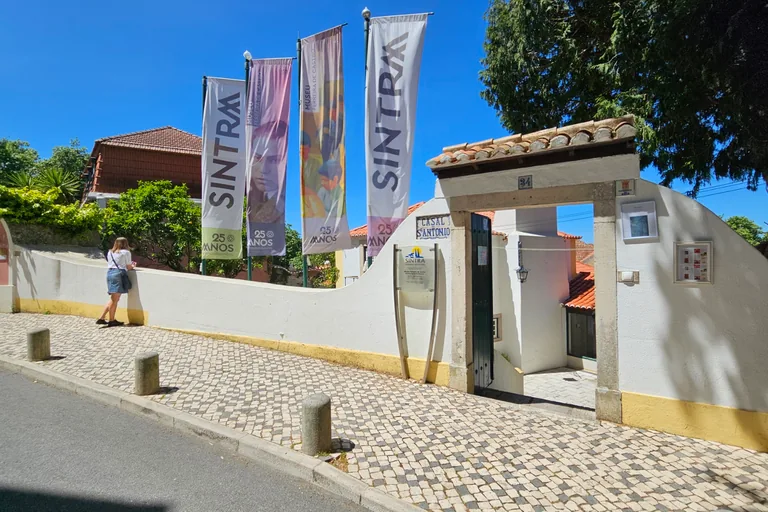
Photo: GualdimG · Wikimedia Commons source · CC BY-SA 4.0 · Cropped to the recorded 3:2 source rectangle and resized from the exact hash-bound source input. Ferreira de Castro Museum
The Ferreira de Castro Museum is a municipal museum, opened in 1982, devoted to the novelist José Maria Ferreira de Castro, author of A Selva, who gave a large part of his collection to Sintra in 1973. The route includes it because he wrote most of his work in Sintra during long stays over about thirty years, and the museum's rooms follow his life in order, from a village childhood and years in the Amazon to translations of his books. Entry is free; the museum is closed on Mondays and most public holidays and is not adapted for reduced mobility, and the street in front is narrow, with light traffic.
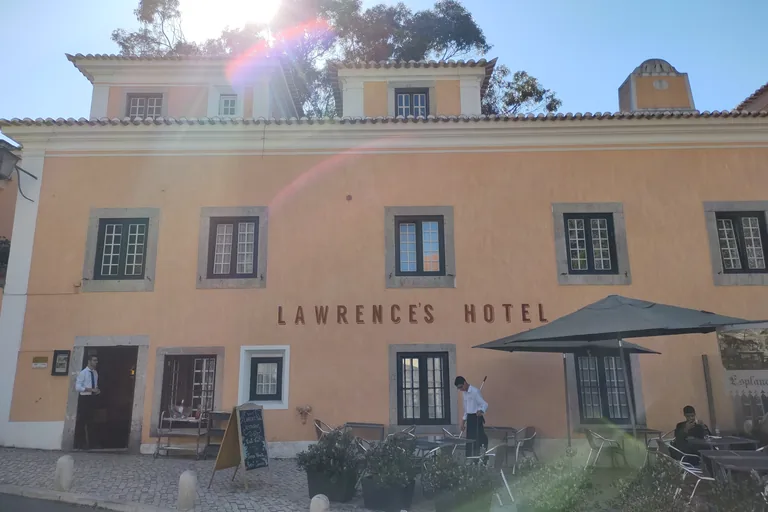
Photo: Addshore · Wikimedia Commons source · CC BY-SA 3.0 · Cropped to the recorded 3:2 source rectangle and resized from the exact hash-bound source input. Lawrence's Hotel
Lawrence's Hotel began taking guests around 1764 under an English family, the Lawrence Oram, who gave it their name; it closed in 1961 and reopened in 1999 after a Dutch couple rebuilt it. The route includes it because foreign travellers drawn to Sintra from the eighteenth century onwards led to hotels such as this one; Lord Byron lodged here in the summer of 1809, and Eça de Queirós made the inn a setting of Os Maias. It is a working hotel, so the stop is made from the pavement opposite its front, on a bend of a narrow street with light traffic; the Ferreira de Castro Museum is next door.
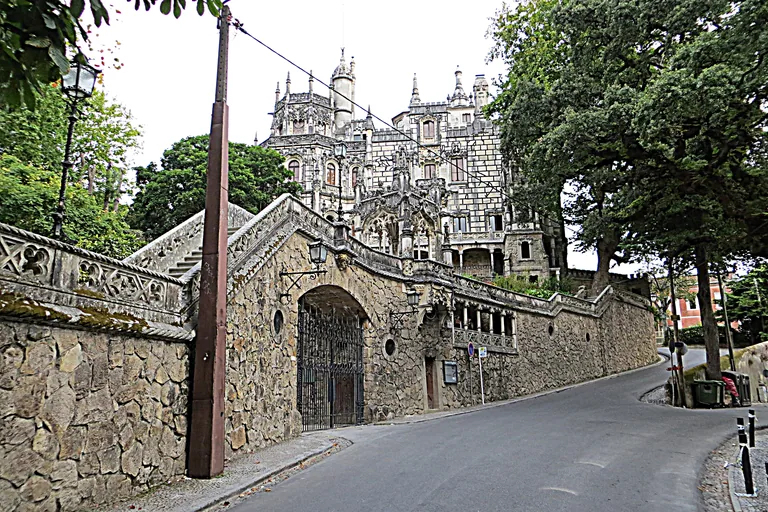
Photo: Mister No · Wikimedia Commons source · CC BY 3.0 · Cropped to the recorded 3:2 source rectangle and resized from the exact hash-bound source input. Quinta da Regaleira
Quinta da Regaleira is an estate bought in 1892 by António Augusto Carvalho Monteiro, whose palace and gardens were designed by the Italian scenographer Luigi Manini and built between 1904 and 1910, with much Manueline revival ornament. The route stops at its gate because it shows the millionaires who summered on this hillside in the early twentieth century; from the road, the carved towers of the palace rise above the estate wall. The town council bought the estate in 1997 and it opened to the public in 1998, with its own tickets and opening hours; the road outside is narrow, with little or no pavement and buses, cars and tuk tuks.
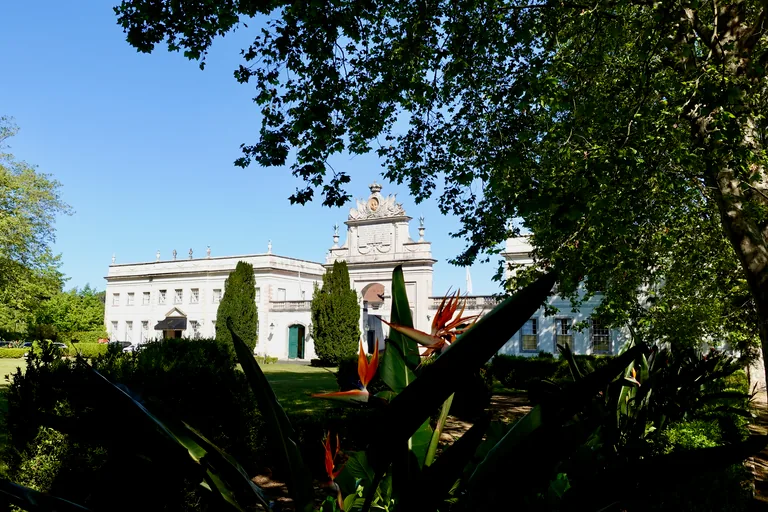
Photo: Rick McCharles from Calgary, Canada · Wikimedia Commons source · CC BY 2.0 · Cropped to the recorded 3:2 source rectangle and resized from the exact hash-bound source input. Seteais Palace
Seteais Palace was built between 1783 and 1787 for Daniel Gildemeester, the Dutch consul in Portugal and a diamond merchant, and in 1802 its two wings were joined by a triumphal arch marking a visit of the Prince Regent João and Carlota Joaquina. The walk ends on the lawn in front, the Campo de Seteais, which a council ruling of 1801 kept from being fenced off, with two gates open to the public, at the far end of the road out of the town. The palace is now a hotel, converted after the State bought it in 1946, so the stop is made outside; the lawn is entered through gates from Rua Barbosa du Bocage, a road with traffic and narrow verges.


.jpg)
.jpg)


.jpg)
.jpg)
Local context
Before you go
This is a line, not a loop, of about two kilometres. It starts at Sintra railway station on Avenida Dr. Miguel Bombarda and ends on the open lawn in front of the Seteais Palace, out along the road west of the old town; it does not climb to Pena or the other palaces on the ridge. The town sits on a hillside, so the roads rise and fall; the bakers' lane, Rua das Padarias, is narrow and sloping, with steps down at its top, and the cobbles are slippery when wet. The last stretch follows Rua Barbosa du Bocage, a narrow road shared with buses, cars and tuk tuks, with little or no pavement in places. The National Palace and the Quinta da Regaleira have their own opening hours and tickets, and the centre is very crowded on summer days.
On the ground
Access and surfaces
A line, not a loop, from the railway station through the old town and out along the road to Seteais, about two kilometres. The town sits on a hillside: the roads rise and fall, the lane of the bakers is narrow and sloping, and the cobbles are slippery when wet. The last stretch follows Rua Barbosa du Bocage, a narrow road with buses, cars and tuk tuks and little or no pavement in places. Every stop works from the street and the audio is written that way. The National Palace and the Quinta da Regaleira have their own opening hours and tickets; the Ferreira de Castro Museum is free and closed on Mondays; the lawn at Seteais is open to the public, and the palace itself is a hotel. The centre is very crowded on summer days.
Frequently asked
Plan the walk
- How long is the Sintra audio walking tour?
- Allow about 100 minutes. The route covers 2 km (1.2 mi) in 9 stops, including walking and listening time.
- Where does the Sintra tour start and end?
- It starts at Sintra railway station on Avenida Dr. Miguel Bombarda and ends on the open lawn in front of the Seteais Palace, on the road west of the old town.
- Is there a pavement on the road to the Quinta da Regaleira and Seteais?
- Not all the way. The last stretch follows Rua Barbosa du Bocage, a narrow road with buses, cars and tuk tuks and little or no pavement in places; at the Quinta da Regaleira, keep to the side by the estate wall.
- Do I need to go inside the National Palace or the Quinta da Regaleira?
- No. Every stop works from the street. The National Palace and the Quinta da Regaleira have their own opening hours and tickets, the Ferreira de Castro Museum is free and closed on Mondays, and the Seteais Palace is a hotel whose lawn is open to the public.
- Will the Sintra audio tour work offline?
- Yes, after download. Audio, stop text, images, and GPS triggering work without data; the live map background still needs a connection.