Seville · Andalusia, Spain
Seville — What the River Brought
Seville is an inland river port where, for over two centuries, the Crown registered every cargo of the American trade — and the city is what that monopoly built, then left behind.
Narration in English · Stop 1 is free
 Tour no. 26
- Stops
- 11
- Distance
- 2.9 km (1.8 mi)
- Time
- About 150 minutes
- Route
- Easy city route
Listen before you buy
Stop 1 · Torre del Oro
Stop 1 is free. Listen before you buy.
The walk
A self-guided audio tour of Seville
Seville is an inland river port where, for over two centuries, the Crown registered every cargo of the American trade — and the city is what that monopoly built, then left behind. This walk follows the river's money from the Almohad watchtower on the bank, through the royal shipyard, the repentant grandee's charity hospital and the archive where an empire kept its receipts, to the converted mosque, the palace a Christian king built in Islamic splendor, and the whitewashed lanes of the old Jewish quarter — ending in the half-circle plaza where, in 1929, the city dressed up as its own memory in painted ceramic.
Route notes
The stops
About each stop · narration stays in the app
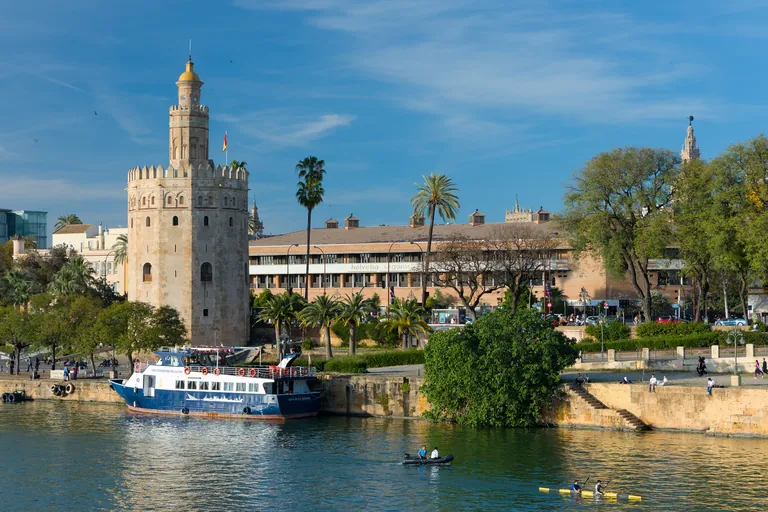
Photo: Benjamin Smith · Wikimedia Commons source · CC BY-SA 4.0 · Cropped to the recorded 3:2 source rectangle and resized from the original. Torre del Oro
Torre del Oro is the early-thirteenth-century Almohad river tower that guarded Seville's Guadalquivir waterfront. The route begins here because the tower makes the river's defensive and commercial importance visible before the walk turns into the monumental centre. The riverside view is free and step-free; check current museum hours before planning to climb inside.
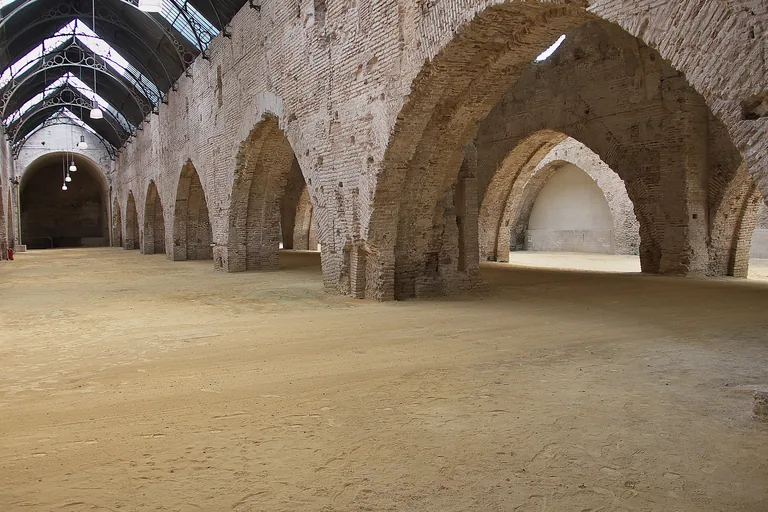
Photo: José Luis Filpo Cabana · Wikimedia Commons source · CC BY 3.0 · Cropped to the recorded 3:2 source rectangle and resized from the original. Royal Shipyards
Seville's Royal Shipyards are the great brick-vaulted naves begun under Alfonso X in the thirteenth century for building and maintaining royal galleys. They follow the river tower to show the industrial scale behind medieval Seville's naval power, later adapted for warehouses and other civic uses. The exterior is reliable from the public street; interior access depends on the site's current cultural programme.
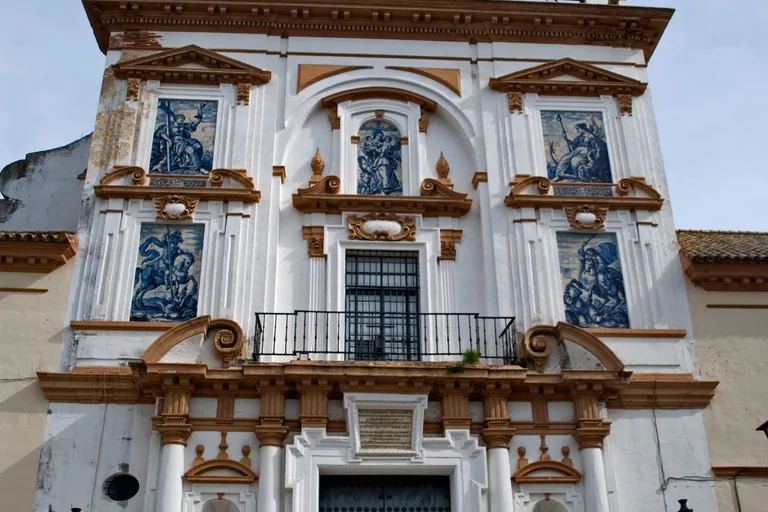
Photo: Anual · Wikimedia Commons source · CC BY 3.0 · Cropped to the recorded 3:2 source rectangle and resized from the original. Hospital de la Caridad
Hospital de la Caridad is the seventeenth-century charitable complex associated with Miguel Mañara, with a Baroque church built beside an institution that cared for the poor and buried the abandoned dead. The route includes it to place Seville's celebrated religious art inside the social work that commissioned and used it. The church façade is visible from the street; interior visiting is ticketed and should yield to worship or charitable activity.
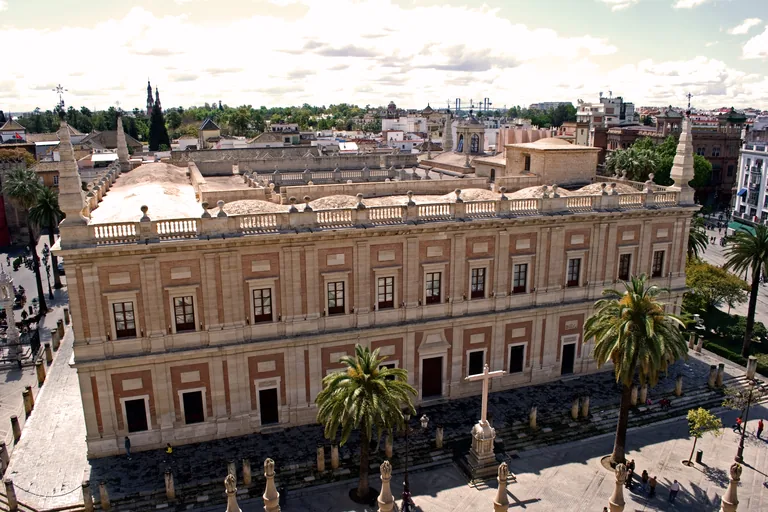
Photo: Anual · Wikimedia Commons source · CC BY 3.0 · Cropped to the recorded 3:2 source rectangle and resized from the original. Archivo de Indias
The Archivo de Indias occupies Seville's former merchants' exchange, a late-sixteenth-century building converted in the eighteenth century to house records of Spain's overseas empire. It stands on the route because the archive turns the wealth and administration behind the surrounding monuments into a physical institution. The exterior is always available; entry is normally controlled by security and exhibitions or opening hours can change.
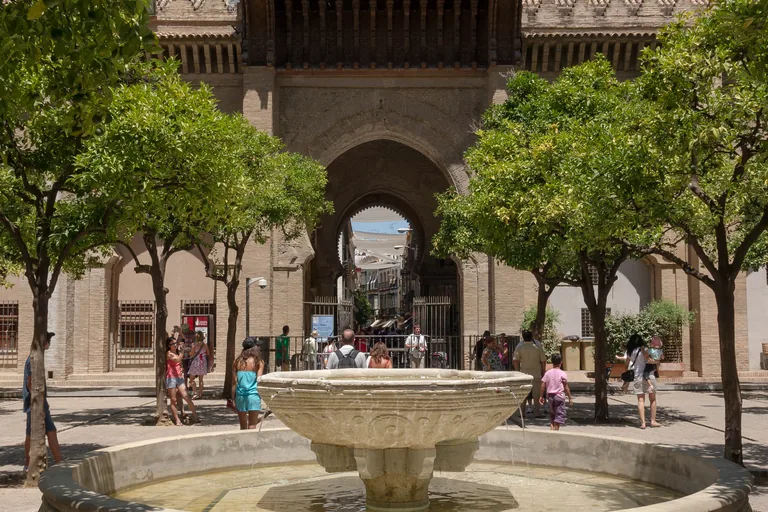
Photo: Jebulon · Wikimedia Commons source · CC0 · Cropped to the recorded 3:2 source rectangle and resized from the original. Seville Cathedral
Seville Cathedral is the vast Gothic church raised on the site of the city's Almohad congregational mosque, retaining the former mosque's courtyard and minaret. The route gives it a separate stop because its scale records the Christian city's deliberate reuse and transformation of the Islamic centre. The exterior and Patio de los Naranjos approaches are public-facing, while cathedral entry is ticketed and worship can alter access.
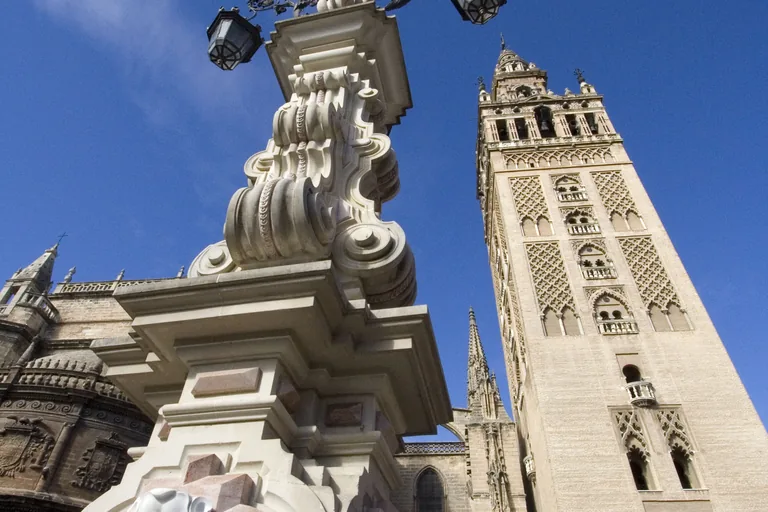
Photo: Gpedro · Wikimedia Commons source · CC BY-SA 3.0 · Cropped to the recorded 3:2 source rectangle and resized from the original. La Giralda
La Giralda is the Almohad mosque's twelfth-century minaret, later converted into the cathedral bell tower and crowned by a Renaissance belfry. It follows the cathedral so the route can read one structure across two religious and architectural lives rather than treating the tower as a detached landmark. The full tower is visible from Plaza Virgen de los Reyes; the interior ascent requires a cathedral ticket and uses long ramps.
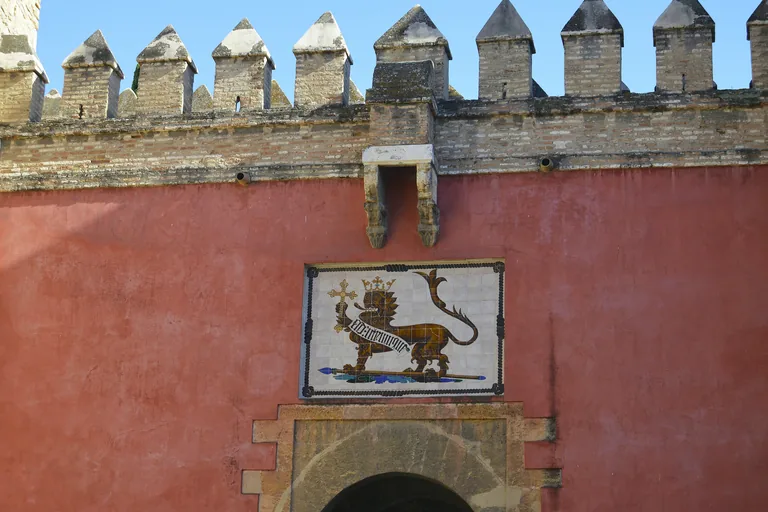
Photo: Alberto-g-rovi · Wikimedia Commons source · CC BY 4.0 · Cropped to the recorded 3:2 source rectangle and resized from the original. Real Alcázar
The Real Alcázar is a continuously used royal palace whose Islamic, Mudéjar, Gothic and later rooms and gardens were built and rebuilt by successive rulers. The route includes it to show how Christian kings adopted Andalusi craft and courtly forms rather than replacing the palace with a single new style. The Puerta del León works as the exterior stop; interiors need a timed ticket and queues can be substantial.
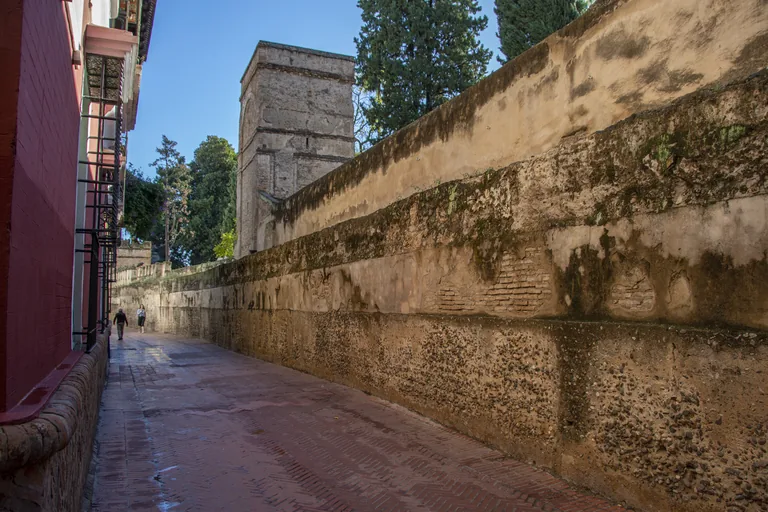
Photo: Anual · Wikimedia Commons source · CC BY-SA 4.0 · Cropped to the recorded 3:2 source rectangle and resized from the original. Barrio Santa Cruz
Barrio Santa Cruz is the dense neighbourhood east of the cathedral, shaped by the old city wall, small plazas and lanes associated with Seville's former Jewish quarter. The route passes through it to connect the royal precinct with lived-in streets instead of jumping between ticketed monuments. The lanes are public and mostly pedestrian, but paving is uneven and the busiest passages become crowded at peak hours.
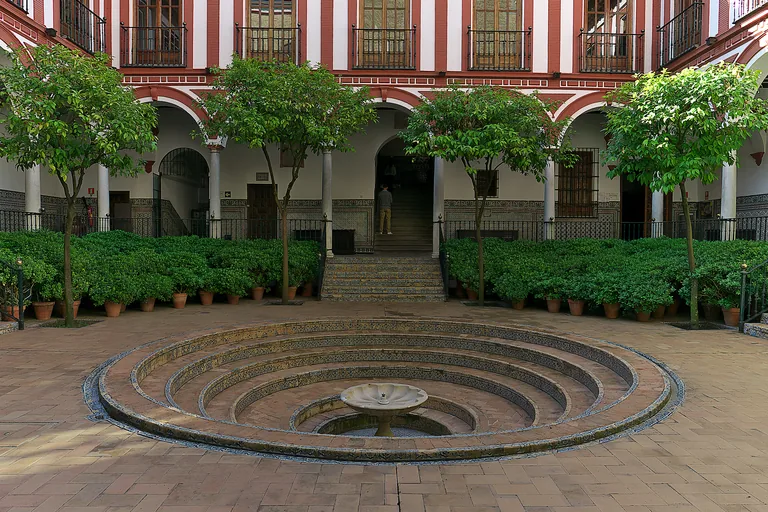
Photo: José Luis Filpo Cabana · Wikimedia Commons source · CC BY-SA 4.0 · Cropped to the recorded 3:2 source rectangle and resized from the original. Hospital de los Venerables
Hospital de los Venerables is a late-seventeenth-century residence for elderly priests arranged around a sunken courtyard and Baroque church. It is included as a quieter counterpoint to the cathedral and Alcázar, showing how institutional architecture fitted into Santa Cruz's small-scale fabric. The courtyard and art centre require admission; the surrounding plaza and façade remain available without a ticket.
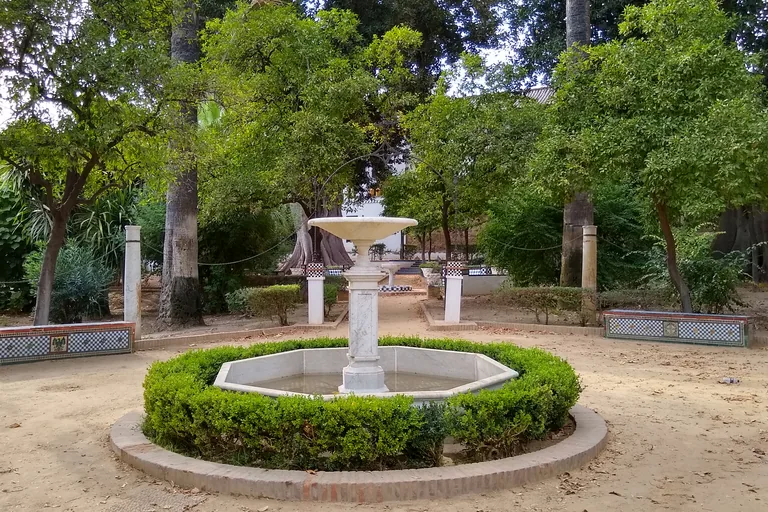
Photo: CarlosVdeHabsburgo · Wikimedia Commons source · CC BY-SA 4.0 · Cropped to the recorded 3:2 source rectangle and resized from the original. Jardines de Murillo
Jardines de Murillo are early-twentieth-century public gardens created from land once belonging to the Alcázar's orchards. The route uses them as a shaded transition from the old walls and Santa Cruz toward the open scale of Plaza de España. The gardens are free, but paths, opening conditions and temporary closures should be checked locally after severe weather or events.
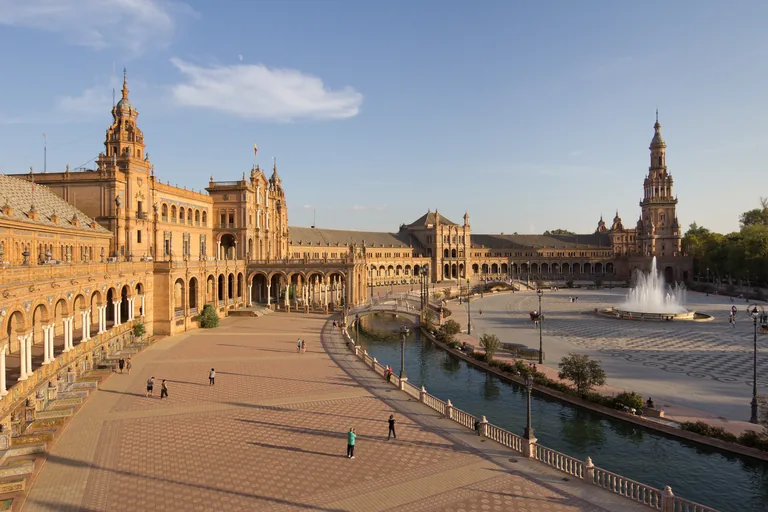
Photo: Carlos Delgado · Wikimedia Commons source · CC BY-SA 4.0 · Cropped to the recorded 3:2 source rectangle and resized from the original. Plaza de España
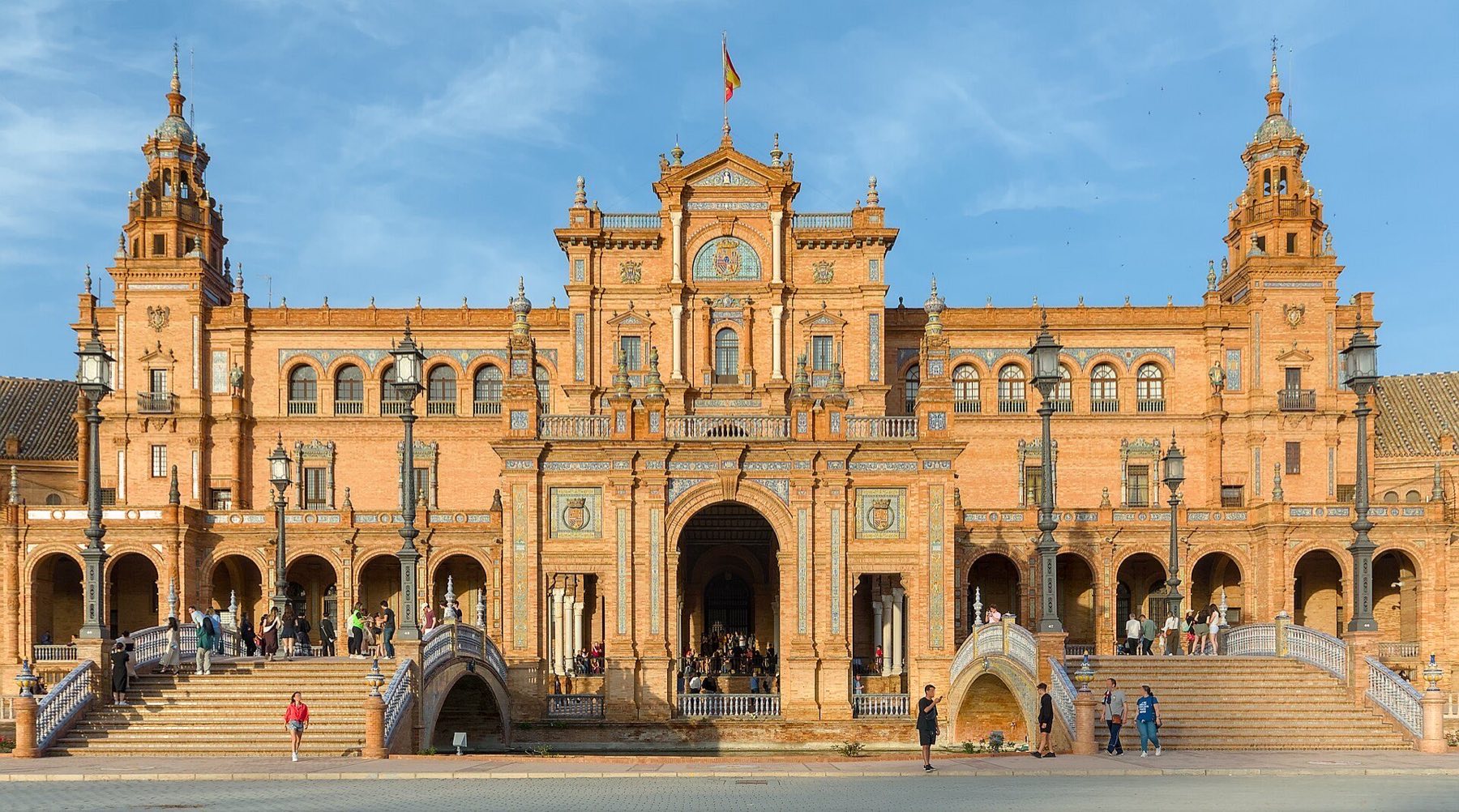
Plaza de España is the semicircular brick, tile and canal ensemble built for the 1929 Ibero-American Exposition. It closes the route because the plaza recasts Seville's historical styles as a modern national spectacle on a scale unlike the medieval centre. The square is free and broadly accessible, although events, heat and limited shade can affect the best time to visit.


.jpg)

.jpg)
_01.jpg)
_-_01.jpg)
Local context
Before you go
The published route starts at Paseo de Cristóbal Colón, s/n, 41001 Sevilla, España. It begins at Torre del Oro and ends at Plaza de España.
On the ground
Access and surfaces
Flat riverside and city-centre walking on paved streets and smooth stone; no significant climbs. The Santa Cruz stretch narrows to pedestrian lanes with occasional single shallow steps and heavy foot traffic at mid-day. All stops are written to work from public exterior positions; the cathedral, Alcázar, Caridad and Venerables interiors are ticketed and optional. The final stretch to Plaza de España crosses two signalled avenues.
Frequently asked
Plan the walk
- How long is the Seville audio walking tour?
- Allow about 150 minutes. The self-guided route covers 2.9 km (1.8 mi) in 11 stops, including walking and listening time.
- Where does the Seville tour start and end?
- It starts at Paseo de Cristóbal Colón, s/n, 41001 Sevilla, España. The published route begins at Torre del Oro and ends at Plaza de España.
- Will the Seville audio tour work offline?
- Yes, after download. Audio, stop text, images, and GPS triggering work without data; the live map background still needs a connection.