Palermo · Sicily, Italy
Palermo — The Cassaro
Palermo's oldest street was traced when the city was founded and runs dead straight from the high ground down to the water.
Narration in English · Stop 1 is free
 Tour no. 22
- Stops
- 12
- Distance
- 3.9 km (2.4 mi)
- Time
- About 165 minutes
- Route
- Moderate walking route
Listen before you buy
Stop 1 · Porta Nuova
Stop 1 is free. Listen before you buy.
The walk
A self-guided audio tour of Palermo
Palermo's oldest street was traced when the city was founded and runs dead straight from the high ground down to the water. Every power that took the city rebuilt along it and renamed it: the Arabs built the palace the street is still named after, the Normans called it the marble road, the Spanish put a monumental gate at each end. This walk goes down it in that order — past a chapel with an Islamic ceiling over a Christian nave, a cathedral that was a mosque and still carries a verse of the Qur'an on one column, a crossroads cut into four curved facades, and an Inquisition prison with the prisoners' writing under four layers of plaster — with detours into two markets, one trading here for a thousand years and one that has nearly stopped.
Route notes
The stops
About each stop · narration stays in the app
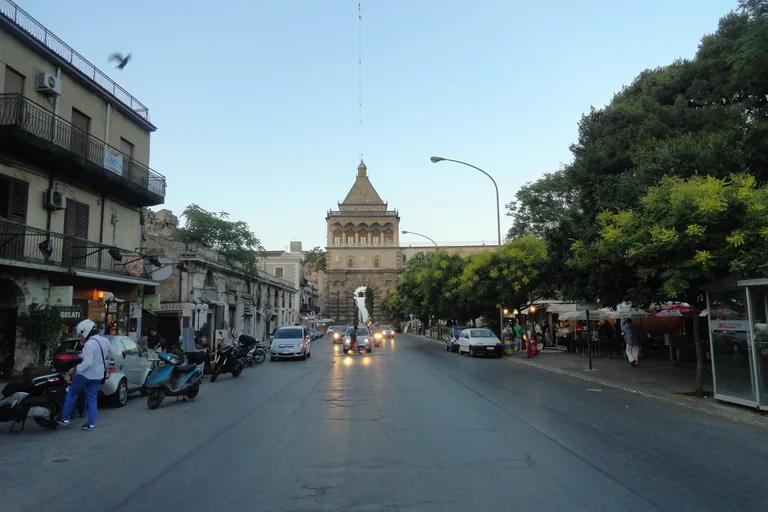
Photo: l0da_ralta · Wikimedia Commons source · CC BY 2.0 · Cropped to the recorded 3:2 source rectangle and resized from the original. Porta Nuova
Porta Nuova is the monumental western gate rebuilt in the sixteenth century beside the Norman Palace, with a façade celebrating Charles V's conquest of Tunis. The route begins here because the gate turns imperial triumph into the threshold of Palermo's long east–west axis. It is an open-air landmark on a busy junction; use the pavements and crossings rather than standing in the carriageway.
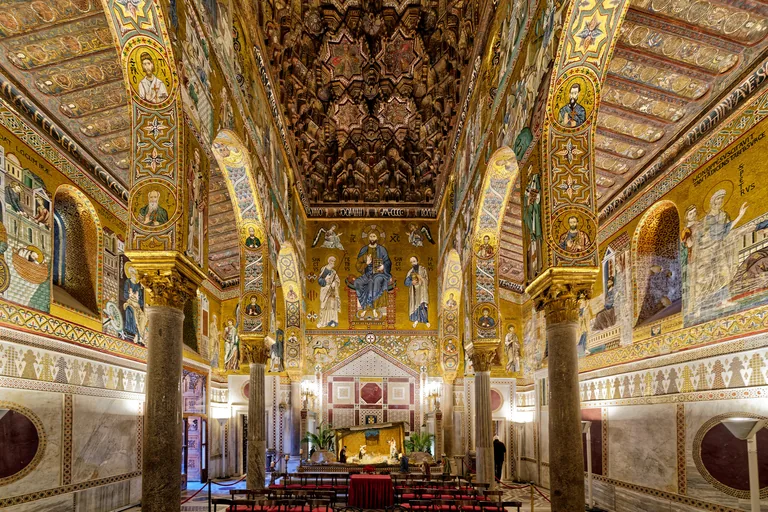
Photo: Holger Uwe Schmitt · Wikimedia Commons source · CC BY-SA 4.0 · Cropped to the recorded 3:2 source rectangle and resized from the original. Palazzo dei Normanni and the Cappella Palatina
Palazzo dei Normanni is Sicily's royal palace, where Norman rulers built over earlier strongholds and created the mosaic-lined Cappella Palatina in the twelfth century. The route includes the palace first because its Arabic, Byzantine and Latin workmanship establishes Palermo's court culture before the walk enters the city. The exterior is always visible, while palace and chapel access is ticketed and can be restricted by parliamentary business or worship.
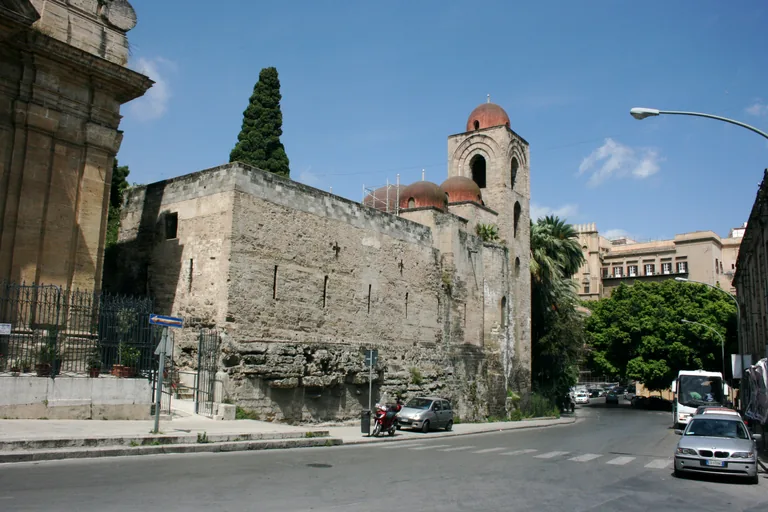
Photo: Matthias Süßen · Wikimedia Commons source · CC BY-SA 2.5 · Cropped to the recorded 3:2 source rectangle and resized from the original. San Giovanni degli Eremiti
San Giovanni degli Eremiti is a Norman-period monastic church whose compact stone volumes and red domes stand beside a cloister and garden. It follows the royal palace to show the same twelfth-century court translating Mediterranean building traditions into a smaller religious complex. The domes can be seen from outside; entry to the cloister and church is ticketed and includes uneven historic surfaces.
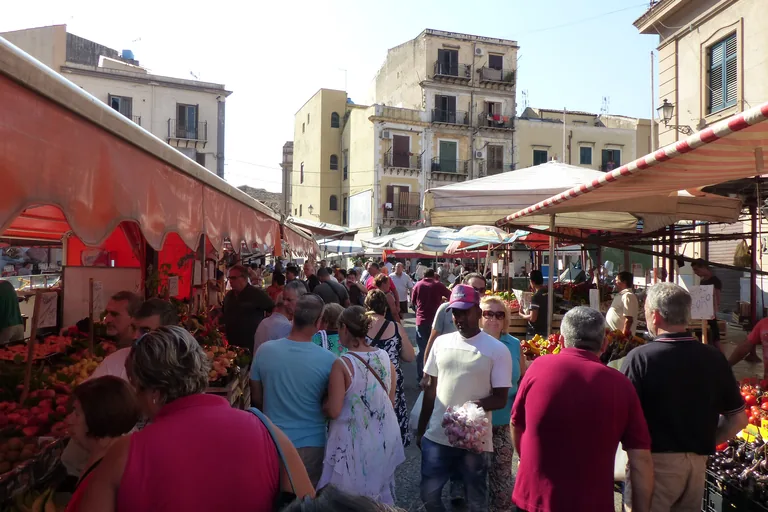
Photo: Benjamín Núñez González · Wikimedia Commons source · CC BY-SA 4.0 · Cropped to the recorded 3:2 source rectangle and resized from the original. Mercato di Ballarò
Ballarò is Palermo's largest historic street market, running through the Albergheria with produce, prepared food and household trade. The route enters it to keep the city's layered architecture connected to the neighbourhood commerce that still uses these streets. Market intensity varies by day and hour; expect crowds, uneven paving and active deliveries, and keep valuables secure.
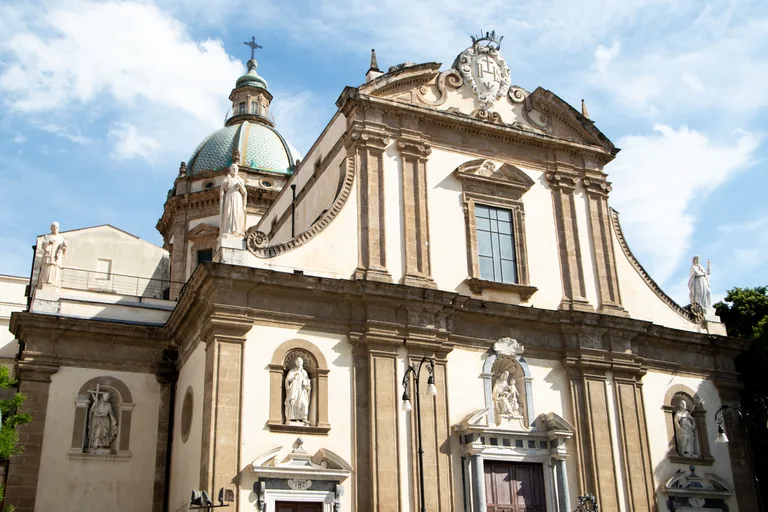
Photo: Julian Lupyan · Wikimedia Commons source · CC0 · Cropped to the recorded 3:2 source rectangle and resized from the original. Chiesa del Gesù (Casa Professa)
Chiesa del Gesù, known as Casa Professa, is Palermo's Jesuit church, rebuilt and decorated from the late sixteenth century with an exceptionally dense marble interior. It is included because the church shows Baroque decoration operating as an organised Jesuit programme rather than surface ornament alone. The façade and forecourt are public; interior access is governed by worship, restoration and visitor hours.
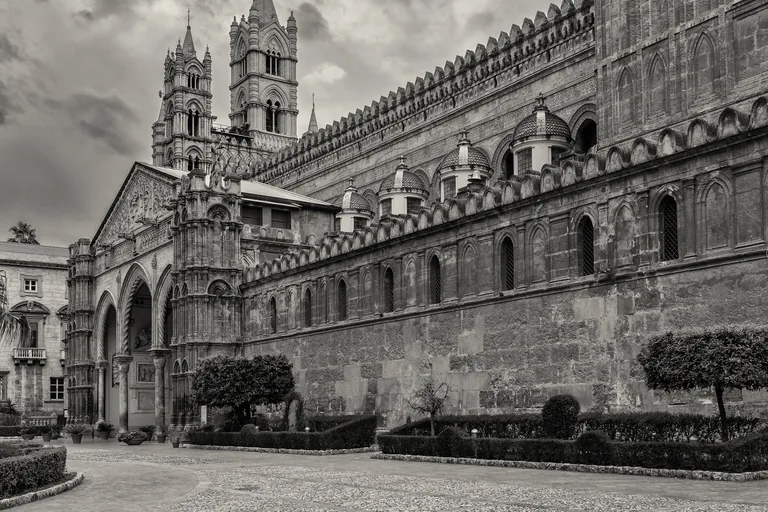
Photo: Mario Giambanco · Wikimedia Commons source · CC BY-SA 4.0 · Cropped to the recorded 3:2 source rectangle and resized from the original. Cattedrale di Palermo
Palermo Cathedral is a repeatedly altered complex that combines Norman foundations, later towers and portals, royal tombs and an eighteenth-century dome. The route gives it its own stop because no single façade or period can explain the building's role in royal, religious and civic Palermo. The nave may be free when open, while roofs, tombs and treasury use separate tickets and access conditions.
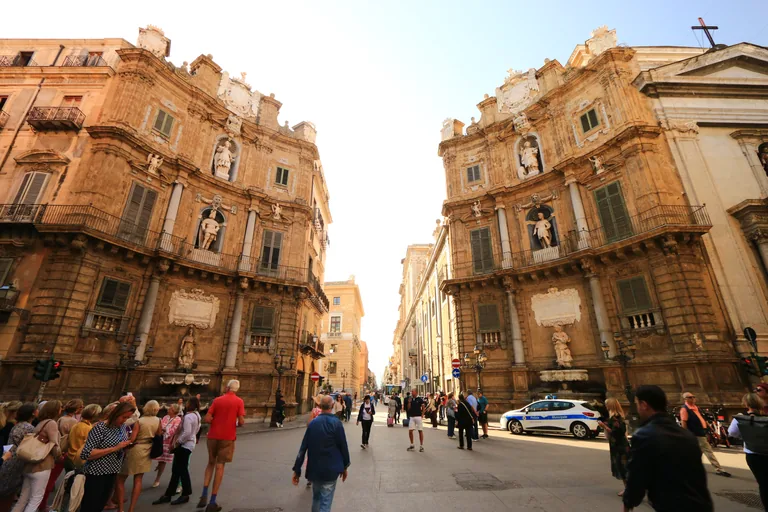
Photo: Benjamin Smith · Wikimedia Commons source · CC BY-SA 4.0 · Cropped to the recorded 3:2 source rectangle and resized from the original. Quattro Canti
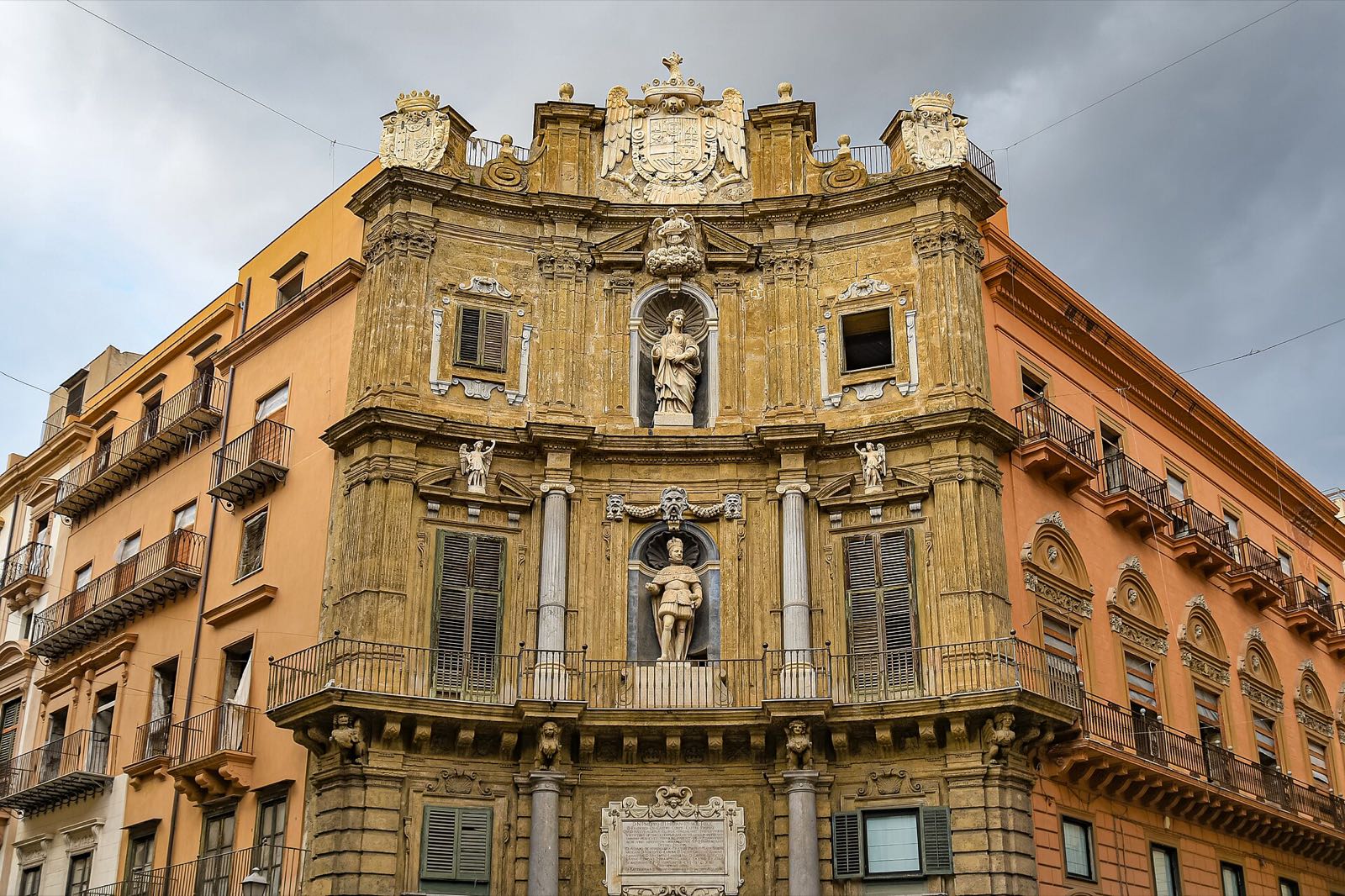
Quattro Canti is the octagonal Baroque crossing formed by four concave façades at the meeting of Palermo's two principal streets. The route pauses here because the intersection made seventeenth-century urban order visible through seasons, rulers and patron saints carved into its corners. The monument is open-air but surrounded by live traffic; view the façades from pavements and crossing refuges.
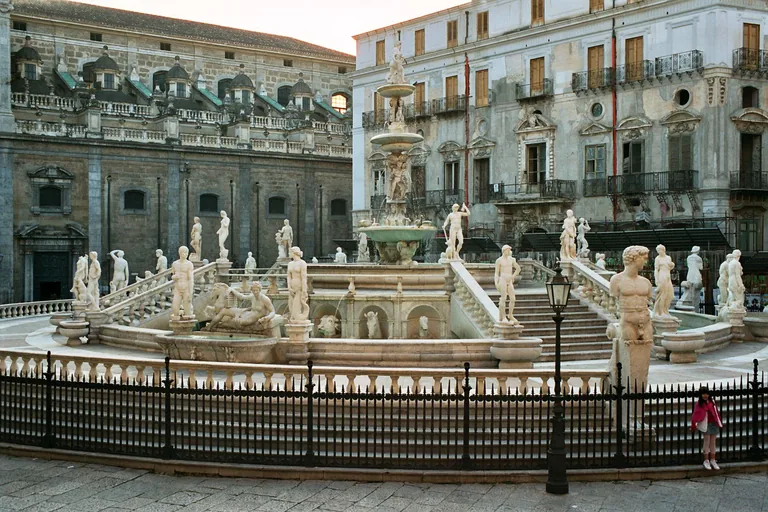
Photo: Bjs · Wikimedia Commons source · CC0 · Cropped to the recorded 3:2 source rectangle and resized from the original. Fontana Pretoria
Fontana Pretoria is the large sixteenth-century Florentine fountain reassembled in Palermo with concentric basins, river figures and classical nudes. It follows Quattro Canti to show how imported court art was made the centrepiece of a Sicilian civic square. The fountain is free to view from the square; temporary barriers, maintenance and intense midday sun can affect the closest approach.
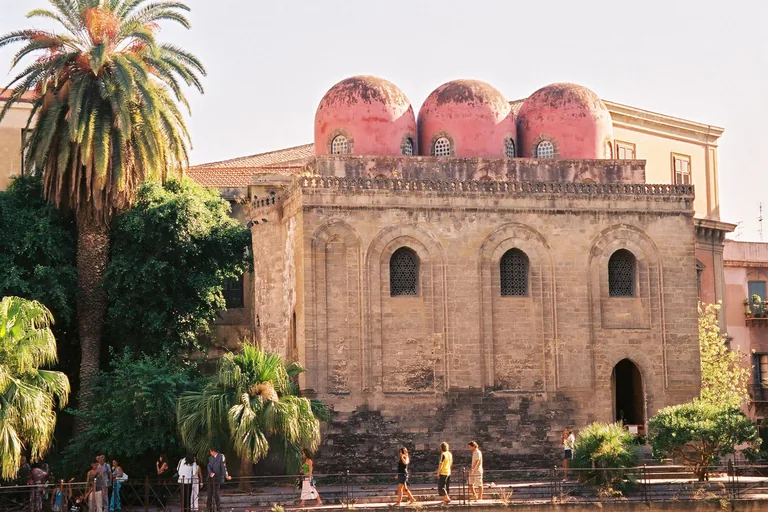
Photo: Bjs · Wikimedia Commons source · CC0 · Cropped to the recorded 3:2 source rectangle and resized from the original. Piazza Bellini — La Martorana and San Cataldo
Piazza Bellini sets two twelfth-century churches side by side: La Martorana with its Byzantine mosaics and San Cataldo with three red domes and a spare stone interior. The route pairs them because their different plans and later histories prevent Palermo's Norman-Arab-Byzantine label from becoming a single visual formula. The square is free, but each church keeps separate ticketing, worship and opening arrangements.
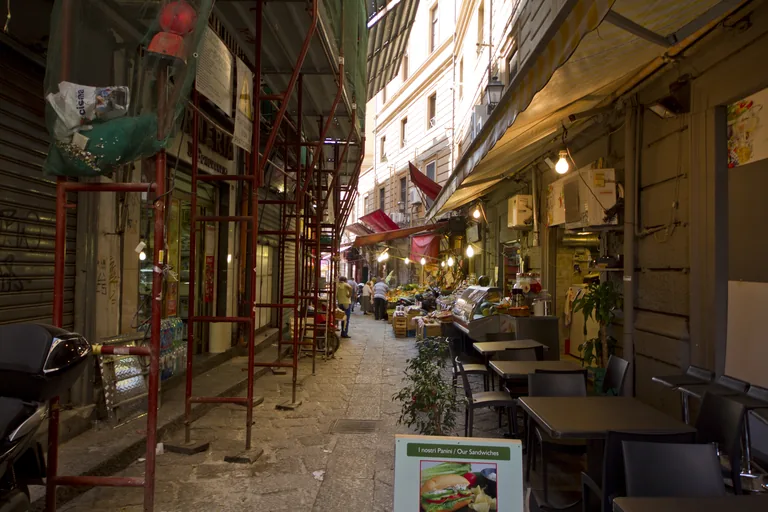
Photo: trolvag · Wikimedia Commons source · CC BY-SA 3.0 · Cropped to the recorded 3:2 source rectangle and resized from the original. La Vucciria
La Vucciria is the old market district between Via Roma and the port, now mixing surviving food trade with bars, street food and nightlife. The route crosses it to show a commercial quarter changing use rather than presenting the market as a preserved folkloric scene. Conditions differ sharply between morning and late evening; expect broken paving, crowds and noise.
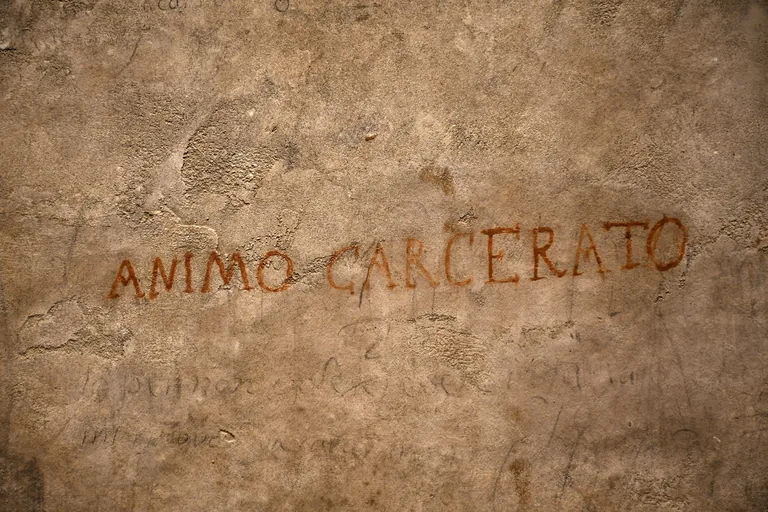
Photo: Phyrexian · Wikimedia Commons source · CC BY-SA 4.0 · Cropped to the recorded 3:2 source rectangle and resized from the original. Palazzo Chiaramonte-Steri
Palazzo Chiaramonte-Steri is a fourteenth-century fortified palace later used by Spanish viceroys and the Inquisition, with prisoners' graffiti surviving in its cells. The route includes it because one building holds Palermo's aristocratic, governmental and coercive institutions in sequence. The exterior courtyard is accessible from the square; the historic rooms and prison cells require a guided or timed visit.
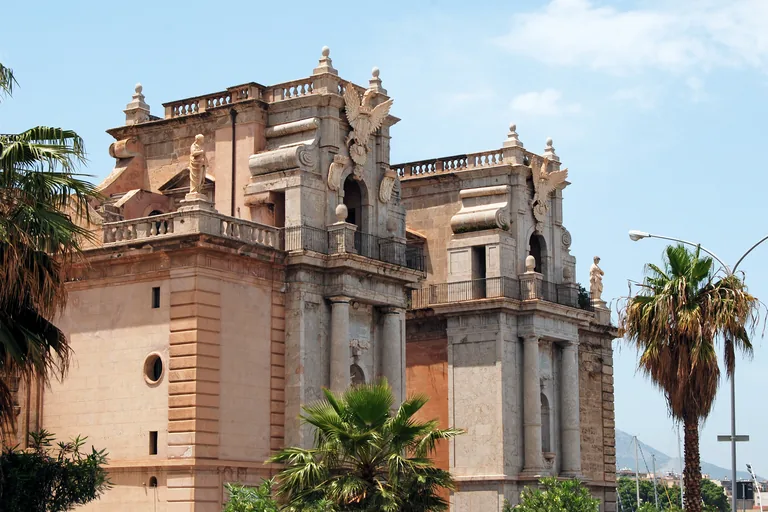
Photo: Harvey Barrison · Wikimedia Commons source · CC BY-SA 2.0 · Cropped to the recorded 3:2 source rectangle and resized from the original. Porta Felice and the Foro Italico
Porta Felice is the paired seaward gate begun at the end of the sixteenth century, opening the Cassaro onto the waterfront and today's Foro Italico. It closes the route by carrying Palermo's main street out to the open coast after the dense markets and palaces inland. The gate and promenade are free, exposed to wind and sun, and separated from parts of the waterfront by traffic crossings.


.jpg)


.jpg)


Local context
Before you go
The published route starts at Via Vittorio Emanuele, 475, 90134 Palermo PA, Italia. It begins at Porta Nuova and ends at Porta Felice and the Foro Italico.
On the ground
Access and surfaces
A long, gently downhill line rather than a loop: the walk starts on the high ground at the palace and ends at the sea about 60 m lower, so it is easier in this direction than reversed, and it does not return to its start. Most of the route is pedestrianised, but the paving is worn stone and uneven throughout the old town. Two stretches are harder than the rest. The detour into the Ballarò market runs through narrow lanes that are crowded, often wet and obstructed by crates and delivery vehicles — the least step-free part of the walk. Piazza Bellini is reached by a short flight of steps. Every stop is written to work from a free public position. The palace and its chapel, San Giovanni degli Eremiti, the two churches on Piazza Bellini, the cathedral's tombs and treasury, and the Steri's Inquisition cells are all ticketed and optional, and several keep restricted hours. Timing changes what two stops are: Ballarò is a morning market and is largely packed up by mid-afternoon, and the Vucciria is quiet by day and busy after dark.
Frequently asked
Plan the walk
- How long is the Palermo audio walking tour?
- Allow about 165 minutes. The self-guided route covers 3.9 km (2.4 mi) in 12 stops, including walking and listening time.
- Where does the Palermo tour start and end?
- It starts at Via Vittorio Emanuele, 475, 90134 Palermo PA, Italia. The published route begins at Porta Nuova and ends at Porta Felice and the Foro Italico.
- Will the Palermo audio tour work offline?
- Yes, after download. Audio, stop text, images, and GPS triggering work without data; the live map background still needs a connection.