Milan · Lombardy, Italy
Milan — Power on Display
Milan has repeatedly made power visible, then changed the meaning of the same streets and monuments.
Narration in English · Stop 1 is free
 Tour no. 28
- Stops
- 8
- Distance
- 3.2 km (2 mi)
- Time
- About 115 minutes
- Route
- Moderate walking route
Listen before you buy
Stop 1 · Piazza Affari and L.O.V.E.
Stop 1 is free. Listen before you buy.
The walk
A self-guided audio tour of Milan
Milan has repeatedly made power visible, then changed the meaning of the same streets and monuments. This outdoor walk moves from the stock exchange and medieval civic centre through the Duomo district to a reconstructed ducal castle and an arch whose dedication changed with the regime. The route is designed first for a staging field beta; public release is a separate decision.
Route notes
The stops
About each stop · narration stays in the app
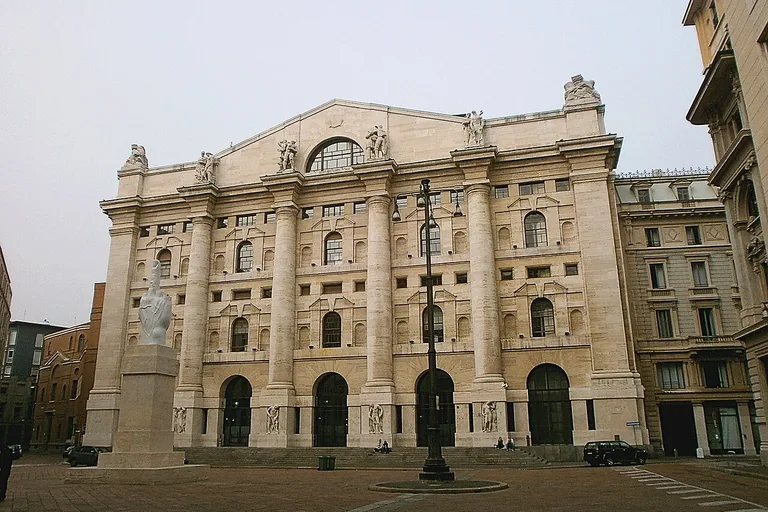
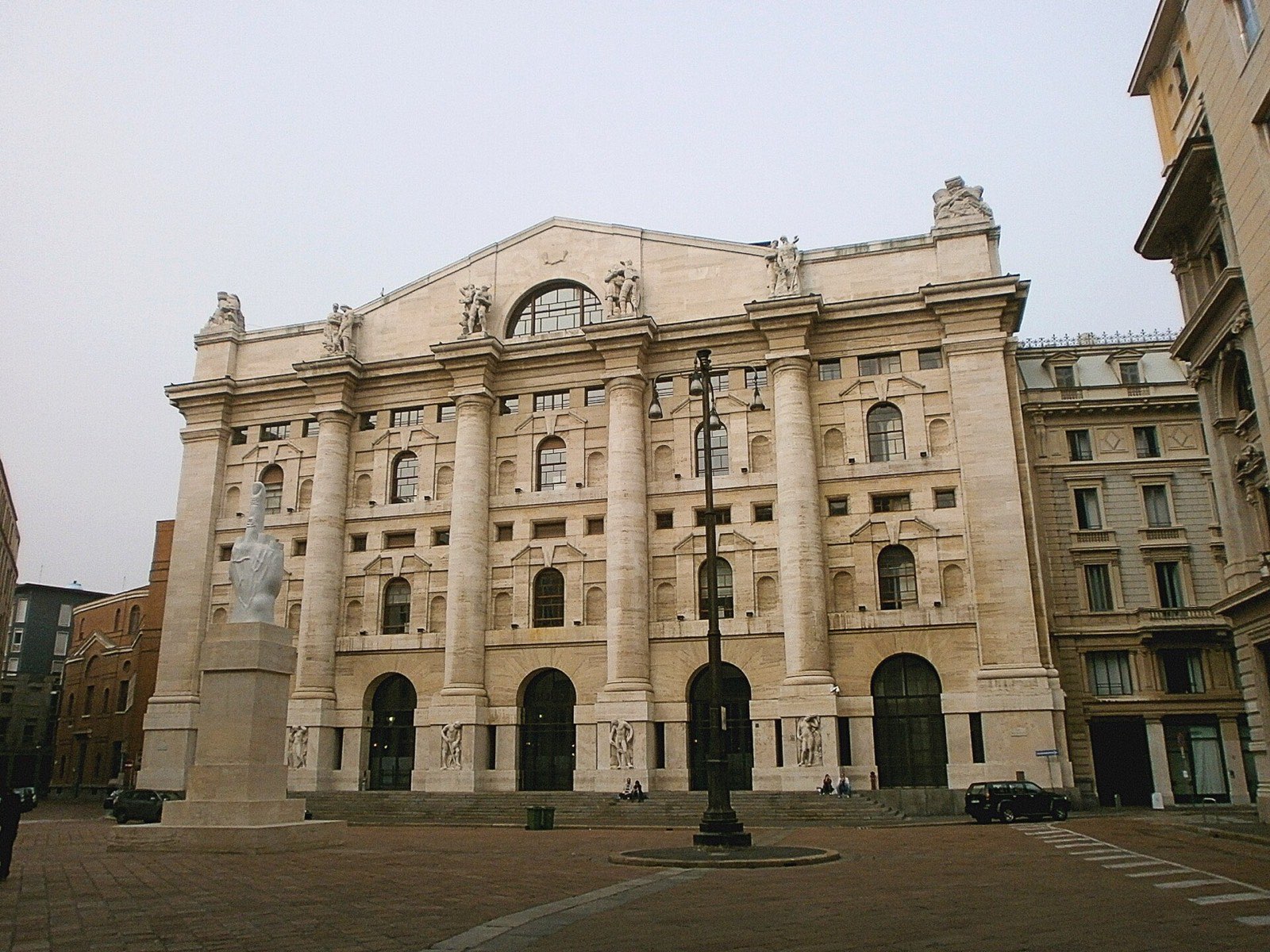
Photo: Stefano Stabile · Wikimedia Commons source · CC BY-SA 3.0 · Cropped to the recorded 3:2 source rectangle and resized from the exact hash-bound source input. Piazza Affari and L.O.V.E.
Piazza Affari sets Maurizio Cattelan's L.O.V.E. sculpture against Palazzo Mezzanotte, the monumental headquarters built for Milan's stock exchange. The route begins with a deliberate clash between institutional authority and a contemporary public artwork whose meaning remains contested. Use the pedestrian centre of the broad square and stay clear of vehicle approaches on its eastern and western edges.
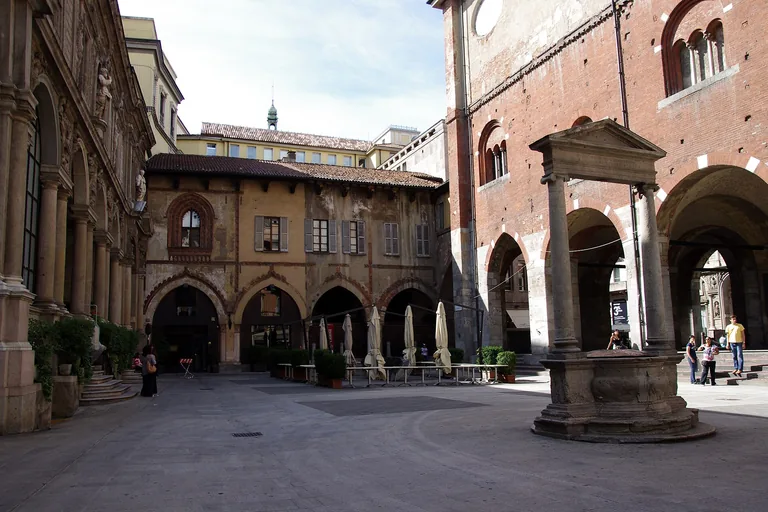
Photo: Jakub Hałun · Wikimedia Commons source · CC BY-SA 4.0 · Cropped to the recorded 3:2 source rectangle and resized from the exact hash-bound source input. Piazza Mercanti
Piazza Mercanti is Milan's compact medieval civic centre, organised around the Palazzo della Ragione and buildings associated with trade and communal government. It follows Piazza Affari to compare two different architectures of commerce and public authority only a short walk apart. The square is pedestrian but its historic paving is uneven and the approaches are narrow.
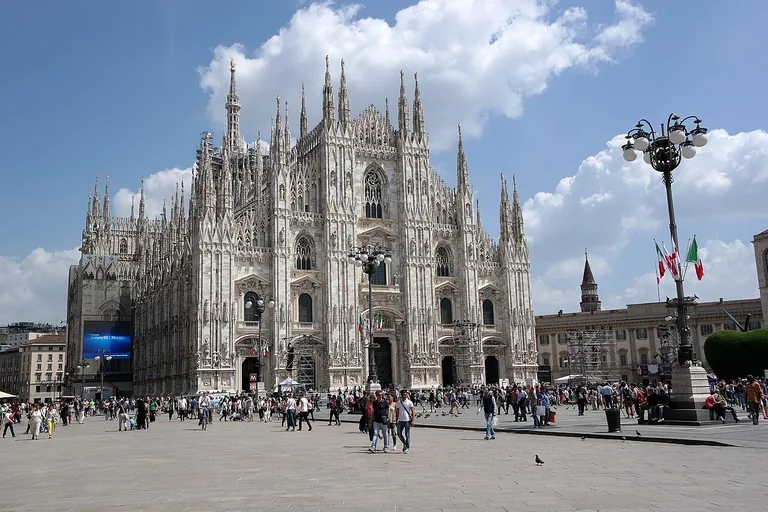
Photo: Luca Aless · Wikimedia Commons source · CC BY-SA 4.0 · Cropped to the recorded 3:2 source rectangle and resized from the exact hash-bound source input. Milan Cathedral — Piazza Duomo Exterior
Milan Cathedral is the result of centuries of construction, changing designers and continuing institutional stewardship rather than one moment or author. The route uses its exterior to make long building processes visible before entering the nineteenth-century commercial city beside it. Piazza Duomo is free but crowded, with mixed slabs, cobbles and temporary barriers; no cathedral ticket is required for this stop.
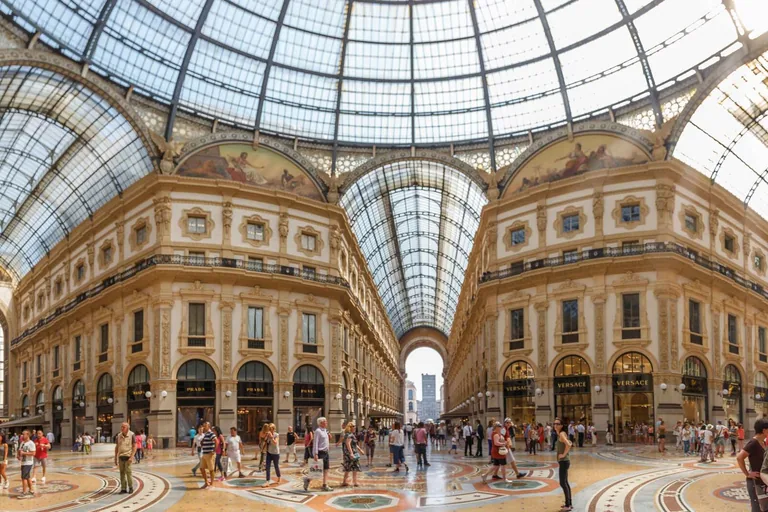
Photo: Photograph: Marco Pagani Derivative work: Arrow303 · Wikimedia Commons source · CC BY 3.0 · Cropped to the recorded 3:2 source rectangle and resized from the exact hash-bound source input. Galleria Vittorio Emanuele II — South Portal
The Galleria Vittorio Emanuele II is a glass-roofed commercial passage built as part of post-unification Milan between Piazza Duomo and Piazza della Scala. Crossing its south portal shifts the route from dynastic cathedral building to modern mass commerce and urban spectacle. Dense pedestrian flows gather at the entrance, so use the open square outside and do not block the portal.
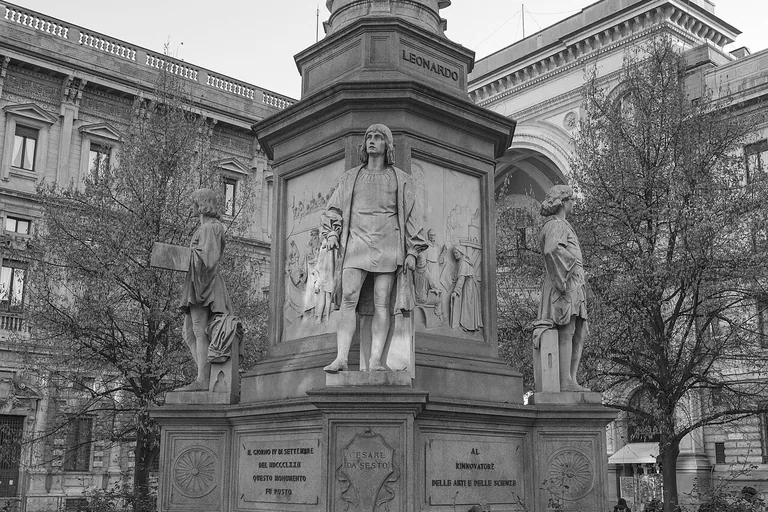
Photo: Giorgio Galeotti · Wikimedia Commons source · CC BY-SA 4.0 · Cropped to the recorded 3:2 source rectangle and resized from the exact hash-bound source input. Piazza della Scala
Piazza della Scala brings the opera house, Palazzo Marino, the Galleria and a monument to Leonardo into one relatively modern civic square. The route pauses here to show how demolition and rearrangement made cultural and municipal institutions face one another. Remain within the level pedestrian area and watch for trams and vehicles around the square's perimeter.
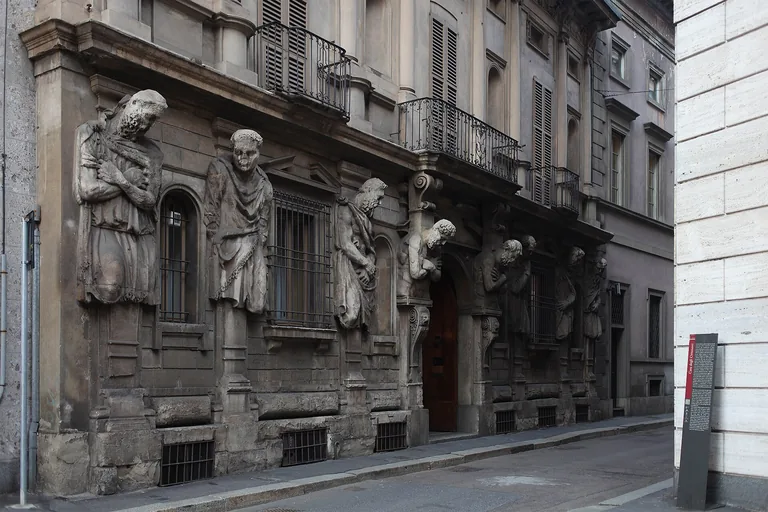
Photo: Paolobon140 · Wikimedia Commons source · CC BY-SA 4.0 · Cropped to the recorded 3:2 source rectangle and resized from the exact hash-bound source input. Casa degli Omenoni — Street Exterior
Casa degli Omenoni is Leone Leoni's sixteenth-century residence, its façade carried by eight monumental stone figures that turn a private house into a public claim of status. It gives the route a close, street-scale expression of power before the longer walk to the ducal castle. The exterior-only stop is on a narrow working street, so stand opposite the façade without blocking pavements or doorways.
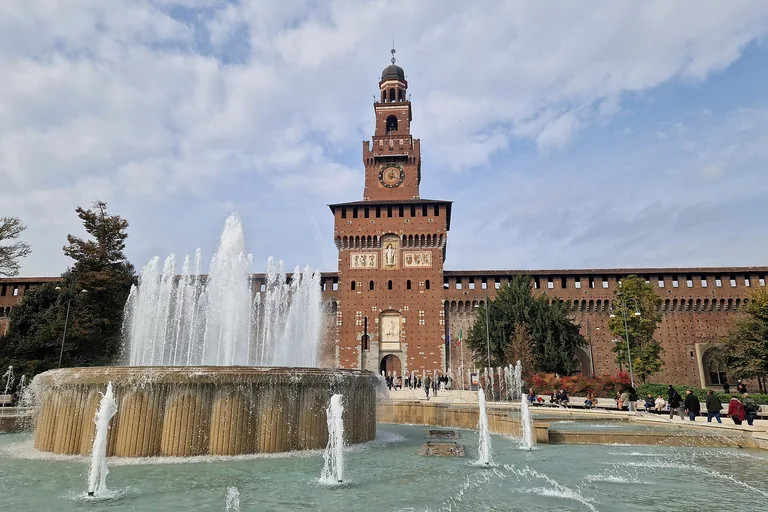
Photo: Gerda Arendt · Wikimedia Commons source · CC0 · Cropped to the recorded 3:2 source rectangle and resized from the exact hash-bound source input. Sforza Castle — Torre del Filarete Exterior
Sforza Castle moved from ducal residence to foreign garrison and civic monument, while the visible Filarete tower is a modern reconstruction. The route includes it as the largest example of Milan repeatedly changing both a building's use and the story told by its restoration. The forecourt view is free and outside ticketed areas; expect crowds, paving seams and spray around the fountain.
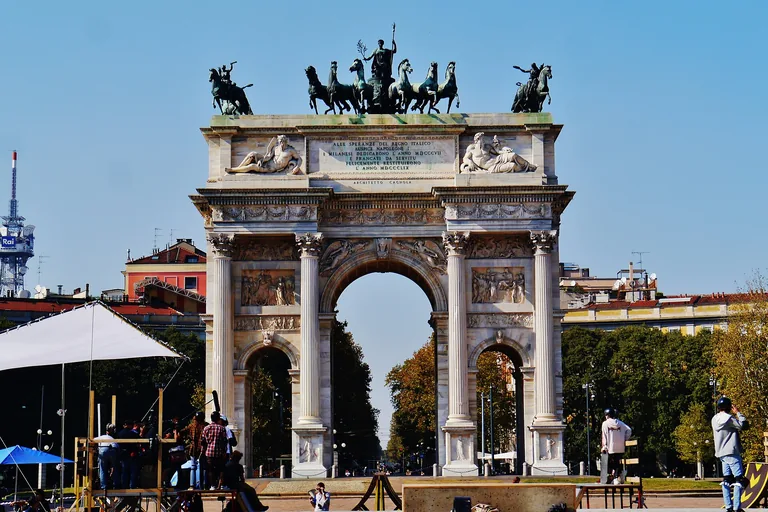
Photo: Zairon · Wikimedia Commons source · CC BY-SA 4.0 · Cropped to the recorded 3:2 source rectangle and resized from the exact hash-bound source input. Arco della Pace
Arco della Pace was begun under Napoleonic rule and completed with a new political dedication after the restoration of Austrian authority. It closes the route with one stone monument whose official meaning changed as regimes changed around it. The broad park-side approach is level and public, and the arch remains visible from surrounding streets if Parco Sempione is closed.


-edit.jpg)

;_veduta_di_tre_quarti.jpg)


Local context
Before you go
The published route starts at Piazza degli Affari, 20123 Milano. It begins at Piazza Affari and L.O.V.E. and ends at Arco della Pace.
On the ground
Access and surfaces
All narration is written for public outdoor standing points and requires no paid indoor admission. The central squares are mostly level but combine stone slabs, cobbles, tram corridors, crowds and occasional temporary barriers; the final two legs are each close to one kilometre. Piazza Duomo can be exceptionally congested. Parco Sempione's published opening hours vary seasonally, but the final Arco stop remains reachable from public streets if the park route is closed. Check live conditions before the field beta and keep the app's location-denial/manual fallback available.
Frequently asked
Plan the walk
- How long is the Milan audio walking tour?
- Allow about 115 minutes. The self-guided route covers 3.2 km (2 mi) in 8 stops, including walking and listening time.
- Where does the Milan tour start and end?
- It starts at Piazza degli Affari, 20123 Milano. The published route begins at Piazza Affari and L.O.V.E. and ends at Arco della Pace.
- Will the Milan audio tour work offline?
- Yes, after download. Audio, stop text, images, and GPS triggering work without data; the live map background still needs a connection.