Khiva · Xorazm Region, Uzbekistan
Khiva — The Last Khanate
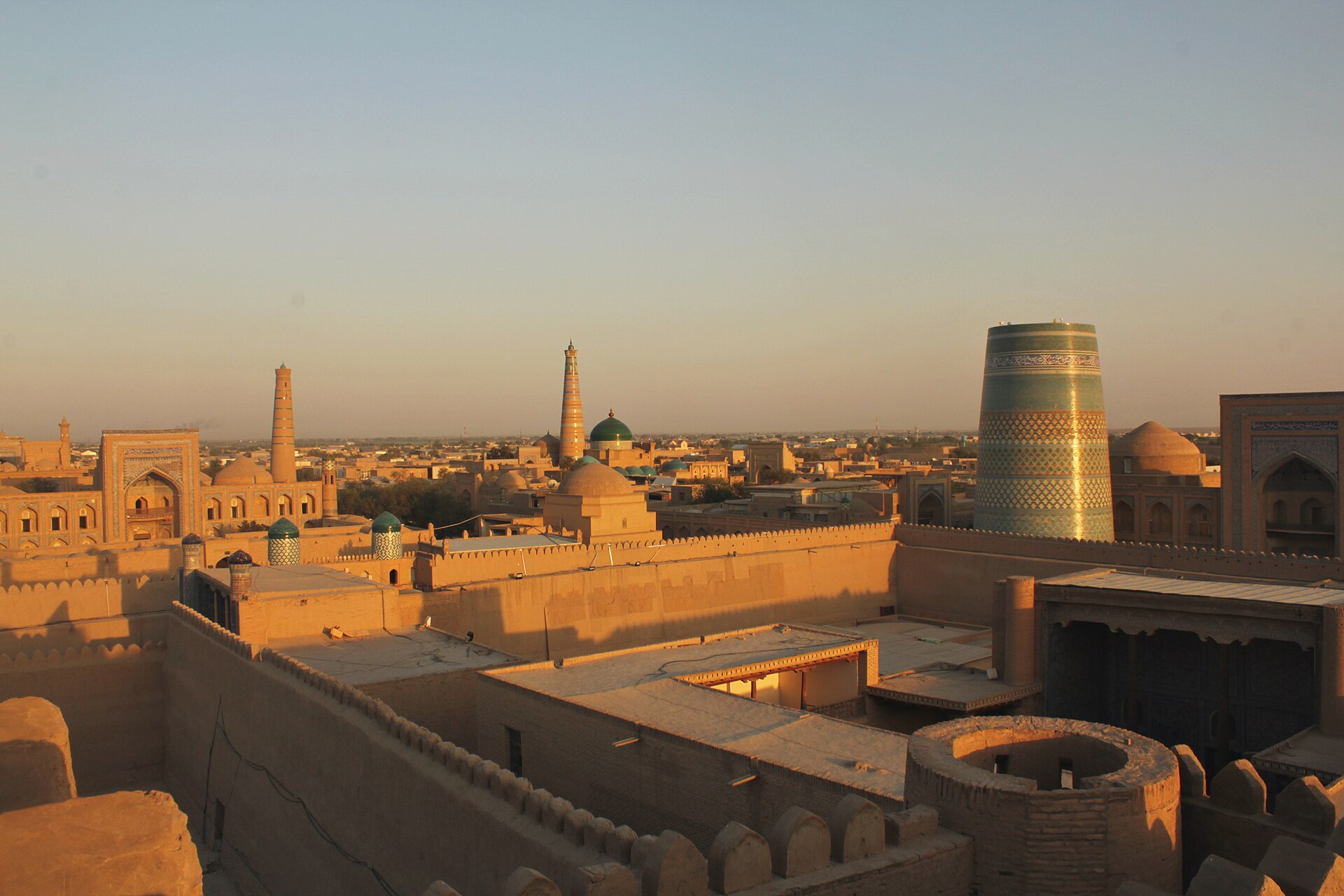
Khiva was the last oasis before the desert and the last khanate to fall — a 19th-century boom city in medieval dress, paid for by caravan tolls and the largest slave market in Central Asia, then frozen whole when the Soviets turned it into a museum.
Narration in English · Stop 1 is free
 Tour no. 12
- Stops
- 10
- Distance
- 1.8 km (1.1 mi)
- Time
- About 130 minutes
- Route
- Easy city route
Listen before you buy
Stop 1 · Ota Darvoza and the City Walls
Stop 1 is free. Listen before you buy.
The walk
A self-guided audio tour of Khiva
Khiva was the last oasis before the desert and the last khanate to fall — a 19th-century boom city in medieval dress, paid for by caravan tolls and the largest slave market in Central Asia, then frozen whole when the Soviets turned it into a museum. This walk crosses the walled inner city in a straight line, west gate to east gate: the unfinished minaret of a khan who died mid-ambition, the fortress where envoys were received in a yurt, a thousand-year-old forest of carved columns, the wrestler-saint the dynasty borrowed, the reformer it murdered, and the gate where the bill for all of it was paid in human beings.
Route notes
The stops
About each stop · narration stays in the app
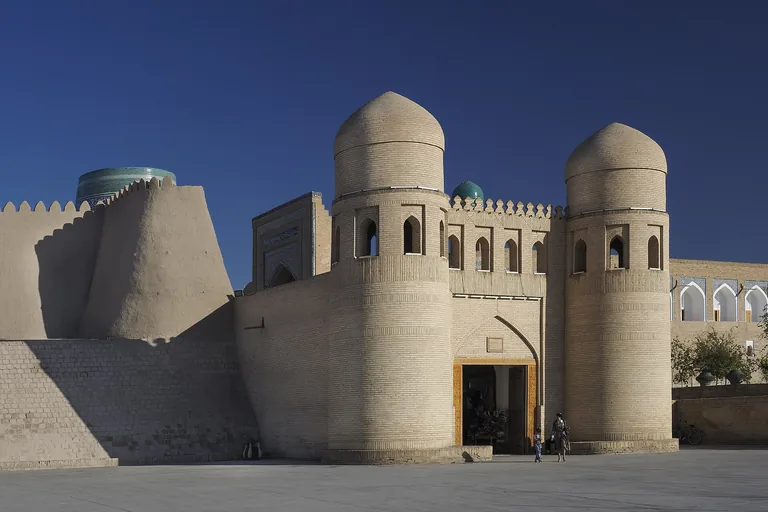
Photo: Petar Milošević · Wikimedia Commons source · CC BY-SA 4.0 · Cropped to the recorded 3:2 source rectangle and resized from the exact hash-bound source input. Ota Darvoza and the City Walls
Ota Darvoza is Khiva's west gate, rebuilt in the 1970s from archival evidence within the mud-brick walls of Itchan Kala. Its former stalls, customs rooms and gatekeeping functions introduce the walled city as a working system of trade and taxation. The gate passage and outer square are public and largely level.
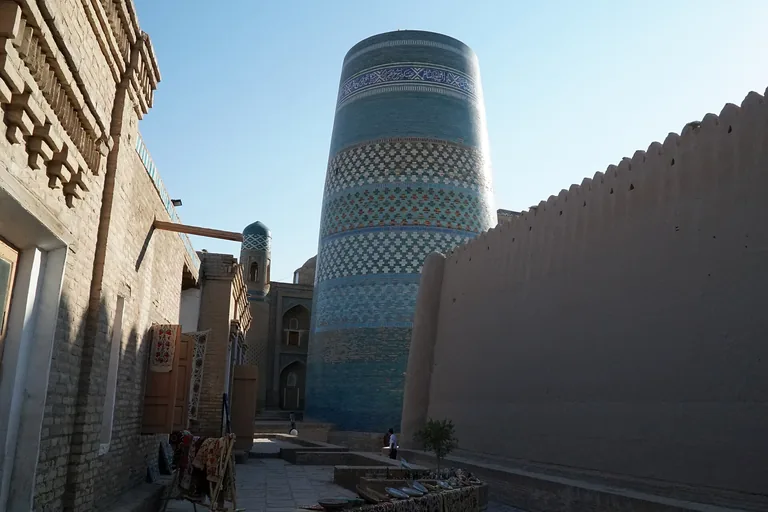
Photo: Adam Harangozó · Wikimedia Commons source · CC BY-SA 4.0 · Cropped to the recorded 3:2 source rectangle and resized from the exact hash-bound source input. Kalta Minor Minaret
Kalta Minor is the broad, fully tiled stump of a minaret begun for Muhammad Amin Khan in the 1850s and abandoned after his death. Its unfinished height makes royal ambition and interruption immediately legible at the start of the route. The monument cannot be climbed and is viewed free from the level main street.
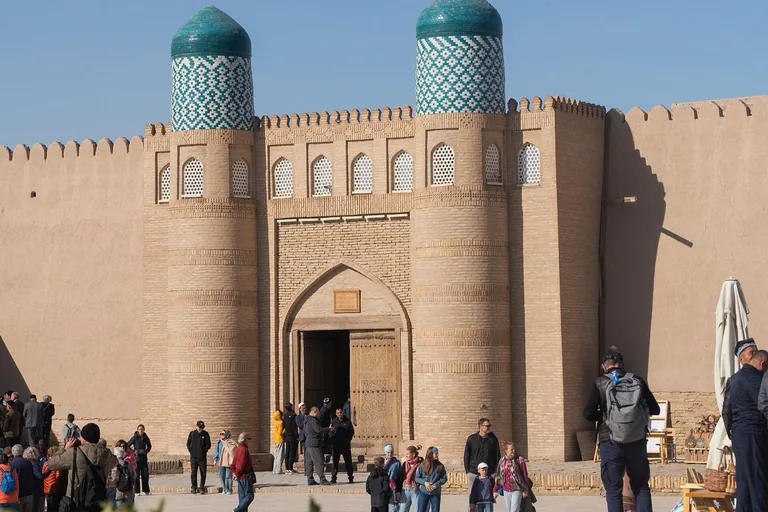
Photo: Panpanchik · Wikimedia Commons source · CC BY-SA 4.0 · Cropped to the recorded 3:2 source rectangle and resized from the exact hash-bound source input. Kunya-Ark Citadel
Kunya-Ark was Khiva's inner citadel, containing the khan's reception spaces, mint, mosque, harem, arsenal and other state functions behind one gate. The route enters its orbit to show how court administration, steppe ceremony and coercive power occupied one compound. Interior access is ticketed, and the Ak Sheikh Bobo viewpoint requires steep stairs but is optional.
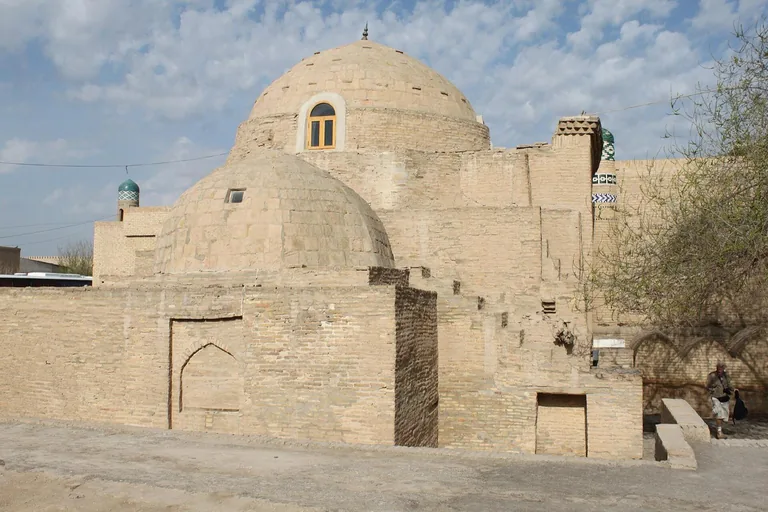
Photo: Faqscl · Wikimedia Commons source · CC BY-SA 3.0 · Cropped to the recorded 3:2 source rectangle and resized from the exact hash-bound source input. Sayid Alauddin Mausoleum
The Sayid Alauddin Mausoleum, built over a Sufi sheikh who died in 1303, is among the oldest surviving monuments in Khiva. Its sunken position shows how centuries of burial and rebuilding gradually raised the surrounding city. Entry involves steps below street level, so the route's required interpretation remains available from outside.
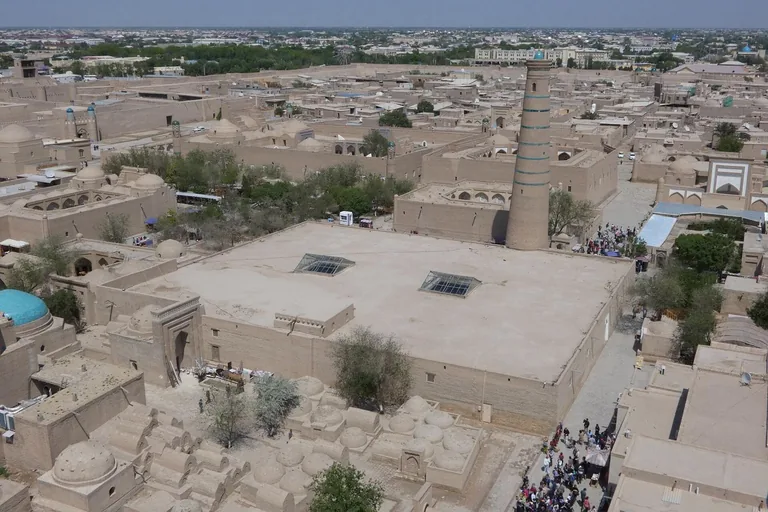
Photo: Gregor Rom · Wikimedia Commons source · CC BY-SA 4.0 · Cropped to the recorded 3:2 source rectangle and resized from the exact hash-bound source input. Juma Mosque
Khiva's Juma Mosque is a low, roofed hall supported by a forest of carved wooden columns, some preserving much older reused timber. The stop reveals a thousand-year institutional memory carried by wood through repeated rebuilding. The interior is ticketed with a threshold step; the northeast street corner remains the exterior listening point.
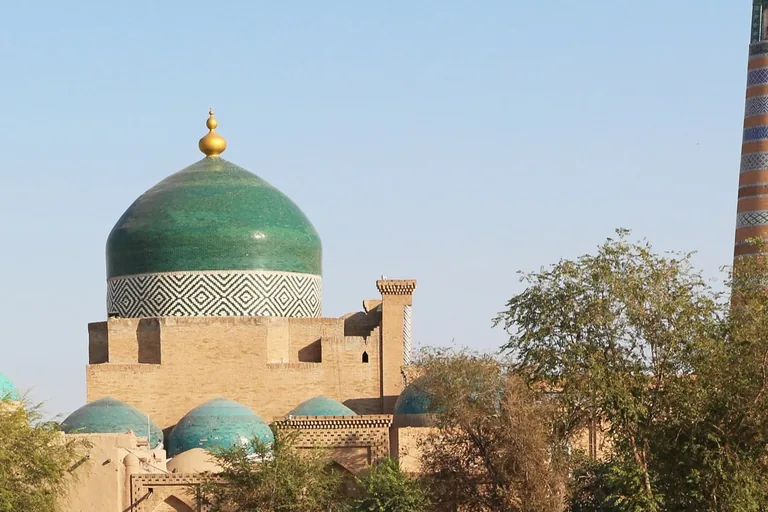
Photo: Bgag · Wikimedia Commons source · CC0 · Cropped to the recorded 3:2 source rectangle and resized from the exact hash-bound source input. Pahlavon Mahmud Mausoleum
Pahlavon Mahmud Mausoleum grew around the grave of Khiva's poet, furrier, wrestler and patron saint before becoming a dynastic burial complex. Its great blue dome shows later khans attaching their own legitimacy to an older popular devotion. The interior is ticketed and busy with pilgrims; the forecourt is sufficient and respectful dress is advisable.
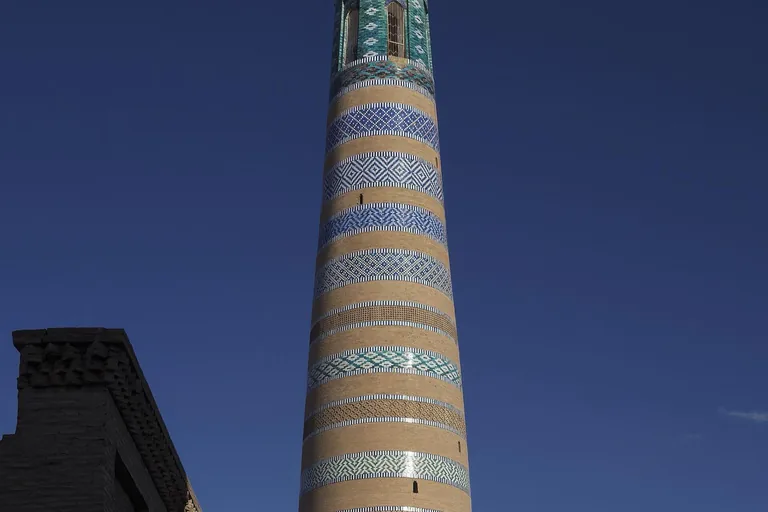
Photo: Petar Milošević · Wikimedia Commons source · CC BY-SA 4.0 · Cropped to the recorded 3:2 source rectangle and resized from the exact hash-bound source input. Islam Khodja Minaret and Madrasa
Islam Khodja's minaret and madrasa were completed around 1910 by the reforming vizier associated with schools, medicine, telegraphy and electrification. Their traditional appearance gives the route a precise example of modern ambition expressed in inherited architectural language. The plaza is level, while the minaret's steep, narrow spiral climb is entirely optional.
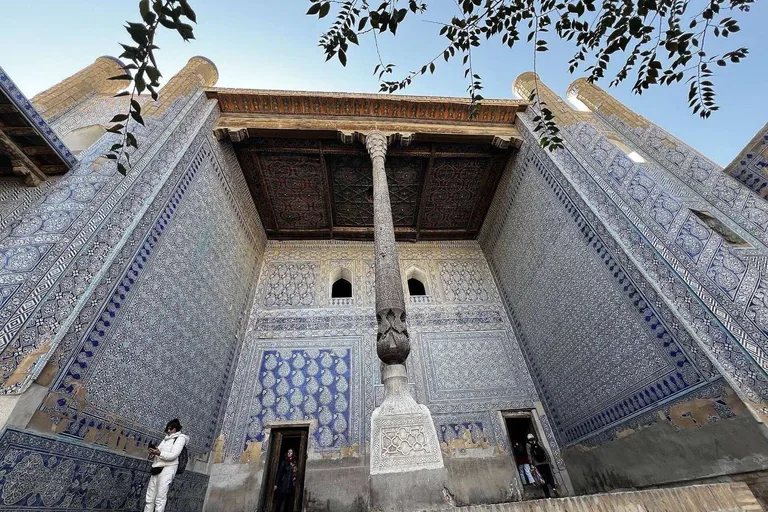
Photo: Bakhtiyarovna · Wikimedia Commons source · CC BY-SA 4.0 · Cropped to the recorded 3:2 source rectangle and resized from the exact hash-bound source input. Tash Hauli Palace
Tash Hauli is Allah Kuli Khan's nineteenth-century town palace, organised around reception, justice and harem courtyards behind fortress-like walls. Its tiled interiors and documented reliance on enslaved labour connect court beauty to the economy that financed it. Interior courtyards require a ticket and involve thresholds; the south-side street provides the required view.
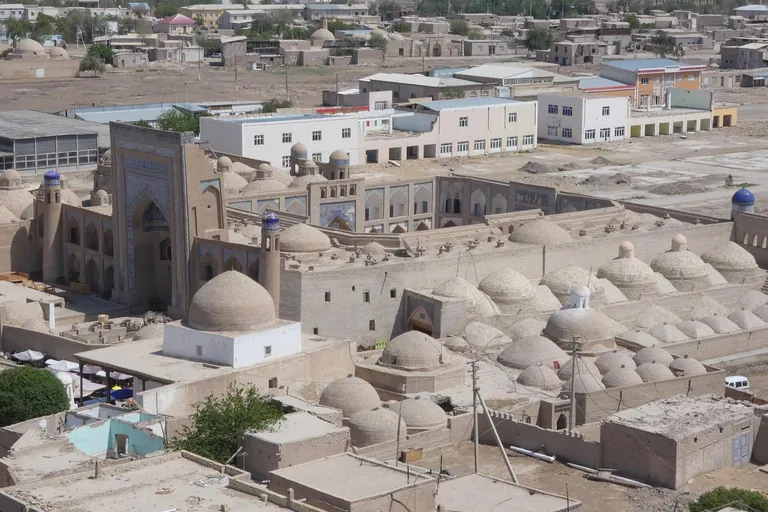
Photo: Gregor Rom · Wikimedia Commons source · CC BY-SA 4.0 · Cropped to the recorded 3:2 source rectangle and resized from the exact hash-bound source input. Alla Kuli Khan Trading Ensemble
The Alla Kuli Khan ensemble links madrasa, caravanserai and covered bazaar so that trade income, lodging and education share one urban machine. The route includes it to show how commercial revenue endowed scholarship and physically reshaped Khiva's east gate. The covered passage is public and near level, though its cobbles are uneven.
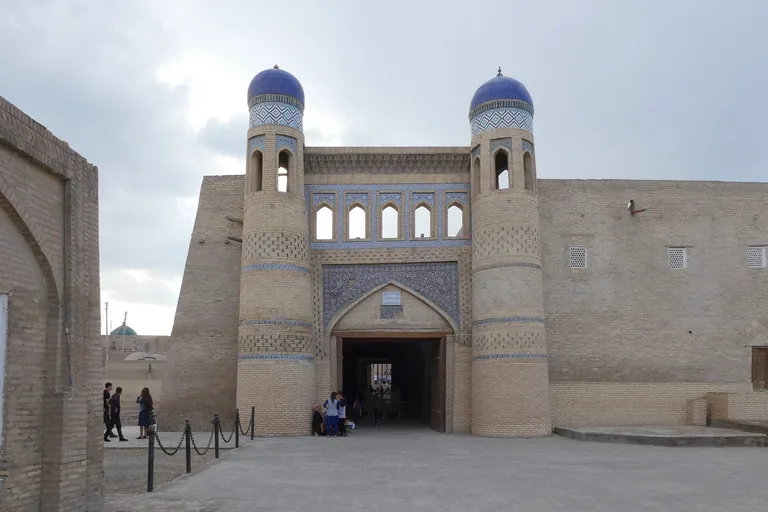
Photo: Gregor Rom · Wikimedia Commons source · CC BY-SA 4.0 · Cropped to the recorded 3:2 source rectangle and resized from the exact hash-bound source input. Polvon Darvoza and the Slave Market
Polvon Darvoza is Khiva's domed east-gate corridor, once lined with shops and adjoining the city's slave market until the Russian conquest of 1873. The route ends here to place the old city's beauty beside the human trade that supported its wealth. The passage remains a public commercial route; keep clear of active stalls and delivery traffic.


.jpg)


.jpg)
.jpg)


Local context
Before you go
The published route starts at Ota Darvoza, Ichan-Kala, 220900 Khiva, Uzbekistan. It begins at Ota Darvoza and the City Walls and ends at Polvon Darvoza and the Slave Market.
On the ground
Access and surfaces
A compact, level route on paved and cobbled lanes inside the walled city — the whole walk covers well under two kilometers. Summer heat is serious and shade is scarce on the main street. The major interiors (Kunya-Ark, Juma Mosque, Pahlavon Mahmud, Tash Hauli) are ticketed; every stop is written to remain complete from its public exterior stand-point. Entry to the walled city itself may require the Itchan Kala combined ticket at the gates.
Frequently asked
Plan the walk
- How long is the Khiva audio walking tour?
- Allow about 130 minutes. The self-guided route covers 1.8 km (1.1 mi) in 10 stops, including walking and listening time.
- Where does the Khiva tour start and end?
- It starts at Ota Darvoza, Ichan-Kala, 220900 Khiva, Uzbekistan. The published route begins at Ota Darvoza and the City Walls and ends at Polvon Darvoza and the Slave Market.
- Will the Khiva audio tour work offline?
- Yes, after download. Audio, stop text, images, and GPS triggering work without data; the live map background still needs a connection.