Córdoba · Andalusia, Spain
Córdoba — The Capital That Outlived Itself
Around the year 950, Córdoba was the seat of a caliphate that built itself to rival Constantinople, Damascus and Baghdad — and then tore itself apart within a lifetime.
Narration in English · Stop 1 is free
 Tour no. 17
- Stops
- 11
- Distance
- 3.2 km (2 mi)
- Time
- About 150 minutes
- Route
- Easy city route
Listen before you buy
Stop 1 · Calahorra Tower
Stop 1 is free. Listen before you buy.
The walk
A self-guided audio tour of Córdoba
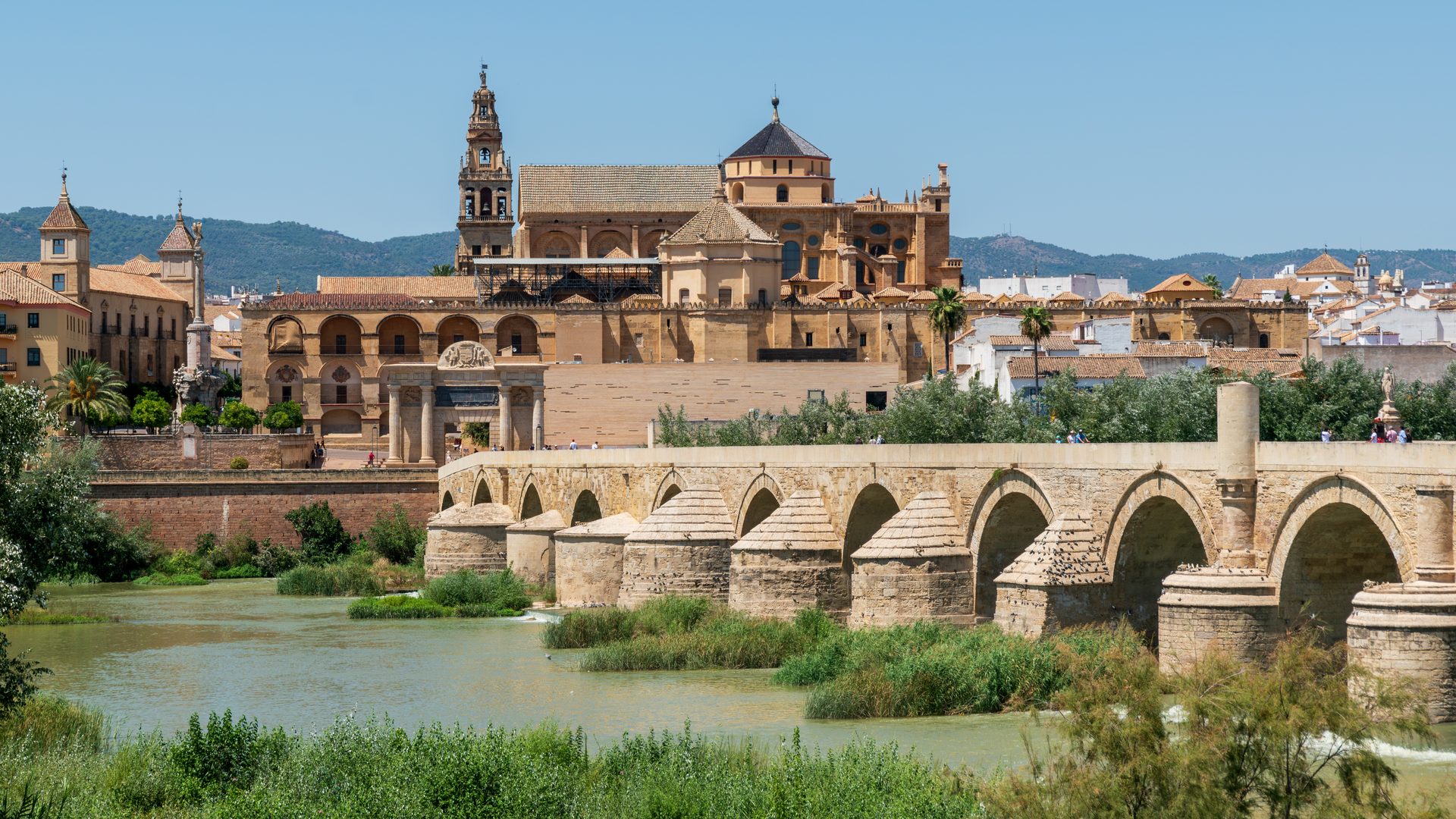
Around the year 950, Córdoba was the seat of a caliphate that built itself to rival Constantinople, Damascus and Baghdad — and then tore itself apart within a lifetime. This walk crosses the old bridge into everything the capital left behind: a great mosque with a cathedral grown through its middle, a fortress where queens ran wars and the Inquisition kept its cells, the lanes of the old Jewish quarter with its small stubborn synagogue, and the flowered courtyards and market squares where the city has gone on living, quite practically, inside its own monument.
Route notes
The stops
About each stop · narration stays in the app
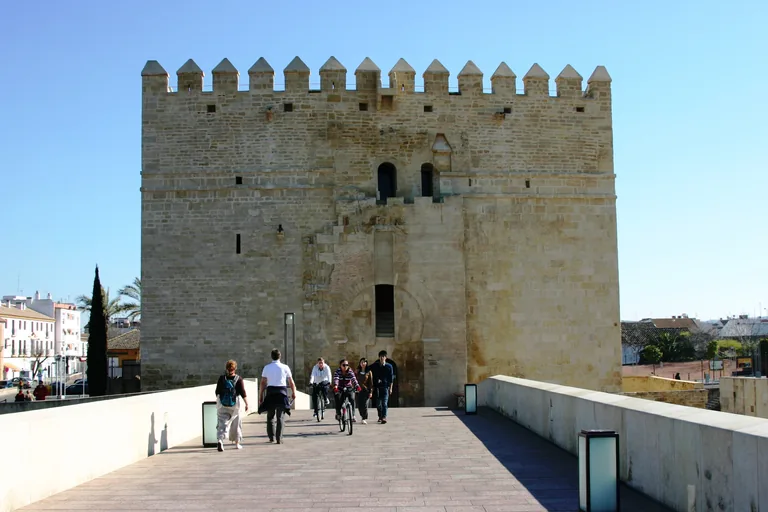
Photo: José Luiz · Wikimedia Commons source · CC BY-SA 3.0 · Cropped to the recorded 3:2 source rectangle and resized from the original. Calahorra Tower
Calahorra Tower is the fortified gate at the south end of Córdoba's bridge, rebuilt and enlarged to control the river approach to the city. The route starts here because the tower frames the Guadalquivir crossing before the monuments inside the walls take over. The exterior and riverside are free; the museum and roof require admission and stairs.
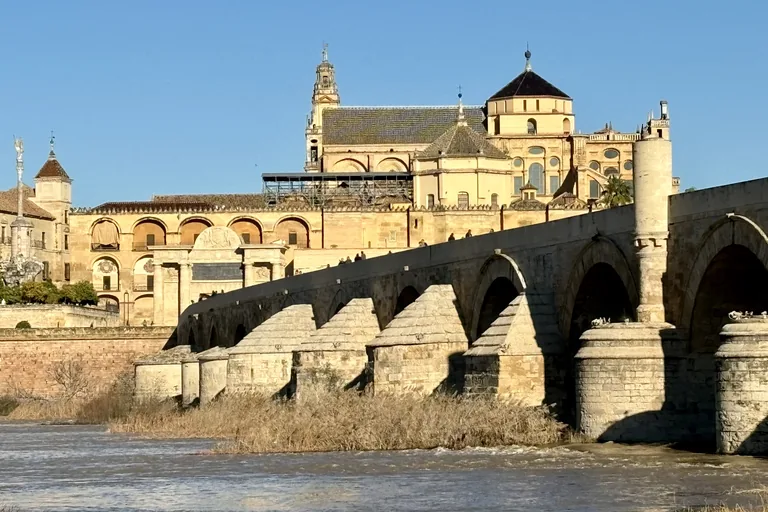
Photo: Frank Kovalchek from USA · Wikimedia Commons source · CC BY 2.0 · Cropped to the recorded 3:2 source rectangle and resized from the original. Roman Bridge and the Albolafia
Córdoba's bridge occupies a crossing used since Roman times, while the nearby Albolafia waterwheel recalls the river engineering that supplied gardens and buildings along the bank. The route crosses here to treat the Guadalquivir as infrastructure and movement, not merely a foreground for the old city. The bridge is pedestrian and exposed with little shade; the waterwheel is viewed from the bridge or riverbank rather than entered.
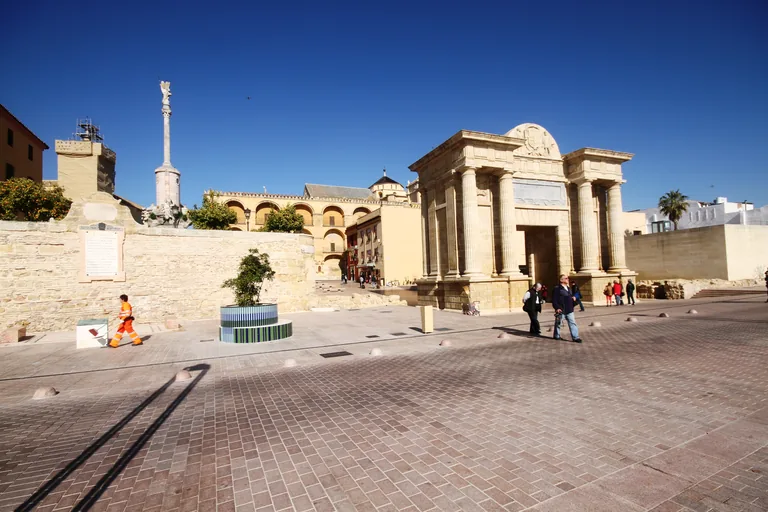
Photo: José Luiz · Wikimedia Commons source · CC BY-SA 3.0 · Cropped to the recorded 3:2 source rectangle and resized from the original. Puerta del Puente
Puerta del Puente is the Renaissance ceremonial gate built in the sixteenth century on the line of an older city entrance. It follows the bridge because the gate marks the formal transition from the river crossing into the cathedral and former mosque precinct. The exterior is free and level from the bridge; rooftop or interpretation access, when offered, has separate hours and steps.
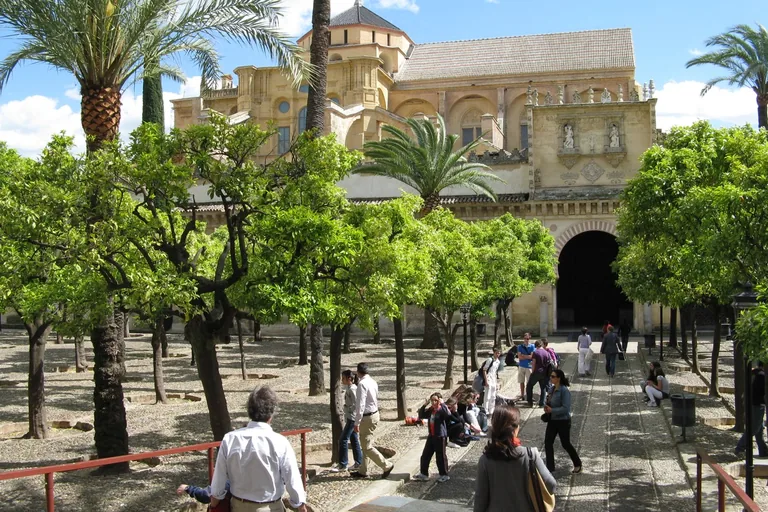
Photo: Yair Haklai · Wikimedia Commons source · CC BY-SA 4.0 · Cropped to the recorded 3:2 source rectangle and resized from the original. Mezquita-Catedral and the Patio de los Naranjos
The Mezquita-Catedral grew from Córdoba's eighth-century congregational mosque through major Umayyad enlargements, then became a cathedral with later Christian additions inside its columned hall. The route centres on it because the building records political and religious change without erasing the earlier structure. The orange-tree courtyard is the reliable public approach; interior entry is ticketed outside limited worship access and can involve queues.
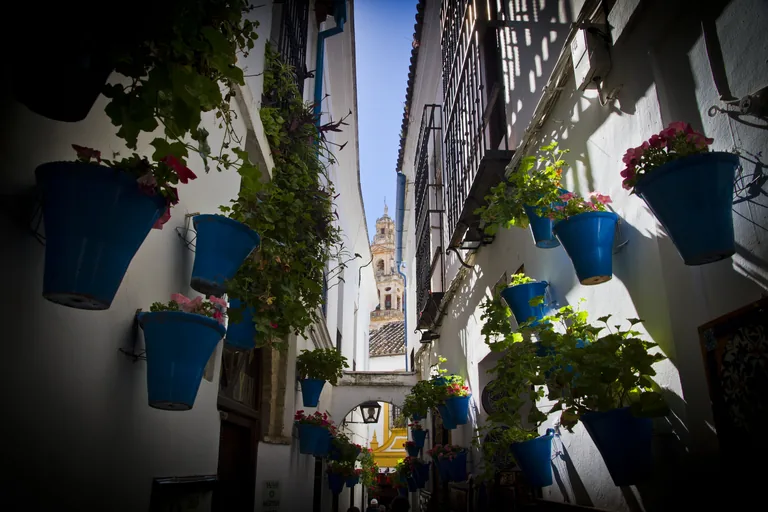
Photo: jorcolma · Wikimedia Commons source · CC BY 2.0 · Cropped to the recorded 3:2 source rectangle and resized from the original. Calleja de las Flores
Calleja de las Flores is a narrow lane and tiny courtyard arranged to frame the cathedral tower between whitewashed walls and flowerpots. The route includes it as a deliberate urban view rather than evidence that every lane in the historic centre looks the same. It is free but confined and often crowded; visit quietly and keep residents' doorways clear.
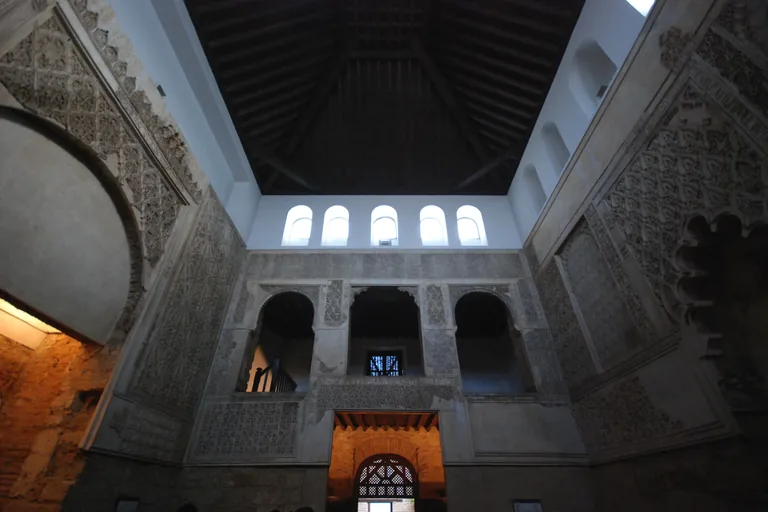
Photo: JP Puerta · Wikimedia Commons source · CC BY 2.0 · Cropped to the recorded 3:2 source rectangle and resized from the original. The Synagogue
Córdoba Synagogue is a small fourteenth-century prayer house whose upper walls preserve Hebrew inscriptions and Mudéjar plasterwork. It is included because its intimate scale supplies rare physical evidence of medieval Jewish worship in Andalusia. Entry conditions and capacity can change, and the approach through the Jewish quarter is narrow and busy.
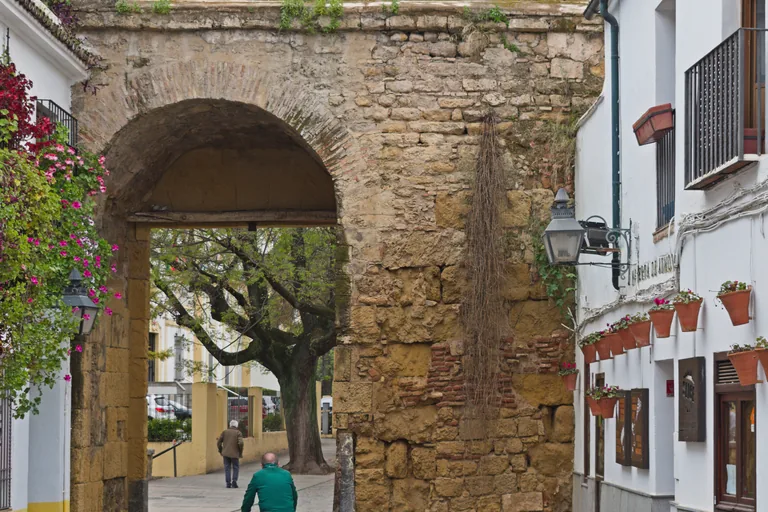
Photo: Ymblanter · Wikimedia Commons source · CC BY-SA 4.0 · Cropped to the recorded 3:2 source rectangle and resized from the original. Calle Judios and the Puerta de Almodovar
Calle Judíos threads through the former Jewish quarter to Puerta de Almodóvar, one of the surviving gates in Córdoba's western wall. The route pairs street and gate to connect neighbourhood life with the defensive edge rather than treating the wall as a detached backdrop. Both are free, but the lane is narrow and the wall-side paving includes uneven sections and traffic at crossings.
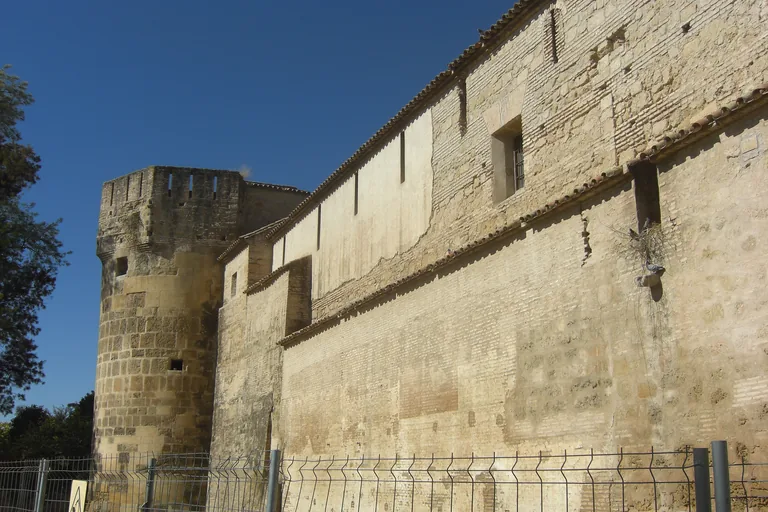
Photo: Olivier Bruchez · Wikimedia Commons source · CC BY-SA 2.0 · Cropped to the recorded 3:2 source rectangle and resized from the original. Alcazar de los Reyes Cristianos
The Alcázar de los Reyes Cristianos is the fortified royal residence begun in the fourteenth century, later used by the Inquisition and reshaped with formal gardens. The route includes it to show Christian royal power building beside, and partly from, the earlier palace landscape. The towers and gardens require a timed ticket; expect stairs, water edges and limited shade in exposed areas.
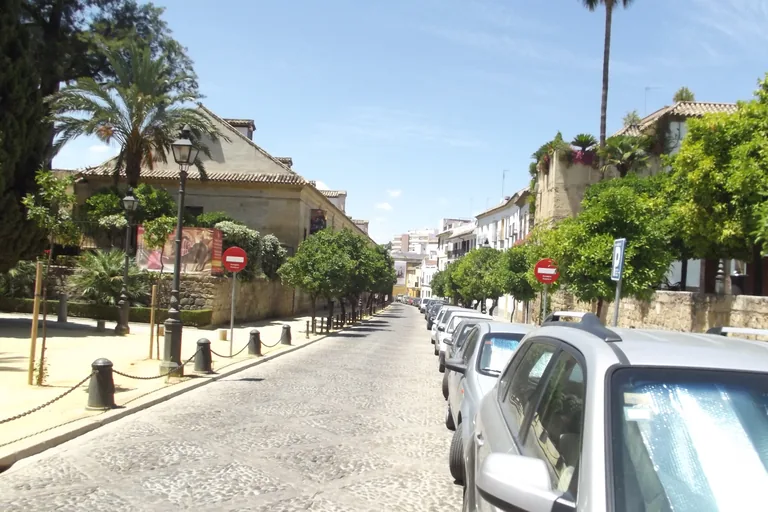
Photo: Elliott Brown from Birmingham, United Kingdom · Wikimedia Commons source · CC BY-SA 2.0 · Cropped to the recorded 3:2 source rectangle and resized from the original. San Basilio and the Royal Stables
San Basilio is a low-rise neighbourhood known for courtyard houses beside the Royal Stables founded by Philip II for breeding Andalusian horses. The route passes through it to connect domestic patio culture with a royal institution that shaped the city's equestrian identity. The streets and stable exterior are public; private patios open only with permission or during organised visits, and performances need separate tickets.
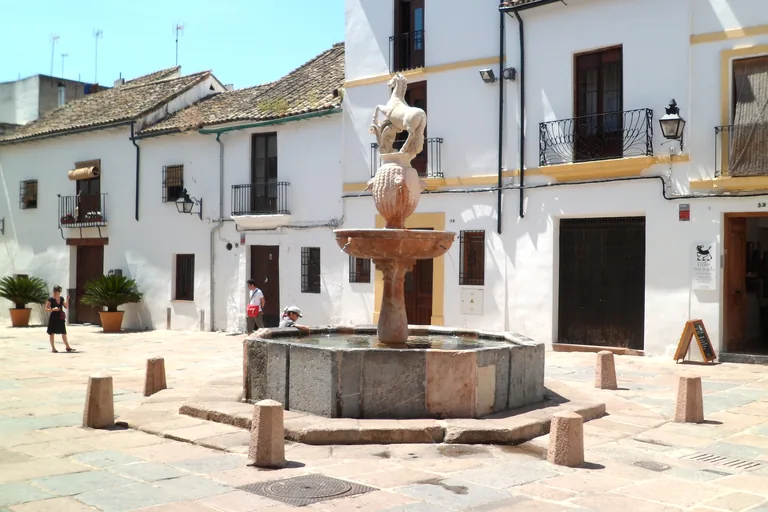
Photo: Américo Toledano · Wikimedia Commons source · CC BY-SA 3.0 · Cropped to the recorded 3:2 source rectangle and resized from the original. Plaza del Potro
Plaza del Potro is a small historic square named for its colt fountain and associated with inns, craft and the nearby Guadalquivir trade quarter. It is included as a quieter civic space between the monumental west and the larger market squares to the east. The plaza is free and mostly level, though café terraces and deliveries can narrow circulation.
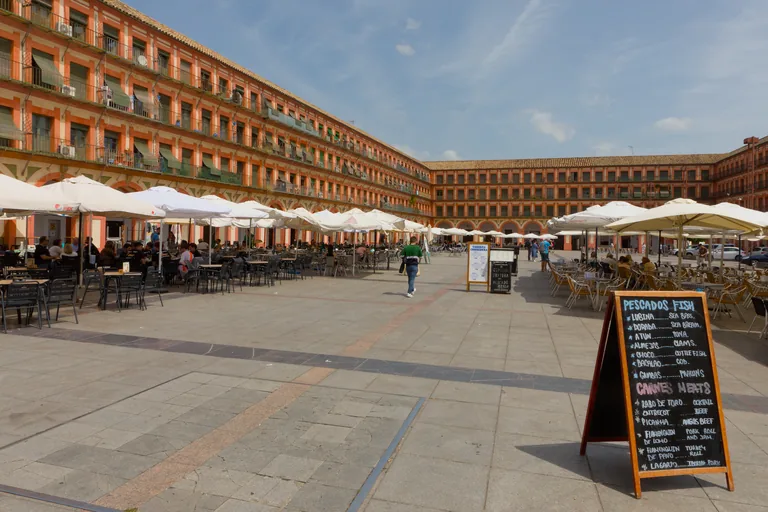
Photo: Benjamin Smith · Wikimedia Commons source · CC BY-SA 4.0 · Cropped to the recorded 3:2 source rectangle and resized from the original. Plaza de la Corredera
Plaza de la Corredera is Córdoba's large rectangular arcaded square, formalised in the seventeenth century and used for markets, ceremonies and public spectacles. It closes the route because its planned Castilian form contrasts sharply with the lanes, courtyards and layered monuments earlier in the walk. The square is free and accessible through several entrances, but paving, heat and event setups can affect the easiest route across it.


.jpg)


.jpg)


.jpg)
_03.JPG)

Local context
Before you go
The published route starts at Puente Romano, s/n, 14009 Córdoba, España. It begins at Calahorra Tower and ends at Plaza de la Corredera.
On the ground
Access and surfaces
Flat river-bank and old-town walking on paved and smooth-stone streets; no significant climbs. The Judería stretch narrows to pedestrian lanes with heavy mid-day foot traffic. All stops are written to work from public exterior positions; the Mezquita courtyard is free to enter, and the Mezquita interior, Synagogue, Alcázar, Calahorra museum and Royal Stables are ticketed or timed and optional. The final stretch to the Corredera crosses the old town on level streets.
Frequently asked
Plan the walk
- How long is the Córdoba audio walking tour?
- Allow about 150 minutes. The self-guided route covers 3.2 km (2 mi) in 11 stops, including walking and listening time.
- Where does the Córdoba tour start and end?
- It starts at Puente Romano, s/n, 14009 Córdoba, España. The published route begins at Calahorra Tower and ends at Plaza de la Corredera.
- Will the Córdoba audio tour work offline?
- Yes, after download. Audio, stop text, images, and GPS triggering work without data; the live map background still needs a connection.