Coimbra · Centro, Portugal
Coimbra — The Hill of Learning
An audio walk through Coimbra, from the first king's tomb up to the university on the hill and down past two cathedrals to the river.
Narration in English · Stop 1 is free
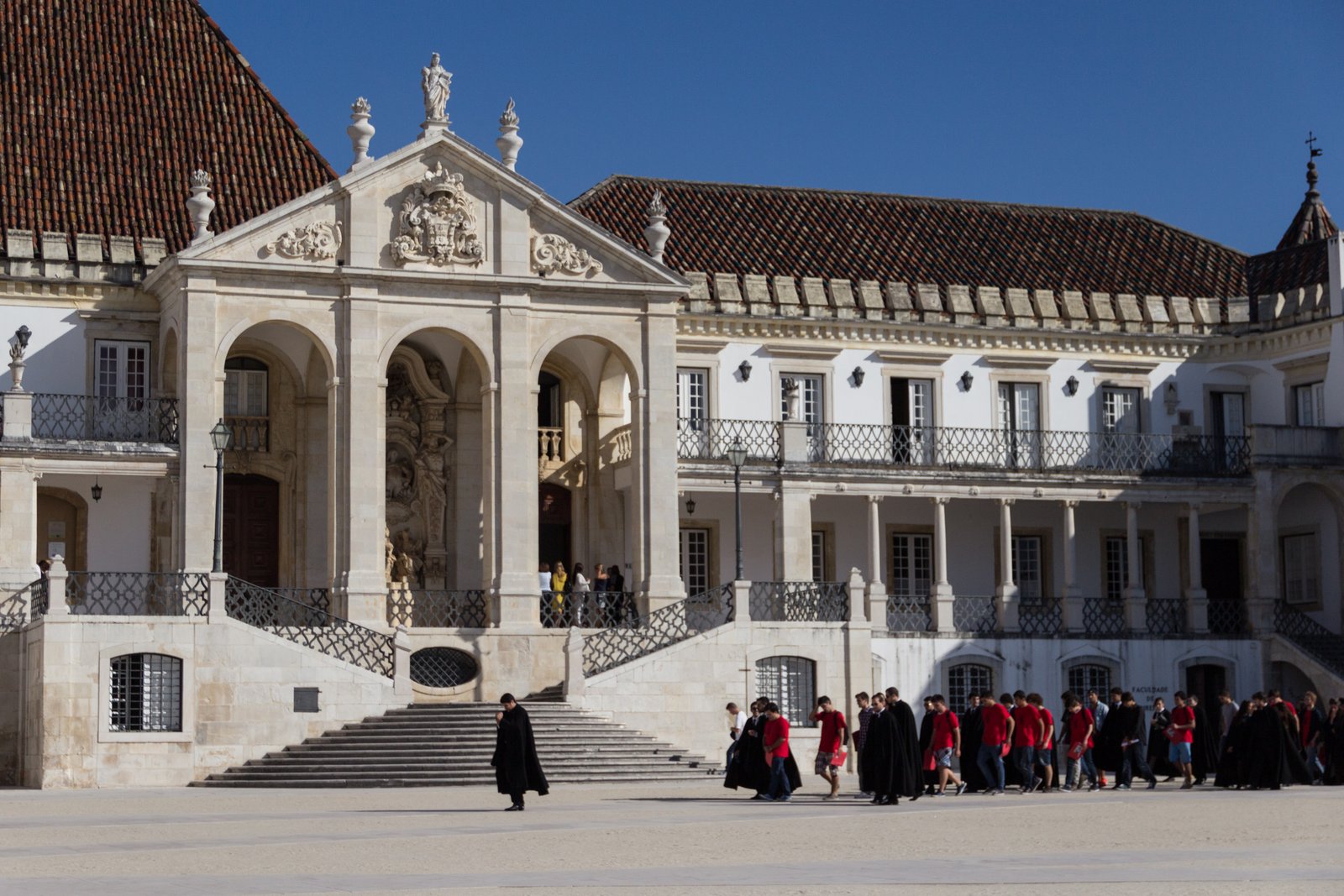 Tour no. 34
- Stops
- 11
- Distance
- 3.1 km (1.9 mi)
- Time
- About 110 minutes
- Route
- Moderate walking route
Listen before you buy
Stop 1 · Monastery of Santa Cruz
Stop 1 is free. Listen before you buy.
The walk
An audio tour up the university hill and down to the river, at your own pace
Coimbra was Portugal's capital from 1131 until the middle of the thirteenth century, and since 1537 its university has held the old royal palace on the hill. The walk starts at the Monastery of Santa Cruz, where the first two kings of Portugal are buried, and climbs a long avenue to Praça da República, the students' square, and the arches of a sixteenth century royal aqueduct. Beyond them, Largo Dom Dinis looks like a monument to learning and was made by demolition: from the 1940s the Estado Novo regime pulled down almost two hundred and fifty buildings on the hill for its University City, and in 1952 the rector put the people forced out at two to three thousand. In April 1969 students in black capes met the country's president there with placards, and by May the government had closed the university.
Through the Porta Férrea lies the courtyard of the palace of Portugal's first kings, which the Crown sold to the university sixty years after it moved in. The bell on the clock tower that faces the river has long been called the goat, and in a corner of the courtyard stands the doorway of the Joanina Library, whose tables are covered every evening against the droppings of the bats that live there. From there the route comes down past the Jesuits' church that became the New Cathedral in 1772, the old bishop's palace raised on the vaulted galleries under the Roman forum, and the Old Cathedral, built like a small fortress, whose 1930s steps are now the stage of the students' midnight serenade. A steep stepped lane leads down to the Almedina Gate, and the walk ends by the Mondego, looking across to the far bank, where the river flooded Queen Isabel's convent so often that its nuns finally left for a new convent on the hill.
Route notes
The stops
About each stop · narration stays in the app
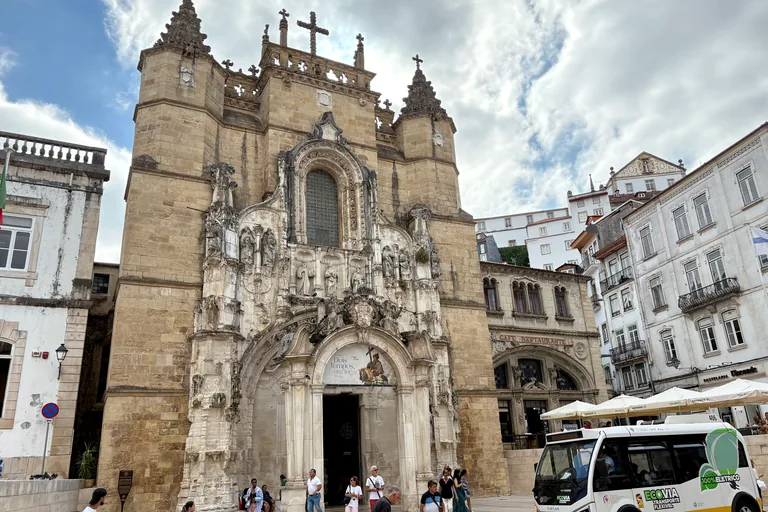
Photo: ほっきー · Wikimedia Commons source · CC0 1.0 · Cropped to the recorded 3:2 source rectangle and resized from the exact hash-bound source input. Monastery of Santa Cruz
The Monastery of Santa Cruz was founded in 1131 by a community of canons regular, and Portugal's first two kings, Afonso Henriques and his successor Sancho I, lie in its main chapel. It opens the walk in the lower town because it dates from Coimbra's years as Portugal's capital, from 1131 to 1255; from here the route climbs to the royal palace on the hill that became the university. The stop is made from the level, pedestrian Praça 8 de Maio in front of the church, which keeps its own opening hours; the Café Santa Cruz beside it occupies a former church of the monastery built in 1530.

Photo: ObserveOwl · Wikimedia Commons source · CC BY-SA 4.0 · Cropped to the recorded 3:2 source rectangle and resized from the exact hash-bound source input. Praça da República
Praça da República, once the square of King Luís, is edged by the student union's buildings and its theatre, the Teatro Académico de Gil Vicente, designed in the 1950s by the architects Alberto Pessoa and João Abel Manta. The route crosses it on the climb from the lower town as the students' own square, where the student union has its seat, beside the park of the old Quinta de Santa Cruz. The square is level, with traffic on two sides, so cross at the marked crossings.
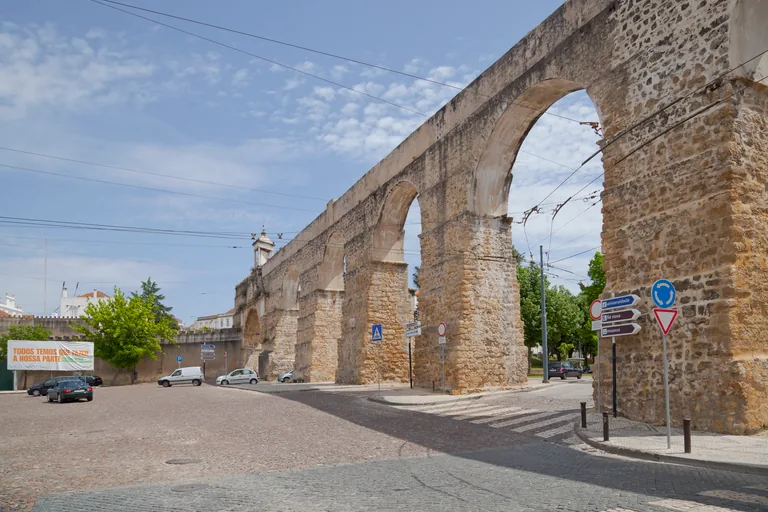
Photo: Diego Delso · Wikimedia Commons source · CC BY-SA 3.0 · Cropped to the recorded 3:2 source rectangle and resized from the exact hash-bound source input. São Sebastião Aqueduct and the Botanic Garden
The São Sebastião Aqueduct, known locally as the Arcos do Jardim, was built in the late sixteenth century under King Sebastião, probably on the line of an earlier Roman aqueduct, to carry water to the upper town. The route reaches it at the top of the long climb from the lower town and follows the arches west towards the university, with the University Botanic Garden, founded in 1772 by the Marquis of Pombal, facing them. The arches cross busy roads, so keep to the pavements; the garden, which covers thirteen hectares, keeps its own opening hours.
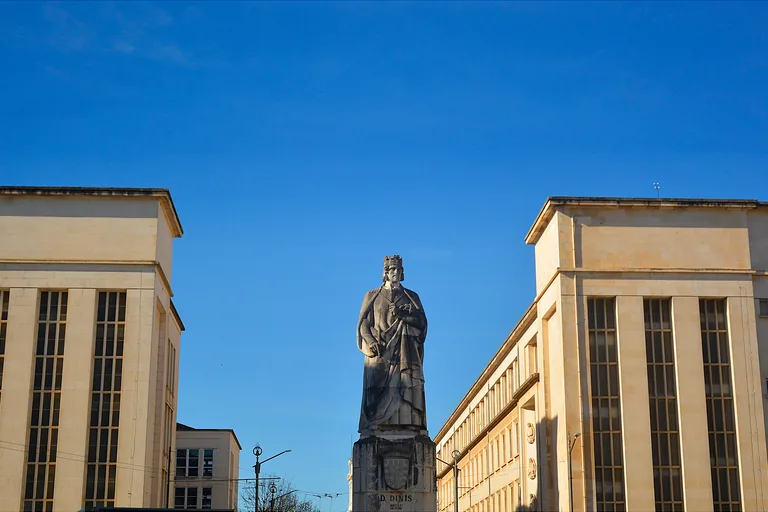
Photo: Miguel Ángel García. from Ólvega., España · Wikimedia Commons source · CC BY 2.0 · Cropped to the recorded 3:2 source rectangle and resized from the exact hash-bound source input. Largo Dom Dinis
Largo Dom Dinis is a square of the University City that the Estado Novo regime built on the hill from the 1940s, with a statue by Francisco Franco of King Dinis, who founded the university in Lisbon in 1290. On this route it shows the twentieth century university, which belongs to the World Heritage site together with the old colleges and the former royal palace a short walk to the west. It is a large, level paved square with parking around its edges and little shade on summer afternoons.
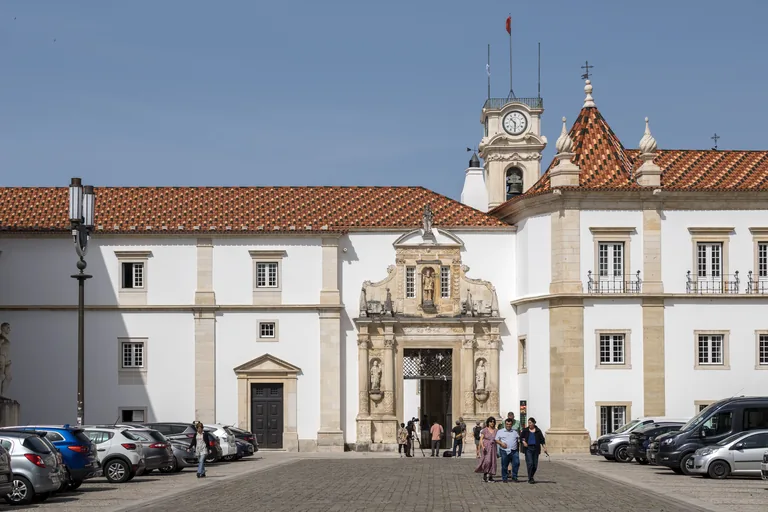
Photo: Alexkom000 · Wikimedia Commons source · CC BY 4.0 · Cropped to the recorded 3:2 source rectangle and resized from the exact hash-bound source input. Porta Férrea and the Paço das Escolas
The Paço das Escolas was the royal palace of Portugal's first kings, built on a fortress of the late tenth century; the university settled in it for good in 1537 and bought it from the Crown in 1597. The route enters the old university through the Porta Férrea, a gateway of 1634 whose figures of King Dinis and King João III honour the king who founded the university and the king who settled it in Coimbra. The square in front of the gate is level and paved, and the palace rooms are seen on a ticket.
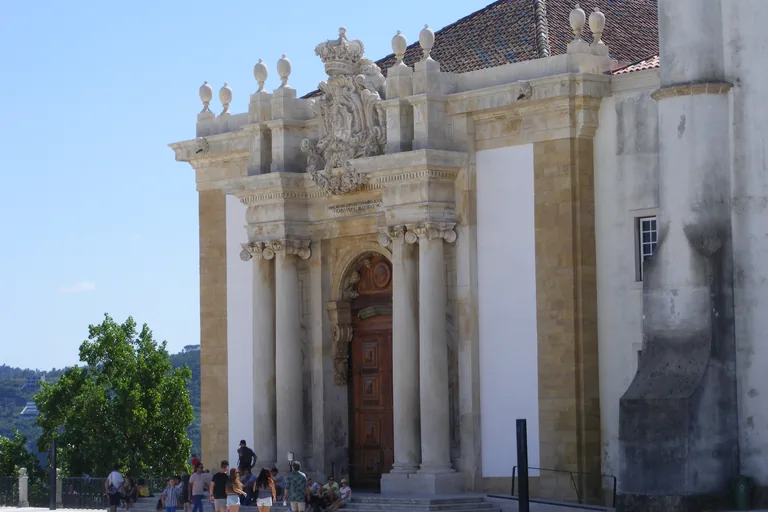
Photo: Marta Magalhães · Wikimedia Commons source · CC BY-SA 4.0 · Cropped to the recorded 3:2 source rectangle and resized from the exact hash-bound source input. Joanina Library
The Joanina Library, named after King João V, who authorised it, was built between 1717 and 1728, and the three halls of its main floor are lined with gilded oak shelves holding about sixty thousand books. It served as the University Library from 1777 until the first half of the twentieth century, and the route sees it from its carved stone doorway in a corner of the palace courtyard. The library and the academic prison below it are seen only on a timed ticket; the stop works from the courtyard outside its doorway, which is level and paved.
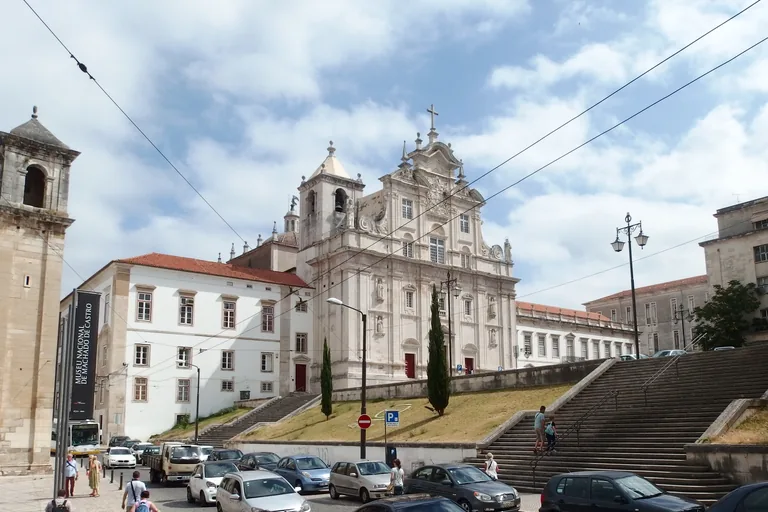
Photo: Palickap · Wikimedia Commons source · CC BY-SA 4.0 · Cropped to the recorded 3:2 source rectangle and resized from the exact hash-bound source input. New Cathedral of Coimbra
The New Cathedral was built as the church of the Jesuits' College of Jesus, begun in 1598 on the model of the Gesù in Rome, and it became Coimbra's cathedral in 1772, after the Jesuits had been expelled. On this route it stands on the Largo da Feira, between the university and the Old Cathedral, and it accounts for Coimbra having two cathedrals a short walk apart. The church faces a sloping square with parked cars in front; it is still a working church, the seat of its parish, with its own opening hours.
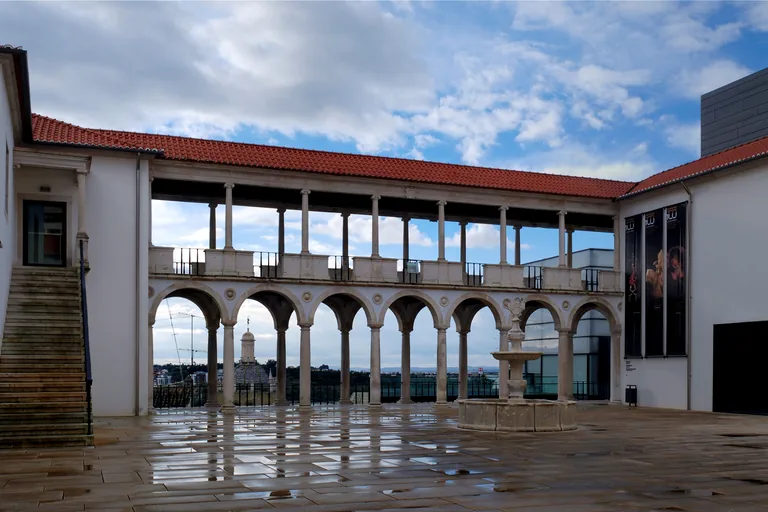
Photo: Alvesgaspar · Wikimedia Commons source · CC BY-SA 3.0 · Cropped to the recorded 3:2 source rectangle and resized from the exact hash-bound source input. Machado de Castro National Museum
The Machado de Castro National Museum occupies the former bishops' palace, whose first buildings date from the eleventh or twelfth century, raised over the vaulted galleries of a Roman cryptoporticus from the middle of the first century. The route passes along the palace between the two cathedrals; the museum opened in 1913, is named after the Coimbra sculptor Machado de Castro, and holds sculpture and church silver from the region's suppressed convents and monasteries. The museum was recorded as temporarily closed for conservation works in October 2026, so check before planning a visit; the stop works from the narrow, sloping street outside, which has some traffic.
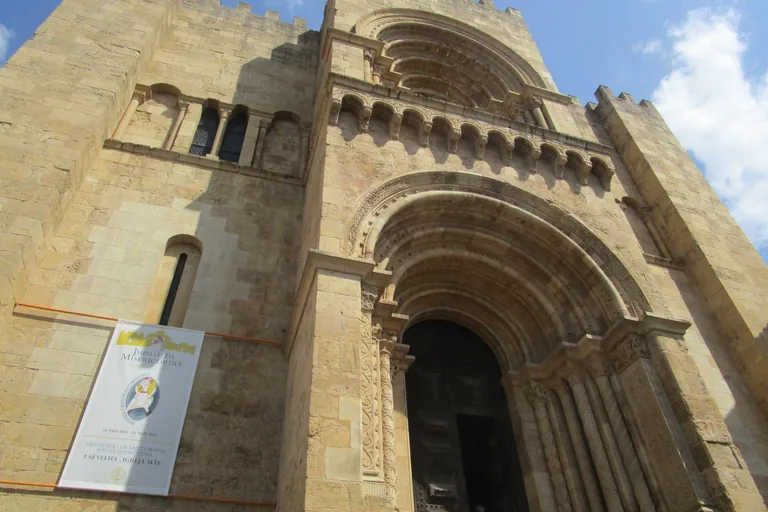
Photo: inês Almendra · Wikimedia Commons source · CC BY-SA 4.0 · Cropped to the recorded 3:2 source rectangle and resized from the exact hash-bound source input. Old Cathedral of Coimbra
The Old Cathedral is a Romanesque church begun some time after 1139 and far enough advanced by 1185 for Sancho I, the second king, to be crowned in it; its high walls are crenellated, with few, narrow windows. It was Coimbra's cathedral until 1772, when the bishop's seat moved up to the former Jesuit church the walk has just passed, so the route meets the two cathedrals in turn. The cathedral is ticketed and the stop works from the small, sloping cobbled square; in early May, at the start of the Queima das Fitas student festival, thousands gather here at night for a serenade on the cathedral steps.
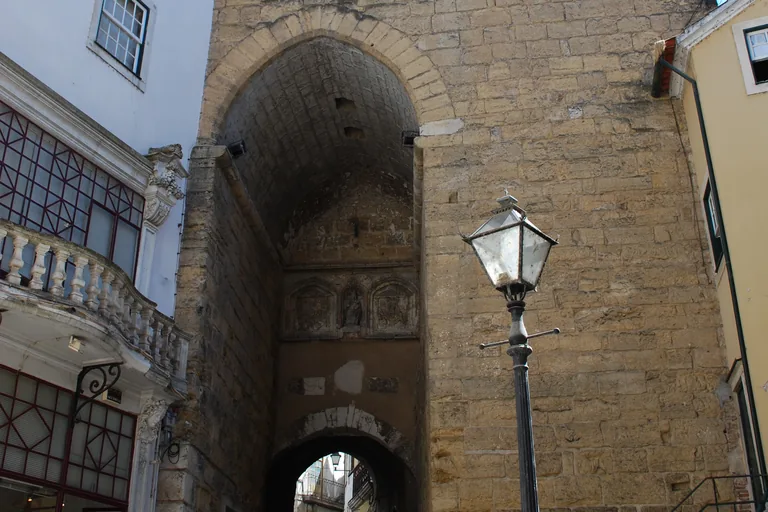
Photo: Concierge.2C · Wikimedia Commons source · CC BY-SA 3.0 · Cropped to the recorded 3:2 source rectangle and resized from the exact hash-bound source input. Almedina Gate and Tower
The Almedina Gate was the main entrance to the walled medieval city and is already named in a document of 933; the tower over its deep arch was added later, at a date historians still dispute. The route passes through it from the upper town to the lower town, at the foot of the stepped street that is the shortest link between the two, and the tower now houses a museum of the walled city. It is reached down a steep stepped street from the Old Cathedral that cannot be avoided on this route, and the arch opens onto a level pedestrian street.
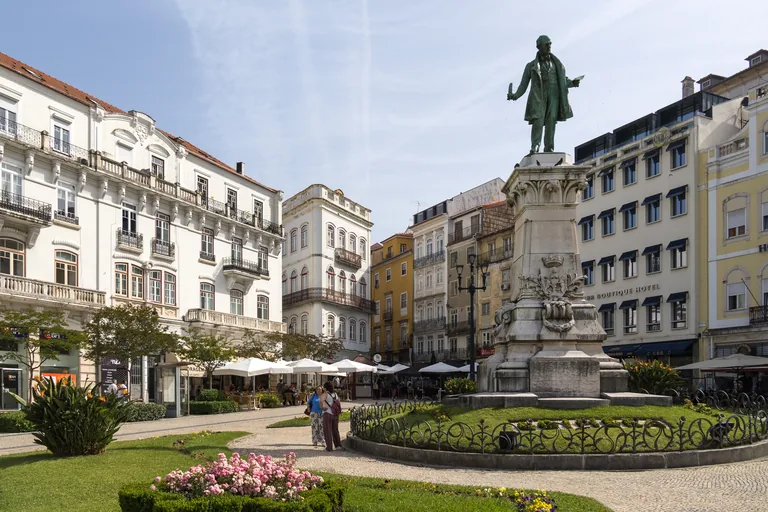
Photo: Alexkom000 · Wikimedia Commons source · CC BY 4.0 · Cropped to the recorded 3:2 source rectangle and resized from the exact hash-bound source input. Largo da Portagem and the Santa Clara Bridge
Largo da Portagem is the square at the head of the Santa Clara Bridge over the Mondego, named after the toll once charged here, with a statue of Joaquim António de Aguiar by Costa Mota, put up in 1913. The walk ends here by the river, a few minutes from the monastery where it began, and the present bridge, opened in 1954, crosses to the far bank, where the excavated ruins of the old convent of Santa Clara lie. The square is a busy junction at the head of the bridge, so use the crossings; the riverside pavement is level, and the pedestrian Rua Ferreira Borges leads from the square into the lower town.


_-_Conjunto_dos_edif%C3%ADcios_da_Associa%C3%A7%C3%A3o_Acad%C3%A9mica_de_Coimbra,_Teatro_Acad%C3%A9mico_de_Gil_Vicente_e_Cantinas_-_20241030145925.jpg)

.jpg)


.jpg)


.jpg)

Local context
Before you go
The route starts in the lower town at the Monastery of Santa Cruz, on Praça 8 de Maio, and ends by the river at the Largo da Portagem, at the head of the Santa Clara Bridge, a few minutes' walk from the start. The first kilometre is a long, gentle climb up a busy avenue to Praça da República. The upper town has steep streets, and the way down from the Old Cathedral to the Almedina Gate is a steep stepped lane that cannot be avoided on this route. Pavements are cobbled and often narrow, the aqueduct's arches cross busy roads, and the walk ends at a busy junction by the bridge. Summer afternoons are hot, with little shade on the upper town's squares.
On the ground
Access and surfaces
About three kilometres, starting in the lower town and ending by the river, a few minutes' walk from the start. The first kilometre is a long, gentle climb up a busy avenue; the upper town has steep streets, and the steep stepped lane down from the Old Cathedral to the Almedina Gate cannot be avoided on this route. Pavements are cobbled and often narrow. Every stop works from the street or the university courtyard, and the audio is written that way; the churches, the university rooms and the library have their own opening hours and tickets, and the Machado de Castro museum was closed for conservation works when the tour was prepared. Summer afternoons are hot, with little shade on the upper town's squares.
Frequently asked
Plan the walk
- How long is the Coimbra audio walking tour?
- Allow about 110 minutes. The route covers 3.1 km (1.9 mi) in 11 stops, including walking and listening time.
- Where does the Coimbra tour start and end?
- It starts at the Monastery of Santa Cruz, at the church on Praça 8 de Maio in the lower town, and ends by the river at the Largo da Portagem, at the head of the Santa Clara Bridge, a few minutes' walk from the start.
- Is there a way around the steps in the upper town?
- No. The way down from the Old Cathedral to the Almedina Gate is a steep stepped lane that cannot be avoided on this route, and the upper town's other streets are steep too. The first kilometre, up the avenue from Santa Cruz, is a long but gentle climb.
- Do I need to go inside the Joanina Library or the cathedrals?
- No. Every stop works from the street or the university courtyard. The churches, the university rooms and the library have their own opening hours and tickets, the Joanina Library is seen only on a timed ticket, and the Machado de Castro museum was closed for conservation works when the tour was prepared.
- Will the Coimbra audio tour work offline?
- Yes, after download. Audio, stop text, images, and GPS triggering work without data; the live map background still needs a connection.