Chiang Mai · Chiang Mai Province, Thailand
Chiang Mai — The City Laid Out Like a Body
An audio walk across the moated old city of Chiang Mai, from its east gate past temples, a teak hall and a broken great chedi to the temple of the lion Buddha.
Narration in English · Stop 1 is free
 Tour no. 51
- Stops
- 9
- Distance
- 2.9 km (1.8 mi)
- Time
- About 100 minutes
- Route
- Easy city route
Listen before you buy
Stop 1 · Tha Phae Gate
Stop 1 is free. Listen before you buy.
Read Stop 1Hide Stop 1 text
Transcript · Stop 1
Chiang Mai, founded in 1296 as the capital of the northern kingdom of Lanna, is a near square of streets inside a brick wall and a moat, with the mountain of Doi Suthep rising above it to the west. The walk crosses the old city on foot, flat all the way.
Ahead runs a long wall of red brick, with battlements along its top — small raised sections with gaps between them — and a gap in the middle that holds tall wooden doors. A plaque on the wall carries the gate's name in Thai and English; flags fly above the gate. Trees line the square's edges; to the right and to the left, where the square ends, the moat runs along the wall behind the trees.
The gate standing here is a reconstruction of the mid 1980s, built on the site of the old gate. The walls and gates have been taken down and rebuilt many times; the city municipality and the Fine Arts Department rebuilt them most recently from old records, excavation and an old photograph of one of the city gates. The photograph is at the centre of an argument: does it show the outer gate on this road, or the Chiang Mai Gate in the south wall?
Offerings to the guardian spirits of the city and of all the inner gates are still regularly held by the governor, the head of the municipality and the people of Chiang Mai. The square is a gathering place: Songkran, the New Year in mid April, with parades and water; Yi Peng, when lanterns are sent up into the sky; and on Sundays a walking street market that starts at the gate and runs along Ratchadamnoen Road. In 2023 the Fine Arts Department announced that an inscription in the old Lanna script had been found hidden in the brickwork. The inscription had been missing since the gate was rebuilt; among its words is the name of the city pillar.
Through the gate, the city's main road runs west toward the mountain; about three hundred metres along it, the narrower Ratchaphakhinai Road crosses, and the walk turns right there, to the north.
The walk
An audio walking tour of Chiang Mai across its moated old city, from Tha Phae Gate past Wat Umong, Wat Chiang Man, the Three Kings Square, the temple of the city's navel, the teak hall of Wat Phan Tao, Wat Chedi Luang and Wat Chai Phra Kiat to Wat Phra Singh, at your own pace
Chiang Mai, the old capital of Lanna, was built in 1296 at the foot of Doi Suthep as a near square of moats and brick walls, and Thailand's heritage nomination describes its plan as a human figure, with a navel at the centre where the spirit of the city resides. This walk crosses the old city from the east gate to the temple at the far end of its main street. It begins on the square outside Tha Phae Gate, rebuilt in the mid 1980s, passes Wat Umong, named for the chamber under its old chedi, and Wat Chiang Man, which an inscription says began as the house King Mangrai lived in while the city was built, and stands in the square of the three founding kings, before the hall of 1924 that is now the city's museum.
From there it visits Wat Inthakhin, the temple that marks the navel, where the city pillar is believed to have stood before it was moved, and the teak hall of Wat Phan Tao, once a ruler's dwelling, taken down and set up again there in 1876. At Wat Chedi Luang it tells of the great chedi broken by the earthquake of 1545 and of the city pillar just inside the gate, at Wat Chai Phra Kiat of a bronze Buddha cast in 1565 from damaged images, and it ends facing Wat Phra Singh, the temple of the lion Buddha, with the road up Doi Suthep on the mountain beyond.
Route notes
Route and itinerary
About each stop · narration stays in the app
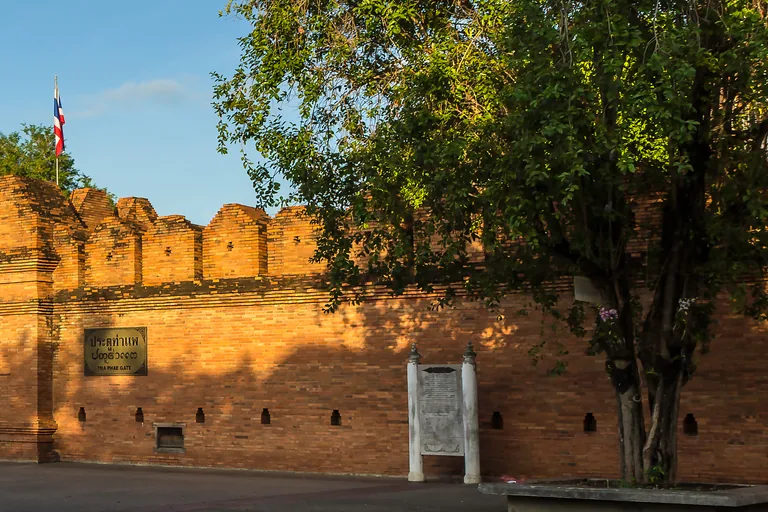
Photo: Stefan Fussan · Wikimedia Commons source · CC BY-SA 3.0 · Cropped to the recorded 3:2 source rectangle and resized from the exact hash-bound source input. Tha Phae Gate
Tha Phae Gate is the east gate of the walled old city of Chiang Mai, where Tha Phae Road meets the moat, with a wide paved square outside it where the walk begins. The route starts here for the gate's other name and its keepers: the encyclopedia records that it was known in the past as Chiang Rueak Gate, after a nearby village, and that the area outside it was a trading quarter tied to the river. Thailand's heritage nomination says the care of the city's corners and five gates, once given to its nobles, is now given to educational institutions at every level and to local communities. Tuk tuks and red songthaew shared taxis wait around the square; on Sundays from late afternoon the road west of the gate becomes a crowded walking street market, and during Songkran in mid April everyone at the gate gets soaked.
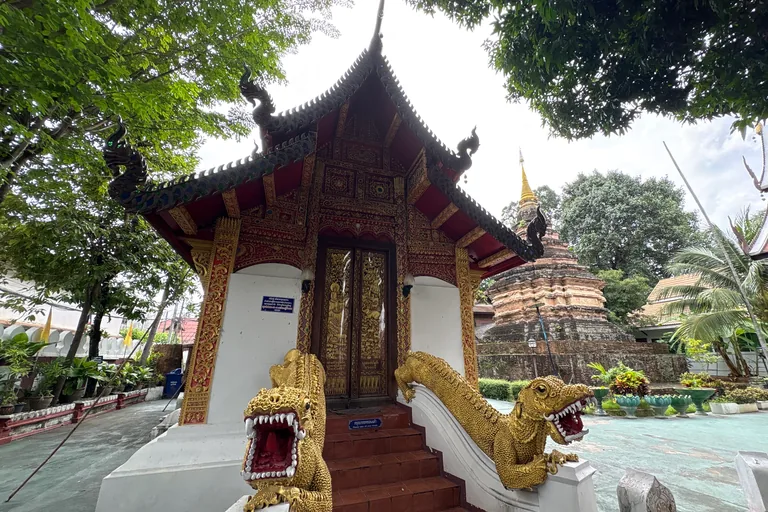
Photo: Chainwit. · Wikimedia Commons source · CC BY 4.0 · Cropped to the recorded 3:2 source rectangle and resized from the exact hash-bound source input. Wat Umong
Wat Umong Maha Thera Chan is a small temple on Ratchaphakhinai Road inside the old city of Chiang Mai, a short walk north of the main street from the east gate. The route stops here for the temple's buildings: the encyclopedia lists an assembly hall built around 1910 in the Lanna style, a small ordination hall with carved wooden doors and windows, and two chedis, and names the pair of guardian beasts at the small hall's stair mom. The walk stays on the pavement at the gap in the temple wall and goes into neither the halls nor the chamber under the chedi; the road is narrow, with motorbikes parked along it, so keep to the side.
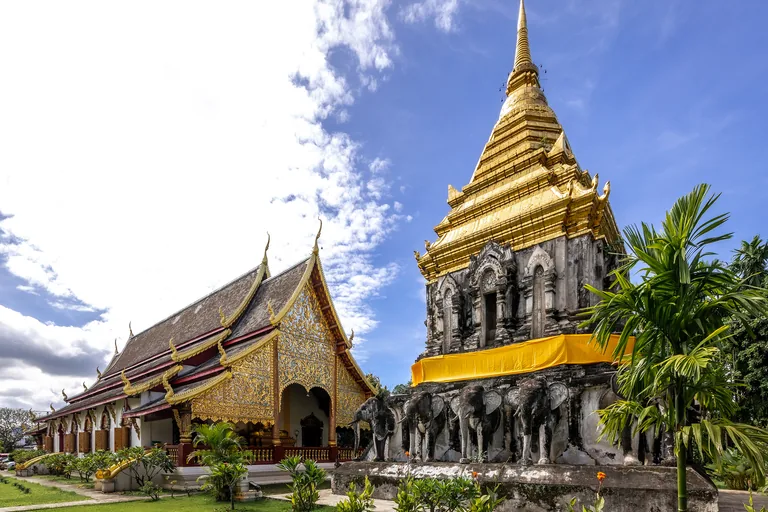
Photo: Supanut Arunoprayote · Wikimedia Commons source · CC BY 4.0 · Cropped to the recorded 3:2 source rectangle and resized from the exact hash-bound source input. Wat Chiang Man
Wat Chiang Man is a temple in the north east quarter of the old city of Chiang Mai, with its street gate on Ratchaphakhinai Road. The route stops here for its inscribed stone: the national database of Thailand's inscriptions describes a slab of red sandstone shaped like a boundary marker, about one and a half metres tall, written in 1581 in Fak Kham script in seventy lines on its two faces, and the encyclopedia adds that before the city was built the Lawa people called the site Wiang Nopburi. The walk is told from the street gate, and the elephant chedi stands behind the main hall, out of sight from there; the temple is a working place of worship, so if you go in, cover your shoulders and knees and take off your shoes before entering a hall.
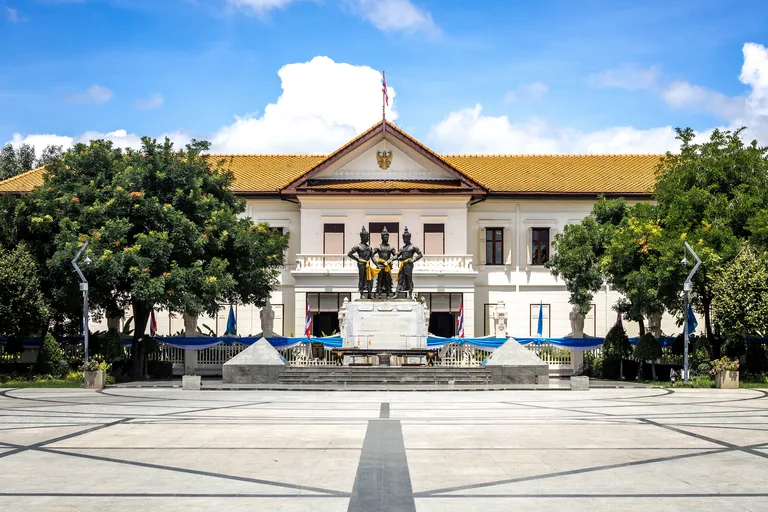
Photo: Supanut Arunoprayote · Wikimedia Commons source · CC BY 4.0 · Cropped to the recorded 3:2 source rectangle and resized from the exact hash-bound source input. The Three Kings Square
The Three Kings Square is the paved square on Prapokklao Road in the middle of the old city of Chiang Mai, in front of the Chiang Mai City Arts and Culture Centre, with the bronze monument to the three kings who founded the city at its far end. The route stops here for the square and the hall: the monument was completed in 1983 and unveiled in 1984, the encyclopedia says the three kings chose a site by the Ping River among fertile plains, and the museum's own record says the hall now traces the history, ways of life and culture of Chiang Mai from prehistoric times to the present. The square has no shade, so bring water and a hat; the walk stays on the square at its north east corner and does not go into the hall.
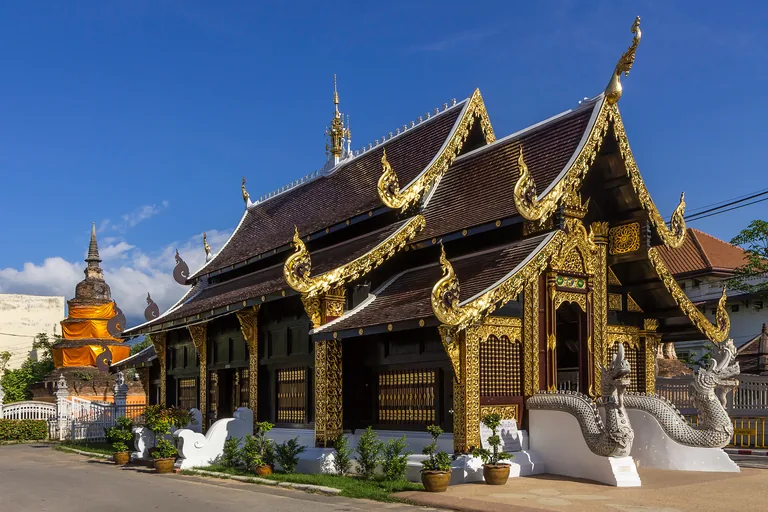
Photo: Stefan Fussan · Wikimedia Commons source · CC BY-SA 3.0 · Cropped to the recorded 3:2 source rectangle and resized from the exact hash-bound source input. Wat Inthakhin, the City's Navel
Wat Inthakhin, also called Wat Sadue Muang, the temple of the city's navel, stands on Inthawarorot Road, a one way street behind the old provincial hall in the middle of the old city of Chiang Mai. The route stops here for its old chedi: the Fine Arts Department records a bell shaped chedi on a base about 7.8 metres square, built over an earlier chedi in whose niche a standing Buddha image can still be seen, dates it by its style to the early years of Chiang Mai, and notes that it is now a working temple. The walk stays on the pavement at the east end of the hall; the street is narrow and one way, so keep to the side.
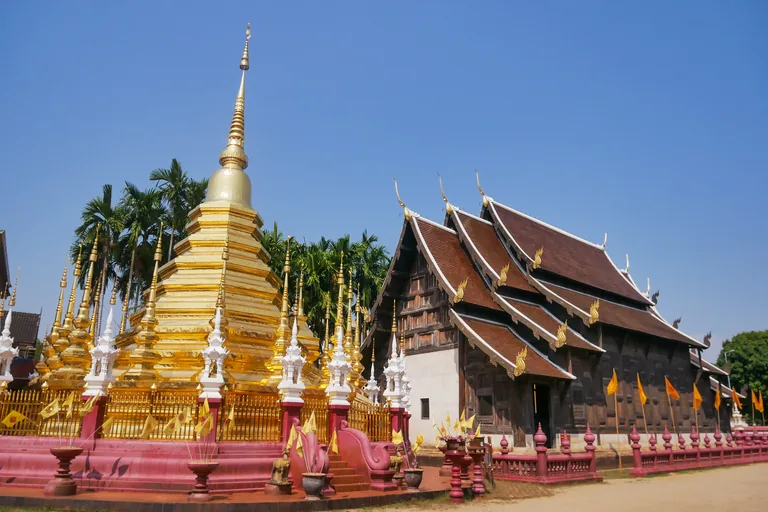
Photo: กสิณธร ราชโอรส · Wikimedia Commons source · CC BY-SA 4.0 · Cropped to the recorded 3:2 source rectangle and resized from the exact hash-bound source input. Wat Phan Tao
Wat Phan Tao is a temple on Prapokklao Road in the centre of the old city of Chiang Mai, just south of the crossroads with Ratchadamnoen Road and next to the grounds of Wat Chedi Luang. The route stops here for the teak hall itself: the encyclopedia says it stood on stilts at its first site, is eleven metres wide and fourteen metres high, and was built in the Central style, with northern carving above its main door and windows. The walk is told from the pavement at the north east corner of the grounds; the temple is a working place of worship, so if you go in, cover your shoulders and knees and take off your shoes before entering the hall.
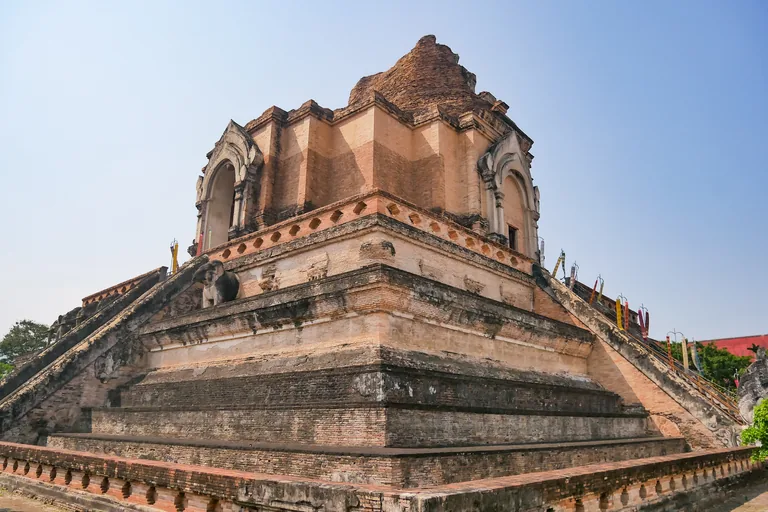
Photo: กสิณธร ราชโอรส (Kasinthorn Ratchaorot) · Wikimedia Commons source · CC BY-SA 4.0 · Cropped to the recorded 3:2 source rectangle and resized from the exact hash-bound source input. Wat Chedi Luang
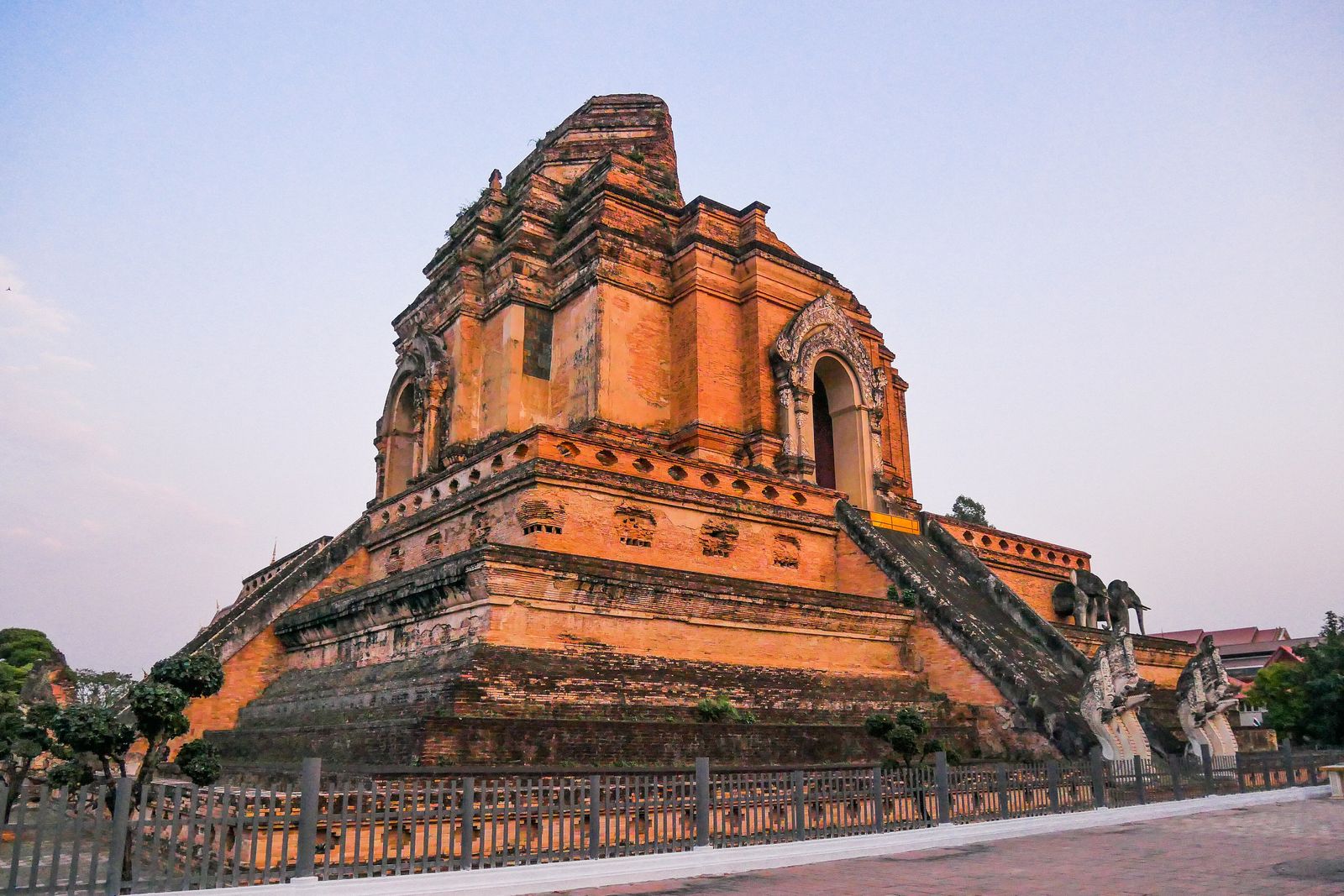
Wat Chedi Luang is a temple in the centre of the old city of Chiang Mai, and this stop stands on the pavement at its main gate on Prapokklao Road, with the shrine of the city pillar just inside. The route stops here for the city pillar and the great chedi: Thailand's heritage nomination says the municipality, the provincial government and the communities still offer flowers at 108 points around the pillar, and the encyclopedia gives the chedi, when it was finished, a base 54 metres across. The great chedi stands far back in the grounds, beyond the shrine and to the left of the front hall, and may not be in view from the gate; some halls ask visitors for a fee and hours change, so check locally.
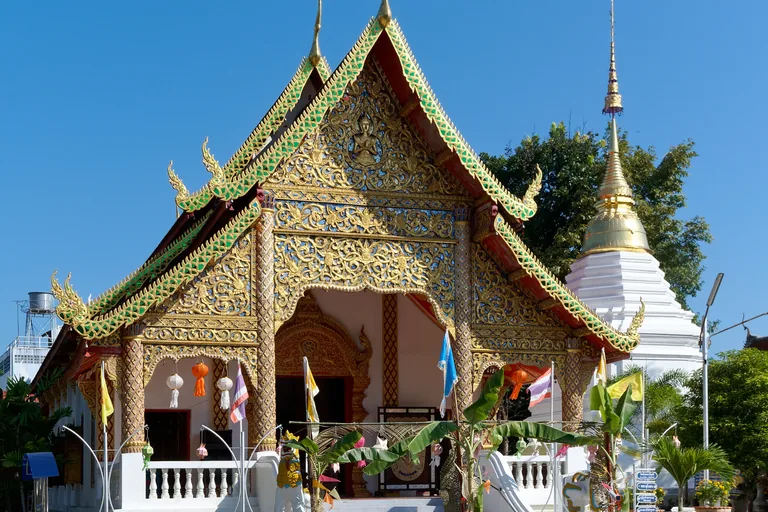
Photo: Jakub Hałun · Wikimedia Commons source · CC BY-SA 4.0 · Cropped to the recorded 3:2 source rectangle and resized from the exact hash-bound source input. Wat Chai Phra Kiat
Wat Chai Phra Kiat is a temple at the head of a short lane off Ratchadamnoen Road, the main street of the old city of Chiang Mai, west of its central crossroads. The route stops here for the temple's inscriptions: the national database records that the base of the bronze cast in 1565 is buried under its pedestal, so that its full height, more than 2.4 metres, is not known, and the encyclopedia notes another inscribed image made in 1591 by a family who lived in front of the temple, then called Wat Chai Pha Kiat. The walk is told from the pavement at the mouth of the lane and goes into neither the courtyard nor the hall; the temple is a working place of worship, so if you go in, cover your shoulders and knees and take off your shoes.
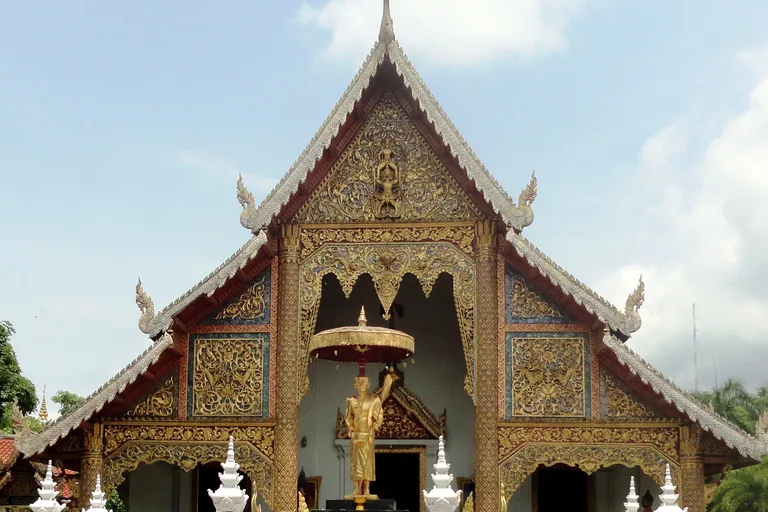
Photo: Fabio Achilli · Wikimedia Commons source · CC BY 2.0 · Cropped to the recorded 3:2 source rectangle and resized from the exact hash-bound source input. Wat Phra Singh
Wat Phra Singh is the temple at the western end of Ratchadamnoen Road in the old city of Chiang Mai, inside the walls and the moat, across Singharat Road from the end of the street. The route ends here for the smaller hall behind the front hall, where the temple keeps the image it venerates as the lion Buddha: the encyclopedia says that hall is about thirty metres long and eight wide, was built between 1815 and 1821 and is painted inside with the stories of Sang Thong and Suwannahong. The walk ends on the corner facing the temple's east gate, and the way back to Tha Phae Gate is the length of Ratchadamnoen Road, eastward; tuk tuks and red songthaew shared taxis pass along the main roads nearby.


Local context
Before you go
The walk is a line of about 2.9 km on foot inside the moat, from the square outside Tha Phae Gate in the east, west along Ratchadamnoen Road and north up Ratchaphakhinai Road, then back through the middle of the old city by Prapokklao Road, to the far western end of Ratchadamnoen Road facing Wat Phra Singh. The end is a little over a kilometre west of the start along the same main street, and tuk tuks and red songthaew shared taxis pass along the main roads near the end.
On the ground
Access and surfaces
A line of about 2.9 km on foot; allow an hour and forty minutes with the audio. The old city is flat. Pavements on Ratchaphakhinai and Prapokklao roads and in the lanes are narrow and uneven, with kerbs, drains and parked motorbikes, and motorbikes and cars share the lanes, so keep to the side and take care at crossings. The Three Kings Square has no shade. The city is hot through much of the year, with heavy rain in the wet season and smoke haze in the dry months, when a mask helps, so bring water, a hat and something for the rain. On Sundays from late afternoon Ratchadamnoen Road becomes a crowded walking street market westward from the gate, and the walk is slower; during Songkran in mid April everyone at the gate and along the moat gets soaked. The temples are working places of worship and the walk is told from their gates and lanes, needing no ticket and entering no hall; if you go in, cover your shoulders and knees, take off your shoes before entering a hall and keep your voice down. Some halls ask a fee and hours change, so check locally.
Frequently asked
Plan the walk
- How long is the Chiang Mai audio walking tour?
- Allow about 100 minutes. The route covers 2.9 km (1.8 mi) in 9 stops, including walking and listening time, on flat streets inside the moat of the old city.
- Where does the Chiang Mai tour start and end?
- It starts on the paved square outside Tha Phae Gate, the east gate of the old city, and ends at the western end of Ratchadamnoen Road facing Wat Phra Singh, a little over a kilometre from the start; tuk tuks and red songthaew pass along the main roads there.
- Can I go inside the temples?
- The walk is told from each temple's gate or lane and needs no ticket. If you go in, cover your shoulders and knees, take off your shoes before entering a hall and keep your voice down; some halls ask a fee and hours change, so check locally.
- What should I bring for the walk?
- Water and a hat for the heat, something for the rain in the wet season and a mask for the smoke haze of the dry months. On Sunday afternoons the main street fills with a walking street market, so the walk takes longer then.