Cefalù · Sicily, Italy
Cefalù — The Cathedral and the Wash-House
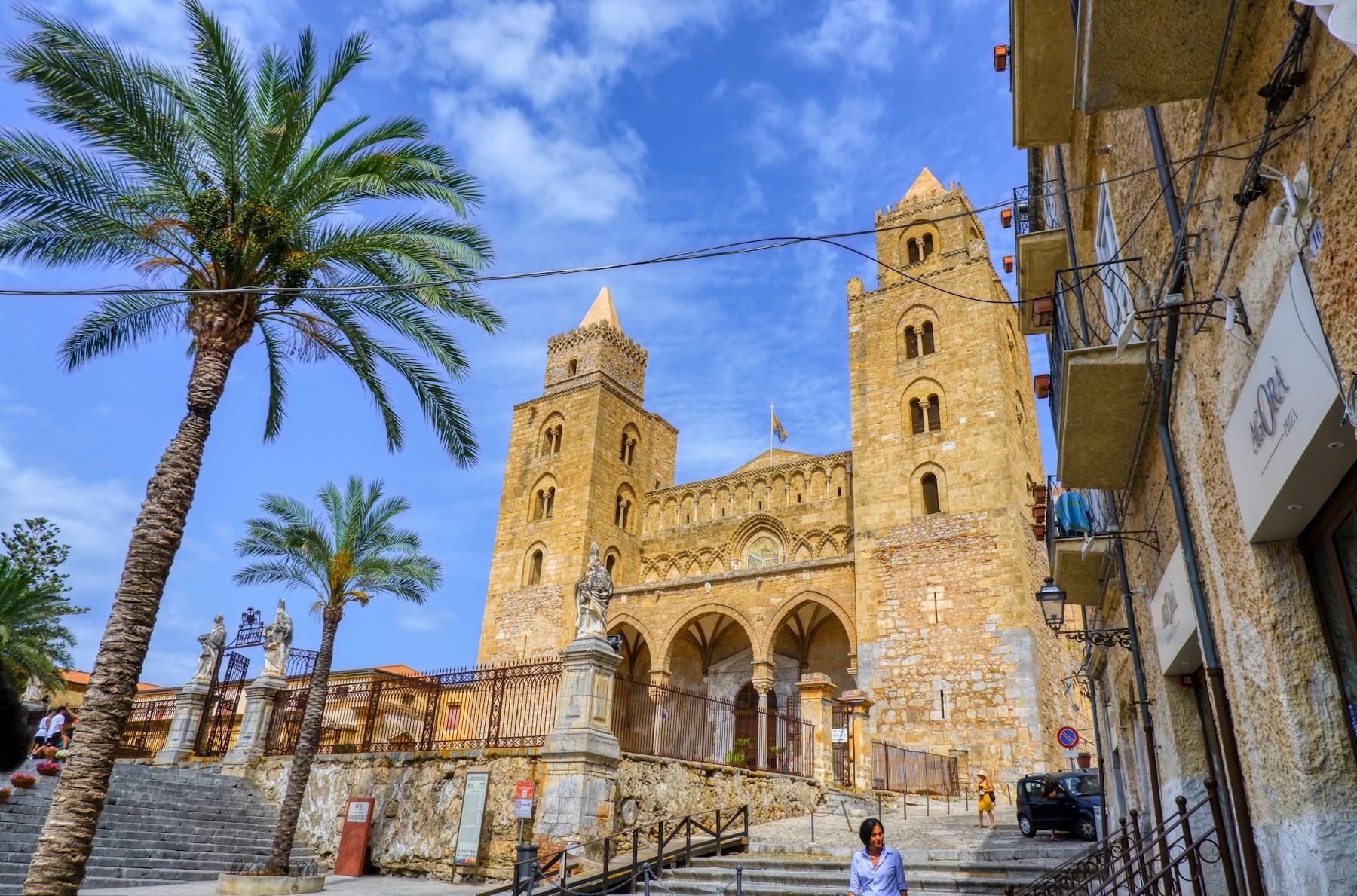
In 1131 Roger II moved this town down off its rock and began a cathedral on the shore — a fortified church that was also to be his own mausoleum, and far too big for the settlement it stood in.
Narration in English · Stop 1 is free
 Tour no. 20
- Stops
- 8
- Distance
- 2.6 km (1.6 mi)
- Time
- About 165 minutes
- Route
- Moderate walking route
Listen before you buy
Stop 1 · Piazza Garibaldi and the land gate
Stop 1 is free. Listen before you buy.
The walk
A self-guided audio tour of Cefalù
In 1131 Roger II moved this town down off its rock and began a cathedral on the shore — a fortified church that was also to be his own mausoleum, and far too big for the settlement it stood in. Part of it fell down while it was being built and the rest was finished smaller. The king was buried in Palermo, and in 1215 his grandson came and took the two porphyry sarcophagi away as well. What was left was an enormous church and a town that went on living around it: washing linen in a covered river, fishing, keeping the guild banners inside the cathedral and carrying them out through the streets once a year in June. This walk goes between those two things — eight stops, from the square where a patriot was shot in 1857 to the rock the whole town once stood on.
Route notes
The stops
About each stop · narration stays in the app
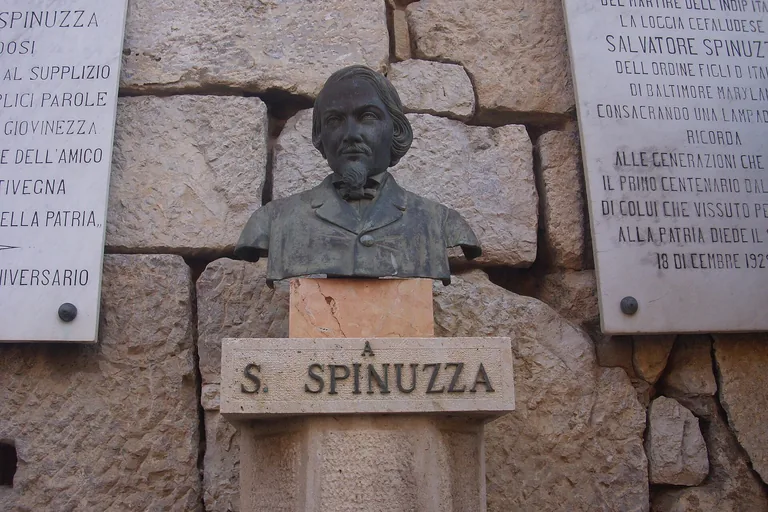
Photo: DaniDF1995 · Wikimedia Commons source · CC BY 3.0 · Cropped to the recorded 3:2 source rectangle and resized from the exact hash-bound source input. Piazza Garibaldi and the land gate
Piazza Garibaldi marks the landward entrance to Cefalù's old town and carries a memorial to Salvatore Spinuzza, executed here in 1857. The route begins with a civic square and one local life before moving into the town's architectural layers. The square is level and free, but vehicles reach its outer edge and café seating can narrow the pedestrian space.
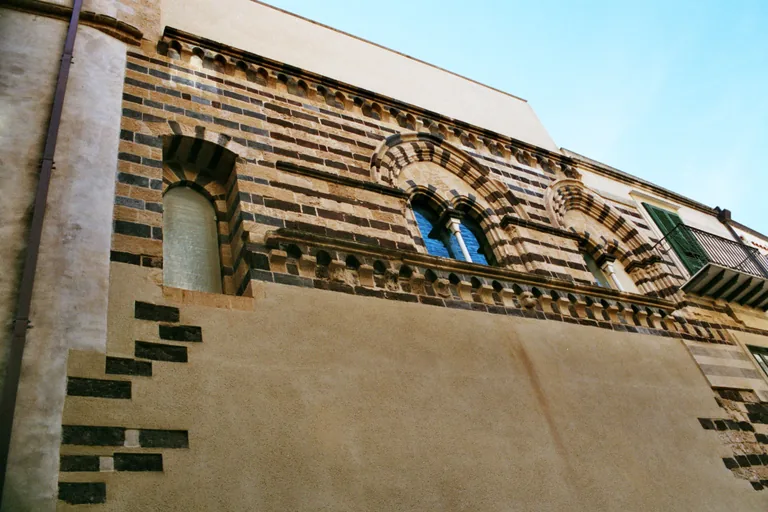
Photo: Bjs · Wikimedia Commons source · CC0 · Cropped to the recorded 3:2 source rectangle and resized from the exact hash-bound source input. The Osterio Magno on Corso Ruggero
The Osterio Magno is a medieval palace traditionally called the king's house, although its royal association is not securely established and earlier fabric lies beneath it. It teaches the route's recurring lesson that Cefalù's familiar names can be less reliable than the physical layers they describe. The exterior is fully visible from the pedestrian street; interior exhibition access is irregular and not required.
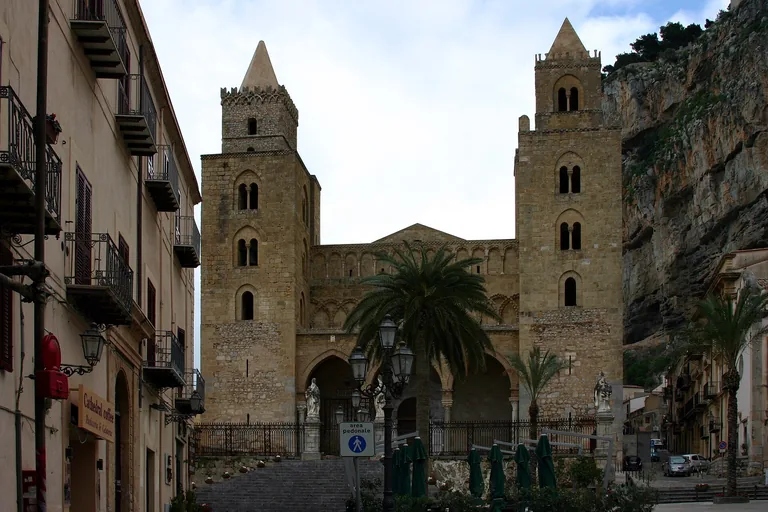
Photo: José Luiz · Wikimedia Commons source · CC BY-SA 4.0 · Cropped to the recorded 3:2 source rectangle and resized from the exact hash-bound source input. Piazza del Duomo and the cathedral of Roger II
Roger II's cathedral dominates Cefalù with twin towers, a monumental terrace and a sanctuary decorated by Byzantine mosaicists. It is the route's central building because the town was reorganised around a royal church and intended mausoleum whose founder was ultimately buried elsewhere. The square view is free; a ramped approach exists on the north side, while church and cloister access follow current dress, worship and ticket rules.
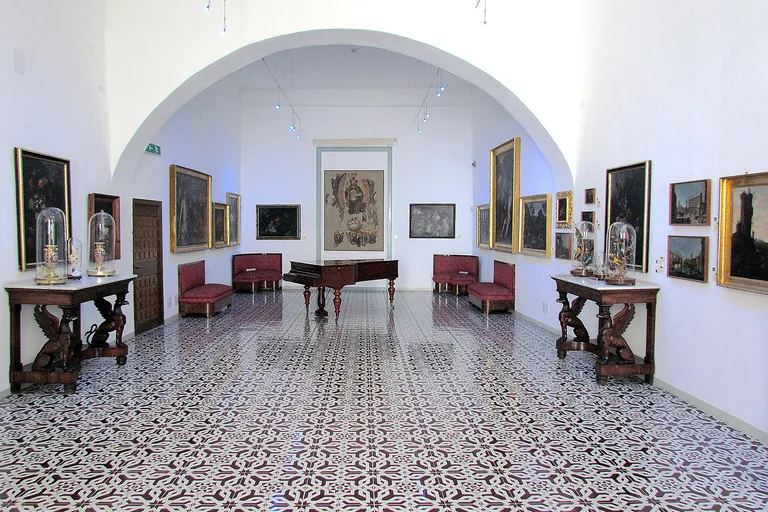
Photo: Gmihail at Serbian Wikipedia · Wikimedia Commons source · CC BY-SA 3.0 rs · Cropped to the recorded 3:2 source rectangle and resized from the exact hash-bound source input. The Mandralisca Museum
The Mandralisca Museum preserves Baron Enrico Pirajno's collection, including Antonello da Messina's small portrait popularly called the Unknown Sailor. The route includes the museum to shift from monumental buildings to a face whose enduring nickname is probably misleading. The stop works from the lane outside; visiting the ticketed, multi-level museum requires checking current hours and accessibility.
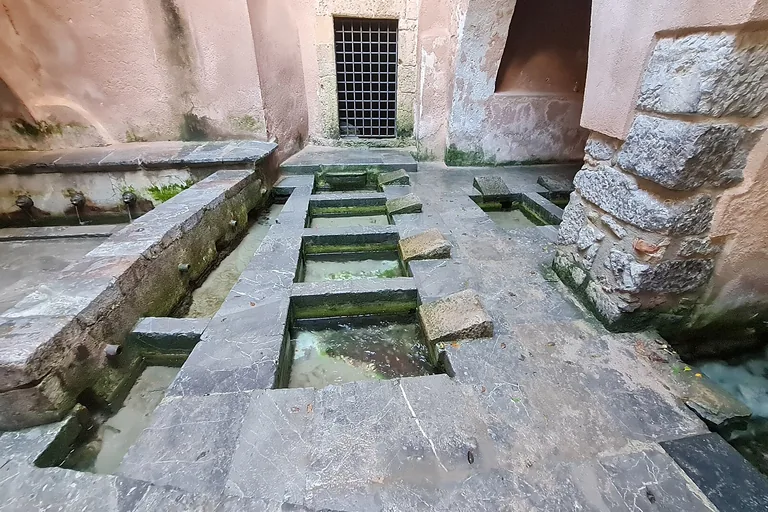
Photo: Derbrauni · Wikimedia Commons source · CC BY 4.0 · Cropped to the recorded 3:2 source rectangle and resized from the exact hash-bound source input. The medieval wash-house on the Cefalino
Cefalù's wash-house channels the Cefalino through stone basins and lion-head spouts beneath the street. It counters the royal cathedral with the infrastructure and physical work that supported ordinary households. Worn steps descend to a damp floor and may be slippery; the stop remains understandable from the head of the stair.
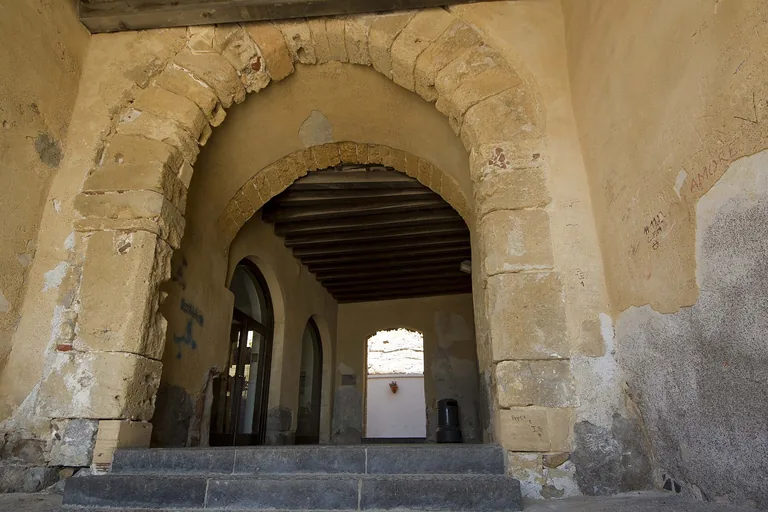
Photo: trolvag · Wikimedia Commons source · CC BY-SA 3.0 · Cropped to the recorded 3:2 source rectangle and resized from the exact hash-bound source input. Porta Pescara and the fishermen's quarter
Porta Pescara is the last surviving sea gate in Cefalù's wall, opening from the lanes to the old fishermen's shore and boat arches. Passing through it turns the route from the street grid toward the maritime edge that sustained the town. The arch and shore are free, but shallow steps, worn stone and the rocky waterfront limit step-free access.
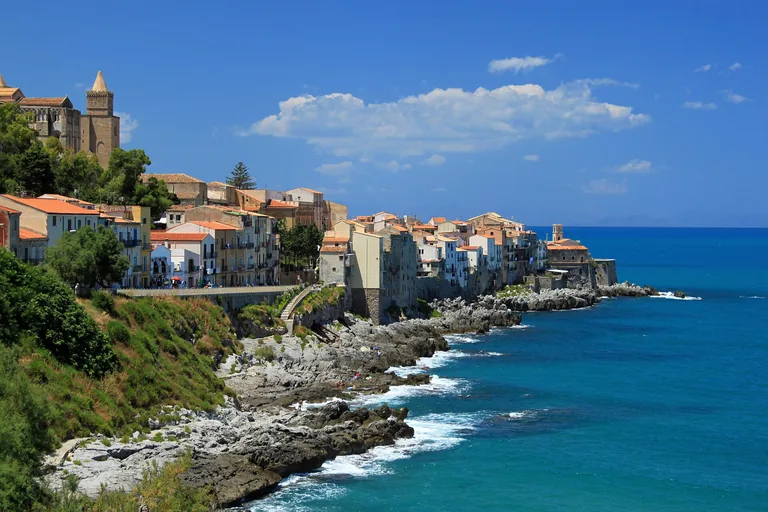
Photo: Liilia Moroz · Wikimedia Commons source · CC BY-SA 4.0 · Cropped to the recorded 3:2 source rectangle and resized from the exact hash-bound source input. The bastion at Capo Marchiafava
Capo Marchiafava's bastion stands above ancient defensive blocks, the medieval wall and the old seafront houses. This short stop gathers several phases of Cefalù's boundary in one view before the optional climb to the Rocca. The paved platform is free and level from the lanes but exposed to sun, wind and uneven stone near the parapet.
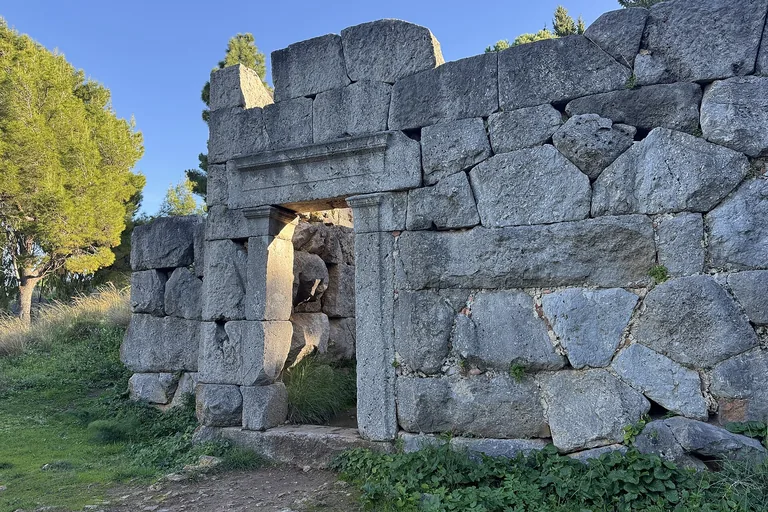
Photo: Codas · Wikimedia Commons source · CC BY-SA 4.0 · Cropped to the recorded 3:2 source rectangle and resized from the exact hash-bound source input. The Rocca and the Temple of Diana
The so-called Temple of Diana on the Rocca is a multi-period building around an ancient cistern whose precise original function remains uncertain. The route ends above the town to show the fortified height Cefalù occupied before Roger II shifted its centre to the shore. Reaching the ticketed archaeological park requires a steep, exposed climb on uneven steps; this stop is designed to be optional.


_01.jpg)
Local context
Before you go
The published route starts at Piazza Giuseppe Garibaldi, 90015 Cefalù PA, Italia. It begins at Piazza Garibaldi and the land gate and ends at The Rocca and the Temple of Diana.
On the ground
Access and surfaces
Seven of the eight stops are in the old town, which is flat, free and almost entirely pedestrianised. The streets are narrow and paved in worn stone and beach cobbles, and the wash-house at stop five is reached down a flight of stone steps with no handrail — the stop works from the top of them. The eighth stop is different in kind and can be left out without breaking the walk. The Rocca is a ticketed archaeological park reached by a steep stepped path, roughly thirty to forty-five minutes up from the town, and the park forbids open-toed footwear — sandals are turned away at the gate. Getting to it also means walking back down the length of Corso Ruggero from the bastion, about six hundred metres. If the climb is not on, the seventh stop makes a good ending, on the sea. The cathedral is free and keeps church hours; its cloister is ticketed separately. The Mandralisca museum is ticketed and keeps museum hours. The old town is genuinely crowded on summer afternoons and the walk is much better early or in the evening.
Frequently asked
Plan the walk
- How long is the Cefalù audio walking tour?
- Allow about 165 minutes. The self-guided route covers 2.6 km (1.6 mi) in 8 stops, including walking and listening time.
- Where does the Cefalù tour start and end?
- It starts at Piazza Giuseppe Garibaldi, 90015 Cefalù PA, Italia. The published route begins at Piazza Garibaldi and the land gate and ends at The Rocca and the Temple of Diana.
- Will the Cefalù audio tour work offline?
- Yes, after download. Audio, stop text, images, and GPS triggering work without data; the live map background still needs a connection.