Catania · Sicily, Italy
Catania — Reading the City Downwards
Catania is a city you read vertically.
Narration in English · Stop 1 is free
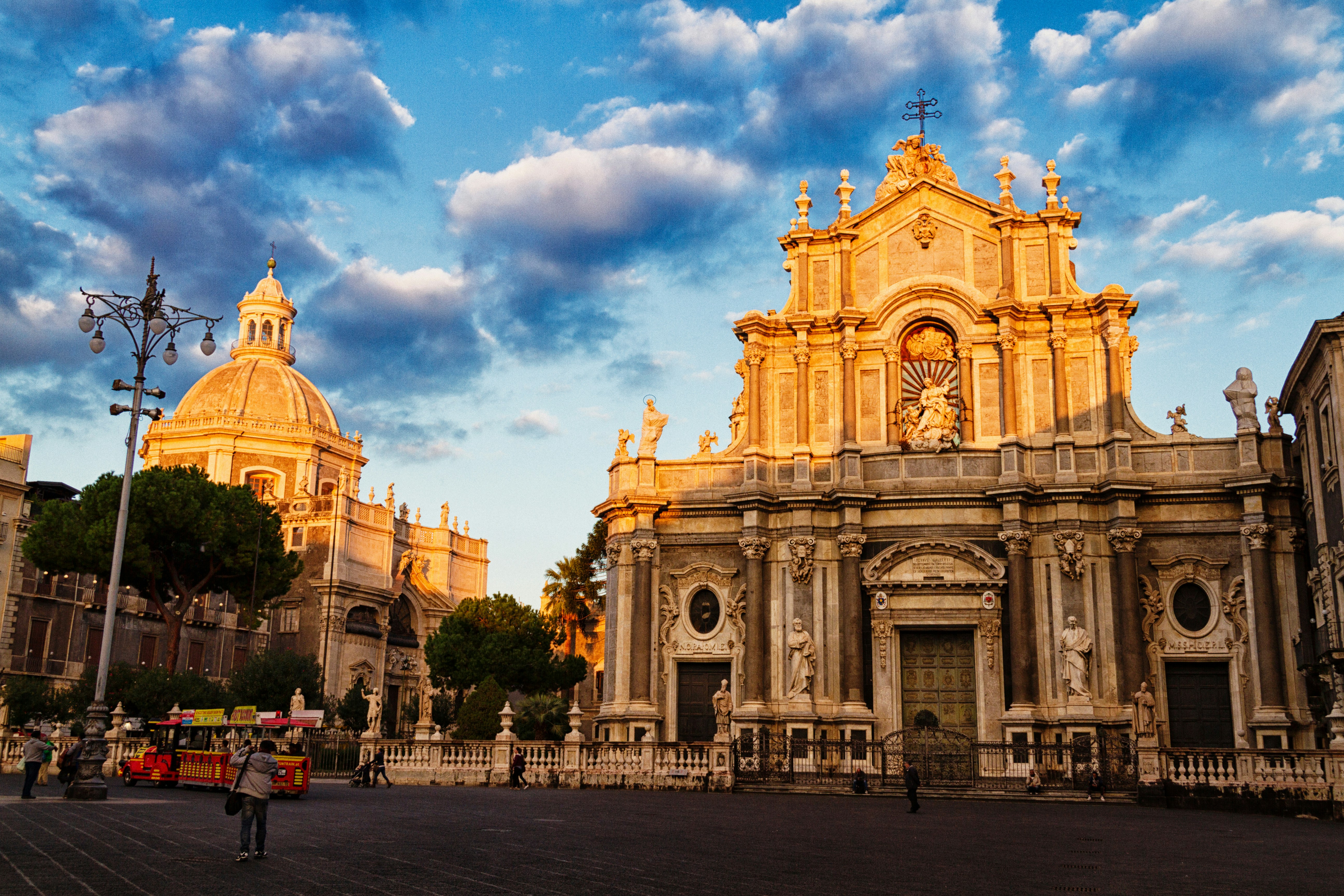 Tour no. 27
- Stops
- 9
- Distance
- 2.6 km (1.6 mi)
- Time
- About 135 minutes
- Route
- Easy city route
Listen before you buy
Stop 1 · Piazza del Duomo and the Elephant Fountain
Stop 1 is free. Listen before you buy.
The walk
A self-guided audio tour of Catania
Catania is a city you read vertically. Lava buried it in 1669 and an earthquake levelled it in 1693, and what stands today was built on top of both — in the black stone the volcano supplied. This walk goes down through the layers rather than along the highlights: a Roman elephant on an eighteenth-century fountain, a Norman cathedral sitting on a Roman bath house, a river that runs under the streets and surfaces beside the fish market, a castle whose moat the lava filled and whose sea it pushed half a kilometre away, and a Roman theatre with eighteenth-century houses standing inside the seating. It ends at a hole in a busy shopping street with the Roman city at the bottom of it.
Route notes
The stops
About each stop · narration stays in the app
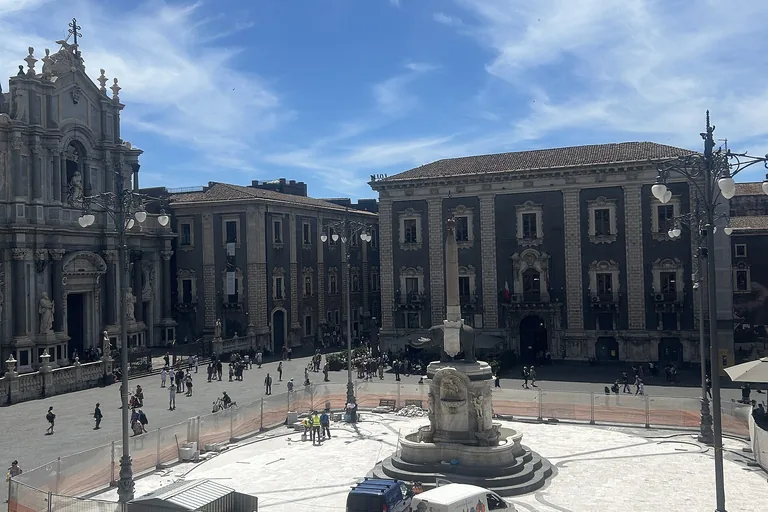
Photo: GiovanniPen · Wikimedia Commons source · CC BY-SA 4.0 · Cropped to the recorded 3:2 source rectangle and resized from the exact hash-bound source input. Piazza del Duomo and the Elephant Fountain
Piazza del Duomo centres on Vaccarini's Elephant Fountain, where an ancient lava-stone elephant carries an obelisk within the rebuilt Baroque square. The route starts here because old objects and post-disaster design are visibly stacked in one civic scene. The square is free and mostly level, though broad paving, traffic at its edges and event barriers can lengthen crossings.
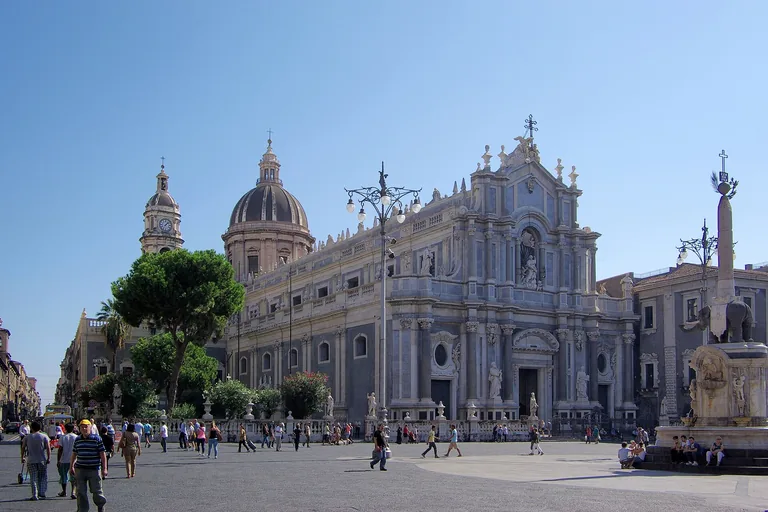
Photo: Berthold Werner · Wikimedia Commons source · CC BY-SA 3.0 · Cropped to the recorded 3:2 source rectangle and resized from the exact hash-bound source input. Cathedral of Sant'Agata
The Cathedral of Sant'Agata combines Roman baths below, Norman fabric behind and a Baroque façade rebuilt after the 1693 earthquake. It gives the route both its clearest architectural stack and the starting point of Catania's major annual festival for its patron saint. The stop works from the square; cathedral entry follows worship hours and the baths are a separate stepped, ticketed visit.
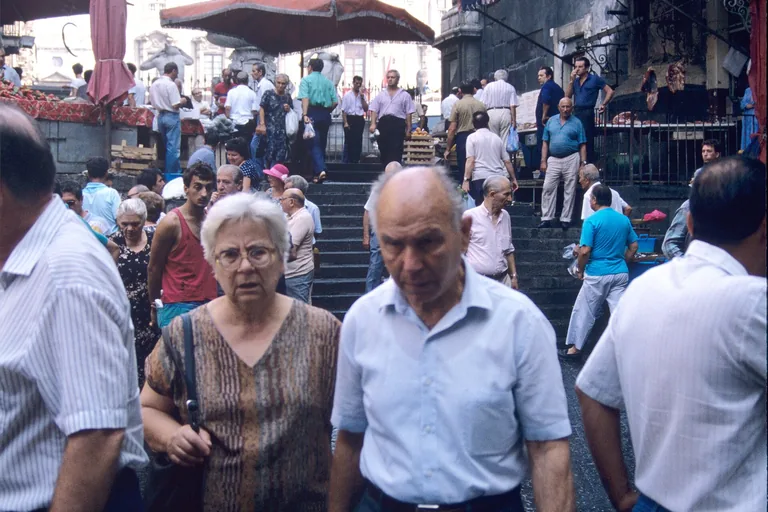
Photo: Jpbazard Jean-Pierre Bazard · Wikimedia Commons source · CC BY-SA 3.0 · Cropped to the recorded 3:2 source rectangle and resized from the exact hash-bound source input. Amenano Fountain and the Fish Market
The Amenano Fountain marks the reappearance of an underground river beside the stepped fish market built into the city's older urban edge. This stop makes Catania's buried water system audible and visible through a working morning market rather than another formal monument. The market floor is wet, crowded and reached by lava-stone stairs; listening from the top preserves the stop without descending.
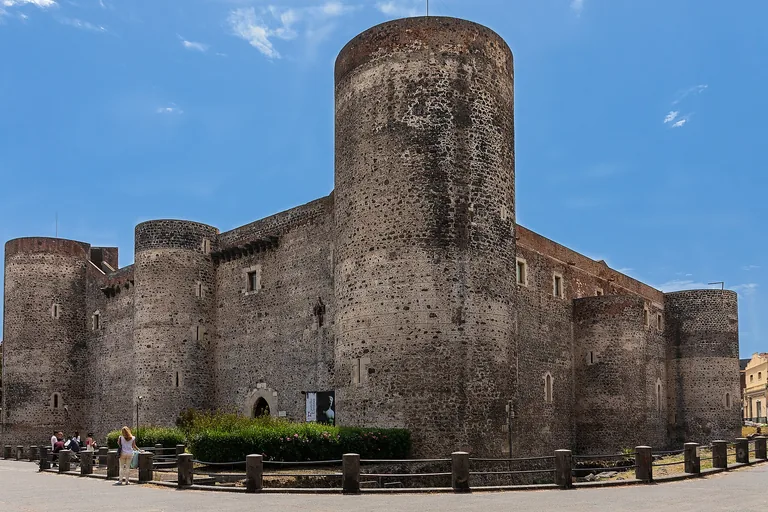
Photo: Maurizio Moro5153 · Wikimedia Commons source · CC BY-SA 4.0 · Cropped to the recorded 3:2 source rectangle and resized from the exact hash-bound source input. Ursino Castle
Ursino Castle was built beside the sea, but lava from the 1669 eruption extended the coastline and left the fortress inland. It is the route's clearest demonstration that Catania's ground and shoreline have physically moved around a surviving building. The level public square gives a complete exterior view; the civic museum inside is ticketed and keeps separate hours.
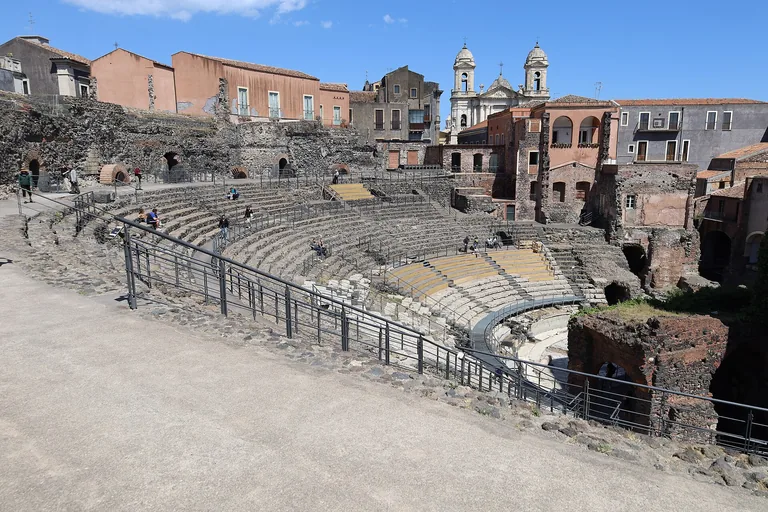
Photo: Antony-22 · Wikimedia Commons source · CC BY-SA 4.0 · Cropped to the recorded 3:2 source rectangle and resized from the exact hash-bound source input. Greco-Roman Theatre
Catania's Greco-Roman Theatre survives inside the modern city, with later houses occupying parts of the ancient seating and perimeter. The route includes it because several historical layers can be read in one view rather than reconstructed only from explanation. The stop works from the entrance street; the ticketed archaeological route is stepped, uneven and not required.
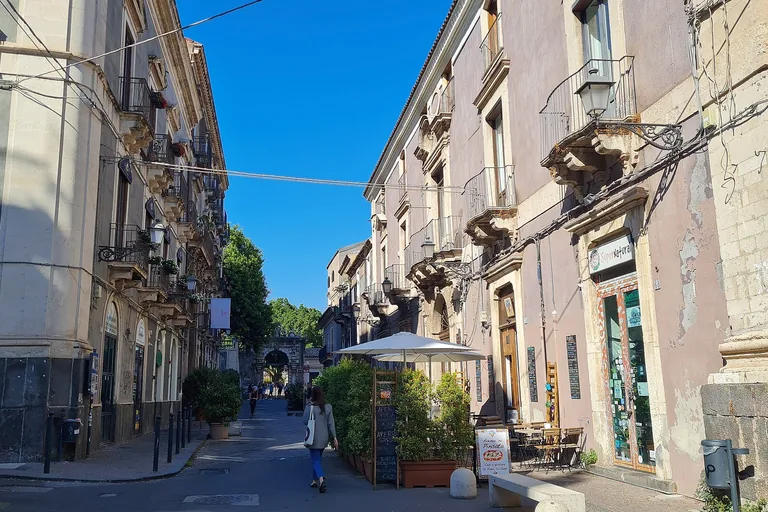
Photo: Derbrauni · Wikimedia Commons source · CC BY 4.0 · Cropped to the recorded 3:2 source rectangle and resized from the exact hash-bound source input. Via dei Crociferi
Via dei Crociferi is a concentrated Baroque street of churches and convent façades planned during Catania's rebuilding after 1693. It gives the route a deliberate urban composition between the salvaged theatre and the more complicated monastery complex. The street itself is pedestrian and level, while church entrances involve steps and their interiors keep individual hours.
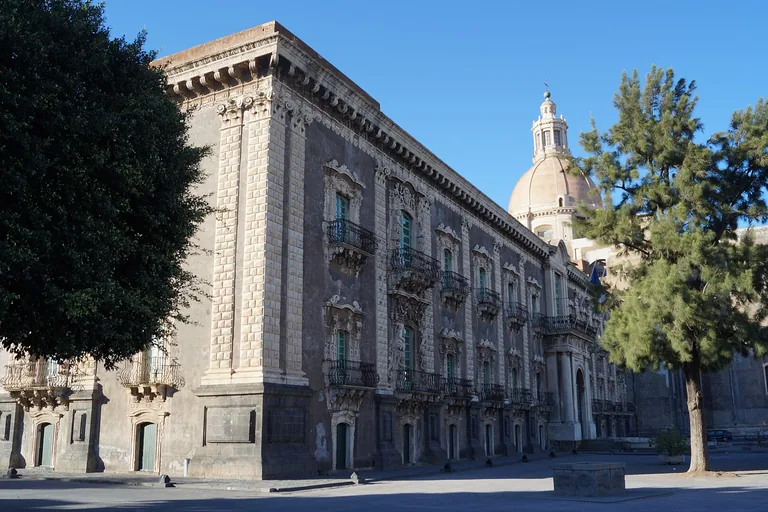
Photo: Nicolò Arena · Wikimedia Commons source · CC BY-SA 4.0 · Cropped to the recorded 3:2 source rectangle and resized from the exact hash-bound source input. Benedictine Monastery of San Nicolo l'Arena
San Nicolò l'Arena is a vast Benedictine complex reshaped by the 1669 lava flow, the 1693 earthquake and the rebuilding that followed. Its unfinished fronts and buried Roman houses bring the route's disaster-and-reconstruction theme together at building scale. Piazza Dante provides a step-free exterior stop; interior access is by separately scheduled guided visit.
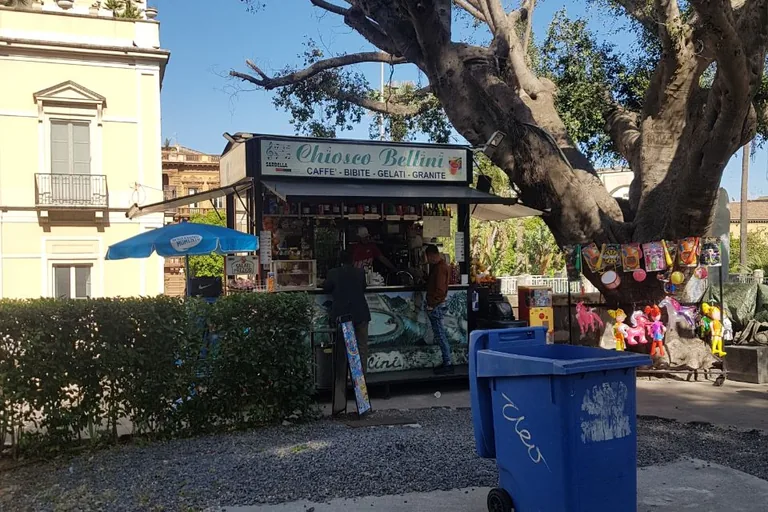
Photo: Simone Manola · Wikimedia Commons source · CC BY-SA 4.0 · Cropped to the recorded 3:2 source rectangle and resized from the exact hash-bound source input. Via Etnea and the Kiosks
Via Etnea follows one of the straight axes laid through Catania's ruins after the 1693 earthquake and remains a principal social street. The route pauses at its kiosks to connect the rebuilt city plan with present-day everyday use. The public street is level in this section but busy with pedestrians, crossings and evening activity.
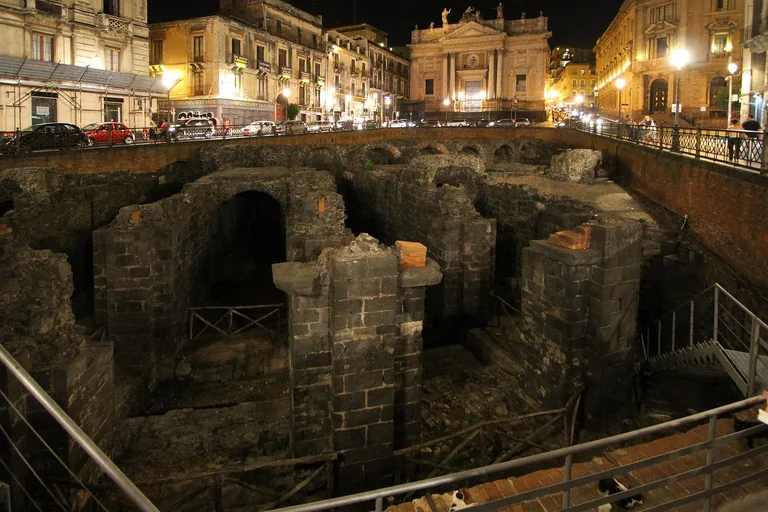
Photo: Carlo Pelagalli · Wikimedia Commons source · CC BY-SA 3.0 · Cropped to the recorded 3:2 source rectangle and resized from the exact hash-bound source input. Roman Amphitheatre at Piazza Stesicoro
At Piazza Stesicoro, a section of Catania's Roman amphitheatre lies below the modern street and surrounding buildings. The route ends here because the city's vertical layers are visible directly from the pavement without pretending the buried monument is complete. The railing view is free and at street level; entry to the limited-hours excavation requires stairs and is optional.


.jpg)


.jpg)


Local context
Before you go
The published route starts at Piazza del Duomo, 95124 Catania CT, Italia. It begins at Piazza del Duomo and the Elephant Fountain and ends at Roman Amphitheatre at Piazza Stesicoro.
On the ground
Access and surfaces
Almost entirely flat and pedestrian-friendly through the centre, on lava-stone paving that is uneven and slippery when wet. Two stops involve steps that can be skipped without losing the stop: the staircase down into the fish market at stop 3, and the entrance stairs on Via dei Crociferi at stop 6 — both can be heard from street level. The interiors at stops 2, 5, 7 and 9 are ticketed or have their own opening hours and the walk never requires entering any of them. Stop-specific access notes are on each POI.
Frequently asked
Plan the walk
- How long is the Catania audio walking tour?
- Allow about 135 minutes. The self-guided route covers 2.6 km (1.6 mi) in 9 stops, including walking and listening time.
- Where does the Catania tour start and end?
- It starts at Piazza del Duomo, 95124 Catania CT, Italia. The published route begins at Piazza del Duomo and the Elephant Fountain and ends at Roman Amphitheatre at Piazza Stesicoro.
- Will the Catania audio tour work offline?
- Yes, after download. Audio, stop text, images, and GPS triggering work without data; the live map background still needs a connection.