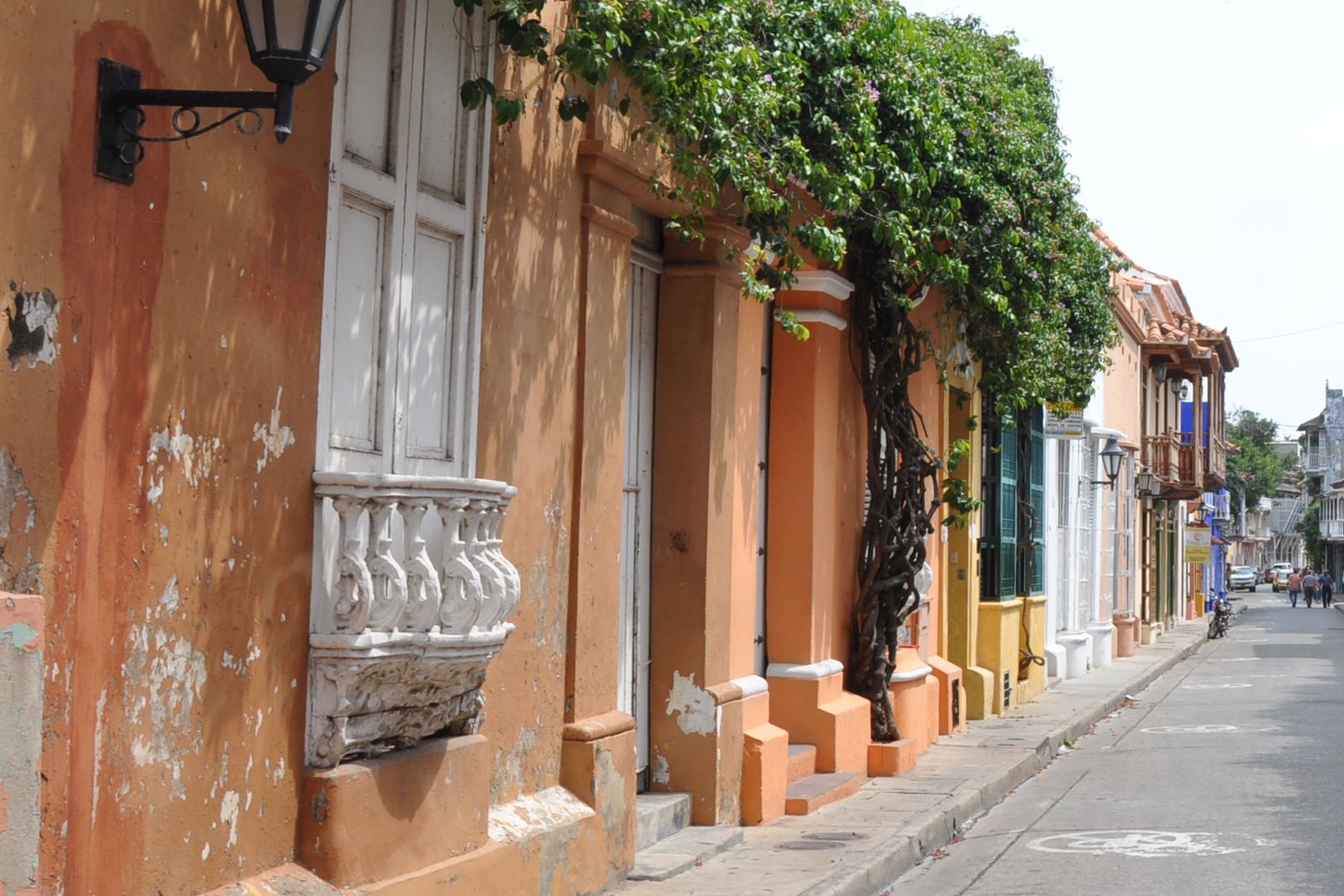
Cartagena · Bolívar, Colombia
Cartagena — The Walls of the Treasure Port
Jorge Láscar, Wikimedia Commons; cropped and resized by ChapterWalks · CC BY 2.0
An audio walk from Getsemaní into Cartagena's walled city through the Clock Tower gate, past San Pedro Claver and along the walls to Las Bóvedas.
Narration in English · Stop 1 is free
- 7 stops
- 2.7 km (1.7 mi)
- About 115 minutes
- Moderate walking route
Stop 1 · Plaza de la Trinidad
Stop 1 is free. Listen before you buy.
Read Stop 1Hide Stop 1 text
Transcript · Stop 1
Cartagena de Indias is a port on a sheltered bay of the Caribbean. Spain's fleets called here, raiders and rival navies came for it, and the city ringed itself with walls of stone. This walk starts in a working quarter beside the old walled centre, goes in by the old main gate, and ends along the walls themselves.
You are on the Plaza de la Trinidad, a small square in Getsemaní. Facing you is the church of the Santísima Trinidad: a plain yellow front, a short bell tower with three arched openings, and a green door in a frame of pale stone.
In 1984 UNESCO listed Cartagena's port, fortresses and monuments as World Heritage, and in UNESCO's own words the city has the most extensive fortifications in South America.
Two Spanish naval officers who visited Cartagena in the eighteenth century, Jorge Juan and Antonio de Ulloa, described Getsemaní as a large suburb on another island, joined to the city by a wooden bridge. UNESCO's statement on the city calls Getsemaní the suburban quarter once inhabited by the artisans and slaves who fuelled much of the economic activity of the city.
Juan and Ulloa also recorded that the church of the Trinity in the suburb was built by a bishop, Gregorio de Molleda.
As the historian José Manuel Restrepo tells it, on the morning of the eleventh of November 1811 the free people of colour of Getsemaní gathered and set out to take the city, and their first demand was a vow of absolute independence from Spain.
Cartagena's newspaper El Universal describes the Plaza de la Trinidad as a place where men like Pedro Romero met to talk over their hopes of independence. The same paper describes Romero as a smith, a master of the workshop at the naval arsenal, who could make a cannon, cast a bell and build a boat. He was long said to come from Matanzas, in Cuba, but El Universal reports that a historian found a letter of 1810 in which Romero, in his own hand, calls himself a native of Cartagena.
A few things before you set off. The sun is strong and the air humid, and the walls at the end of this walk have no shade: walk early or late in the day, wear a hat and carry water. The rains fall mostly from May to November. Walk in daylight, and in Getsemaní keep to the main streets and squares. Keep your valuables close. Vendors and people offering photographs will come up to you; a polite no is enough.
Now turn round, with the church behind you, and leave the square at its left hand corner by Calle de la Sierpe, away from the church. Follow it as it bends north to a wide, busy street, Calle de la Media Luna. Turn left along it, with the trees of the Parque del Centenario across the road, to where it forks round the tip of a long promenade with busts on pedestals: the Camellón de los Mártires. Cross the left fork at the marked crossing, looking both ways. Walk to its far end and stop facing the yellow tower above the gate across the road.
An audio walking tour of Cartagena, from the Plaza de la Trinidad in Getsemaní through the old main gate under the Torre del Reloj, past San Pedro Claver and the Palace of the Inquisition, and along the city walls to Las Bóvedas, at your own pace
Pedro de Heredia founded Cartagena de Indias on 1 June 1533, on a small archipelago off the Caribbean coast, as ICOMOS records it, and UNESCO, which added its port, fortresses and monuments to the World Heritage List in 1984, ranks it among the Caribbean's leading ports for its strategic position. This walk of about 2.7 km starts on the Plaza de la Trinidad in Getsemaní, the old suburb outside the walls whose free people of colour, in the historian José Manuel Restrepo's account, rose for absolute independence on 11 November 1811. It enters the walled city through the old main gate under the Torre del Reloj, where the siege of 1815 that gave the city the name La Heroica is told, and crosses the Plaza de la Aduana, where the founding, the Tierra Firme fleet and Francis Drake's attack of 1586 are told.
At the church of San Pedro Claver it tells plainly of the port through which enslaved Africans were brought into New Granada, in the words of the historian Efraín Sánchez and of the Jesuit Alonso de Sandoval, and of Pedro Claver, who met them as they landed from 1610 and was made a saint in 1888. It passes the Palace of the Inquisition, seat of a tribunal created in 1610, on the Parque de Bolívar, then climbs onto the Santo Domingo bastion for the walls the engineer Bautista Antonelli was charged with in 1586, the French capture of 1697 and the British attack of 1741, and follows the walls to Las Bóvedas, the vaults the workshop school dates from 1792 to 1798, at the edge of the San Diego quarter.
Route notes
Route and itinerary
About each stop · narration stays in the app
Plaza de la Trinidad
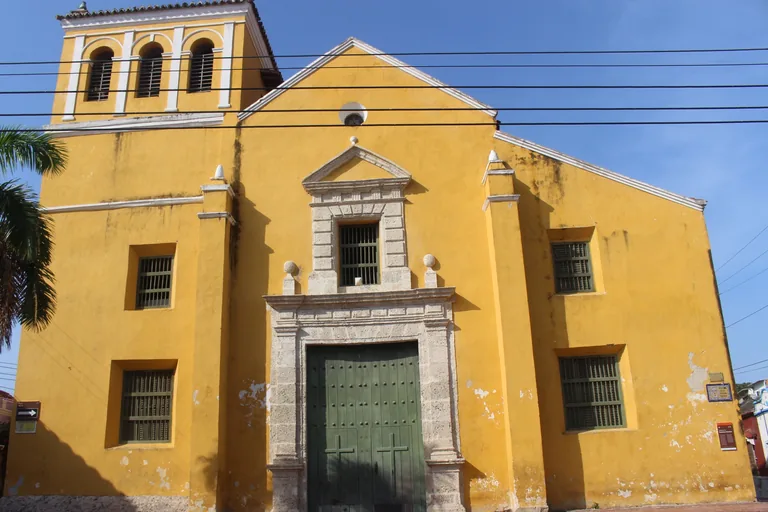
Photo: Jami430 · Wikimedia Commons source · CC BY-SA 4.0 · Cropped to the recorded 3:2 source rectangle and resized from the exact hash-bound source input. The Plaza de la Trinidad is a small square in Getsemaní, the quarter that grew up outside the walled city, with the yellow front and short bell tower of the church of the Santísima Trinidad on its south side.
The route starts here for Getsemaní and the rising of 1811: UNESCO, which inscribed the city on the World Heritage List in 1984, remembers the quarter as home to artisans and enslaved people whose work drove much of the city's economy, the historian José Manuel Restrepo writes that its free people of colour rose on 11 November 1811 to demand absolute independence from Spain, and the newspaper El Universal reports a letter of 1810 in which the smith Pedro Romero called himself a native of Cartagena.
The walk enters the church at no point, as it is a place of worship; it is best walked in daylight, early or late in the day, keeping to Getsemaní's main streets and squares, with water and a hat for the sun.
The Torre del Reloj
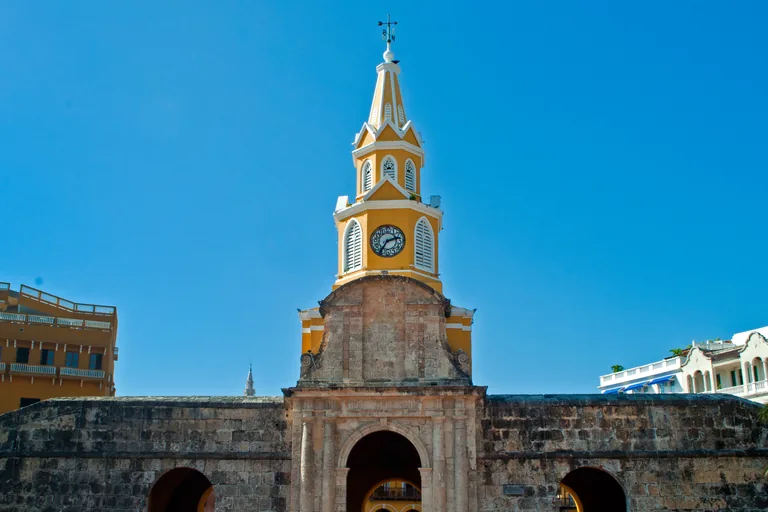
Photo: Rafaela Ely · Wikimedia Commons source · CC BY 2.0 · Cropped to the recorded 3:2 source rectangle and resized from the exact hash-bound source input. The Torre del Reloj is the old main gate into the walled city, three arches in a thick stone wall below a yellow octagonal clock tower with a spire, seen across the avenue from the end of the Camellón de los Mártires, a promenade lined with busts.
The route stops here for the gate and the siege: El Universal dates the gate, once called the Boca del Puente, to 1601 and credits the local architect Luis Felipe Jaspe with the tower's present shape in the 1880s, Restrepo's history tells how Pablo Morillo's army besieged the city by land and sea from August 1815 for about a hundred days, and the newspaper El Heraldo writes that the siege won Cartagena the name La Heroica.
Cross to the gate only at the lights, as the avenue is busy, and inside the walls be ready to step aside for carriages and cars in the narrow streets.
Plaza de la Aduana
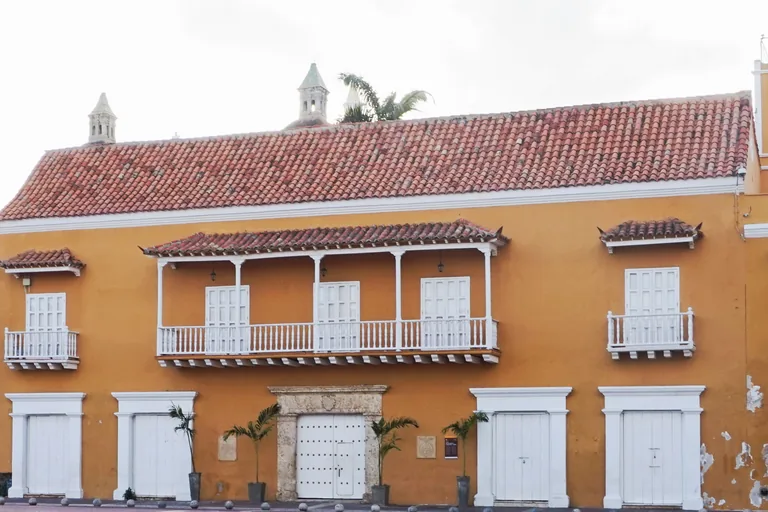
Photo: Bernard Gagnon · Wikimedia Commons source · CC BY-SA 4.0 · Cropped to the recorded 3:2 source rectangle and resized from the exact hash-bound source input. The Plaza de la Aduana is a long, open square inside the walls, named after the customs house whose arcade runs down one side, and ringed by old houses with wooden balconies.
The route stops here for the founding and the port: ICOMOS gives 1 June 1533 as the day Pedro de Heredia founded the city on a small archipelago, historians in a Banco de la República book write that the square was long known as the Plaza del Mar and date Francis Drake's attack on the city to 1586, and the historian Javier Ortiz Cassiani says that enslaved people were handled as goods to be cleared through the customs.
From here the walk heads diagonally over the paving to the narrow south west end of the square and goes into no building along the way.
San Pedro Claver
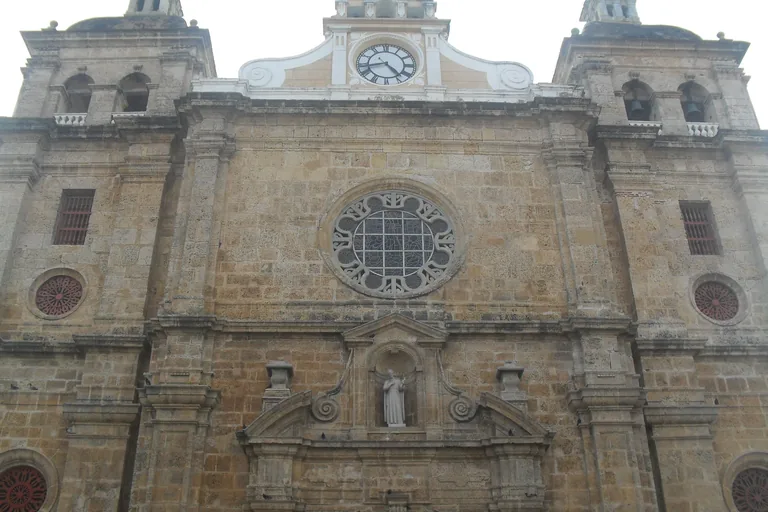
Photo: Jhon jairo1398 · Wikimedia Commons source · CC BY-SA 3.0 · Cropped to the recorded 3:2 source rectangle and resized from the exact hash-bound source input. San Pedro Claver is a stone church whose front, flanked by two bell towers, closes the small square that bears its name, beside the cloister of the former Jesuit college.
The route stops here for the trade in enslaved Africans: the historian Efraín Sánchez names Cartagena as the main port through which enslaved Africans reached New Granada, the Jesuit Alonso de Sandoval set down an account of their ships in a book published in 1627, and Pedro Claver, who arrived in 1610 and was declared a saint in 1888, met the newly landed at the Jesuit college, as a Javeriana University study records.
It is a working church that the walk does not enter, and the museum in the cloister is a separate visit with its own tickets.
The Palace of the Inquisition
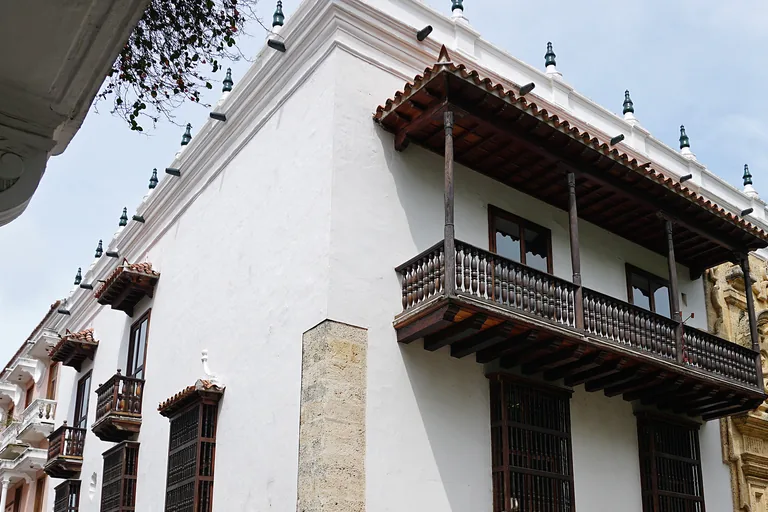
Photo: Mariordo (Mario Roberto Durán Ortiz) · Wikimedia Commons source · CC BY-SA 4.0 · Cropped to the recorded 3:2 source rectangle and resized from the exact hash-bound source input. The Palace of the Inquisition is a whitewashed mansion on the Parque de Bolívar, its upper floor hung with wooden balconies and its entrance framed by a Baroque portal of carved limestone.
The route stops here for the tribunal on the old main square: an archaeology bulletin of the Banco de la República records the royal decree of 25 February 1610 that set up the Inquisition's tribunal in Cartagena, with a district covering New Granada, Venezuela, Nicaragua and Panama among other lands, and the city's history museum, which now occupies the building, ranks it first among the city's eighteenth century civil buildings.
The museum keeps its own tickets and the walk stays outside; the cathedral beyond the square's corner is a working church seen only from the square.
The Walls at Santo Domingo
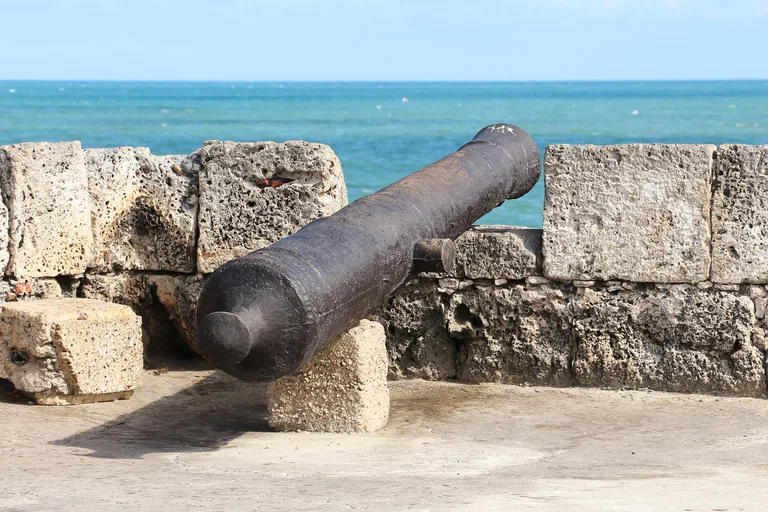
Photo: Bernard Gagnon · Wikimedia Commons source · CC BY-SA 4.0 · Cropped to the recorded 3:2 source rectangle and resized from the exact hash-bound source input. The Baluarte de Santo Domingo is a broad stone bastion on the city wall facing the Caribbean, with old guns along the parapet and a little domed sentry post looking out to sea.
The route stops here for the walls and their sieges: ICOMOS records that the Spanish crown charged the engineer Bautista Antonelli in 1586 with fortifying the city, Jorge Juan and Antonio de Ulloa wrote that a French force under Pointis took Cartagena in 1697 and plundered it, and Restrepo's history tells of the British fleet under Admiral Vernon that came before the city in March 1741, an attack that ended with the fleet's withdrawal.
The bastion is reached by a stepped ramp with a handrail; the walls give no shade and lack a railing in places, so keep away from the edges and carry water, and where the wall top is shut the walk keeps to the base of the wall inside the city.
Las Bóvedas
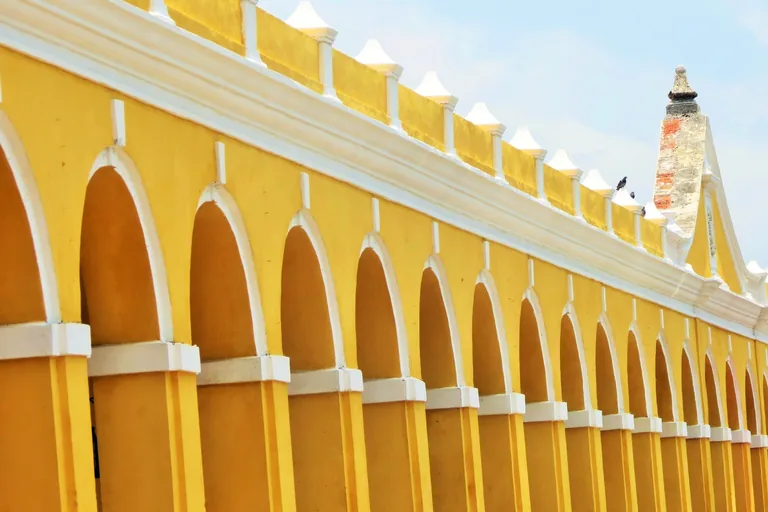
Photo: Picore12 · Wikimedia Commons source · CC BY-SA 3.0 · Cropped to the recorded 3:2 source rectangle and resized from the exact hash-bound source input. Las Bóvedas is a long yellow arcade of arches trimmed in white, built against the city wall between the bastions of Santa Clara and Santa Catalina, in the San Diego quarter.
The walk ends here for the barracks built into the walls: the workshop school that cares for the fortifications says the vaults were started in 1792 as quarters for the guard and stores for food and munitions, and that the date 1798 on the crown's arms over the central arch marks the end of the work.
The arcade is the first shade after the walls; the way out is the Santa Catalina gate in the wall, about 250 metres further on, which leads to the busy avenue outside the old city.


Before you go
The walk is a line of about 2.7 km: from the Plaza de la Trinidad in Getsemaní by Calle de la Sierpe and Calle de la Media Luna to the Camellón de los Mártires, across the avenue and through the gate into the Plaza de los Coches, along its arcade to the Plaza de la Aduana and on into the Plaza de San Pedro Claver, north to the Parque de Bolívar to face the Palace of the Inquisition, west by Calle de la Inquisición and Calle Baloco to the wall and up onto the Santo Domingo bastion, then about a kilometre north east along the walls to Las Bóvedas, on the edge of San Diego.
The audio gives each turn as you reach it.
Access and surfaces
Allow about 115 minutes with the audio, over about 2.7 km between the stops.
Cartagena is flat and at sea level, but the paving is uneven stone in places, a stepped ramp with a handrail leads up onto the Santo Domingo bastion, and the wall walk has uneven stone, single steps and short flights; the base of the wall inside the city is the alternative.
The walk crosses five roads, some of them without lights or a marked crossing, and carriages, cars and vans use the narrow streets of the walled city.
The walls give no shade and lack a railing in places, sun and heat are strong all year and most rain falls between May and November, so walk in daylight, early or late, with water and a hat.
The walk enters no church or museum: the museums keep their own tickets, and the churches are places of worship.
Plan the walk
- How long is the Cartagena audio walking tour?
- Allow about 115 minutes. The route runs one way for 2.7 km (1.7 mi) with 7 stops, including walking and listening time, mostly on level streets, with a stepped ramp up onto the city walls.
- Where does the Cartagena walk start and end?
- It starts on the Plaza de la Trinidad in Getsemaní, facing the church of the Santísima Trinidad, and ends at Las Bóvedas, the arcade built against the wall in San Diego; the Santa Catalina gate, about 250 m further on, leads out to the avenue east of the walled city.
- Does the walk go inside San Pedro Claver or the Palace of the Inquisition?
- No. The walk is told from squares, streets and the walls and enters no building. San Pedro Claver and the cathedral are working churches, and the museums in the cloister of San Pedro Claver and in the Palace of the Inquisition keep their own tickets; visiting them is up to you.
- Can I walk on the city walls?
- Yes, for part of the way: the workshop school in charge of the fortifications says walking them is free and open to the public. The route climbs onto the Santo Domingo bastion and follows the walls for about a kilometre; where a stretch of the wall top is closed, it keeps to the base of the wall inside the city. The wall top has no shade and no railing in places.
- When should I walk the Cartagena route?
- In daylight, early in the morning or late in the afternoon. Sun and heat are strong all year and the walls have no shade, so carry water and a hat; most rain falls between May and November.
$4.99Stop 1 is free